• Yoga and the Mind-Body Complex

    Yoga and the Mind-Body Complex

    For a yogi, the body is his laboratory for perpetual experimentation and experience.

    B.K.S. Iyengar

    The Effects of asana practice

    In practicing asanas, we put our body in different and unusual postures, such that are not performed in our daily routine. What is the value of those unconventional yoga postures for our mind-body? Are asanas purely physical postures? Do asanas have a role beyond physical exercise?

    Prashant Iyengar noted that for a posture to be an asana, there should be a certain body-set, a certain breath-set, and a certain mindset (See his book: The alpha and the omega of Trikonasana). Placing the body in the posture creates a unique and unusual state of consciousness.

    The Effects of asana practic
    The Effects of asana practice

    Asana practice is intended primarily to experience these states of consciousness or the mind-body complex and explore, through yoga, the deep connections that exist between body postures, breathing blood and lymph circulation, nervous system, and so on, and the mental state that accompanies them. It is this exploration that makes practicing yoga so fascinating fresh and surprising. If we consider our practice as a mere exercise, (i.e., refer only to the physical aspect), it becomes mechanical, automatic – and therefore might be boring. Although such a practice will have a positive effect on the body, the real purpose of yoga will not be accomplished.

    Ultimately, all asanas aim for a similar effect: transcending the fluctuations of consciousness (or in the words of Patanjali: Citta Vritti Nirodha). Our mind is typically preoccupied with plans, thoughts, concerns, judgments, hassles, memories, etc. When all these vrittis are stopped, and the mind becomes serene, a new composure arises, one of clarity and harmony, of balance and joy. This allows for a neutral, clear observation of ourselves and the nature of reality. This is the effect of each and every asana for a mature and skilled practitioner. But for us, who are still on the yogic path, the mental effects of asanas are influenced by several factors:

    • The type of asanas that we practice: forward bends, backbends, inversions, standing positions, etc.
    • The specific asana we practice: for example, there is a difference between the effects of Virabhadrasana I to those of Prasarita Padottanasana; even though both are standing poses.
    • The variations and the way we use props: all asanas have countless variations and can be performed focusing on different actions with props (all these variations have different mental effects the asana brings about).
    • The use of breathing: breathing can be used in different ways, we can direct breathing to various areas of the body and this also affects our asana.

    The effects of asanas are inner experiences and feelings that may be difficult to articulate. One can only understand these effects in depth through personal practice. It is a journey in which each one is for herself or himself: an in-depth exploration of the breath, body and mind. Despite this difficulty, I will try to shed some light on the subject and give several ideas that might help to reflect and explore during this journey. This overview does not aim to be exhaustive, but merely touch upon several asanas and describe their main effects. The description is based (of course) on my own experiences that are clearly derived from my personality and practice, and is limited by my (poor) capacity to describe what I experience while practicing. So – please regard the following descriptions as suggestions that would encourage you to discover for yourself the effects of the asanas on your mind-body system.

    As I mentioned above, each family of yoga postures shares some central mind-body effects. However, there are differences between the postures. To demonstrate this point, we will discuss briefly two postures from each of the three families: standing postures, forward bends, and inversions.

    Standing postures

    Standing postures form the basis of Iyengar Yoga practice. They develop strength, flexibility, stability, lightness, a sense of direction, and balance. They strengthen the legs; teach us how to be grounded on the feet and to extend the body from the base. They also open two critical areas of the body: the pelvis and the shoulder girdle.

    Freedom of movement in the pelvic area results in light movement that prevents strain on the spine and lower back. Freedom of movement in the shoulders expands the ribcage and improves respiratory function. Standing postures form the basis for learning alignment and precision – two fundamental principles of the Iyengar method. All standing poses are challenging but are also rewarding. They develop willpower, mental strength, and endurance. For this reason, our exploration begins with these postures.

    Rooting the feet into the floor provides a solid foundation not only physically. When we stand firmly on strong legs, it also strengthens our confidence and our interactions with the world. It is not as easy to shake or toss us. Physical and mental stability develop in tandem. The sense of ease and comfort of movement that develops with practicing postures creates mental lightness that helps us leap over crises and pitfalls that can potentially create heaviness and low spirit. If we are light and flexible, both in body and mind, it may help us bypass and avoid pitfalls that are bound to come our way in life.

    These effects derived from all standing postures. However, as noted, there are differences between the effects of various positions in this family, and these differences become more subtle as we become familiar with the different variations and various options for using props.

    To illustrate, I will compare two of the hero (or warrior) postures: Virabhadrasana I and Virabhadrasana II.

    Virabhadrasana I - II
    Virabhadrasana 1 and 2

    Both postures are challenging; both strengthen the legs, create flexibility in the pelvic region, extend the spine from its base (the tailbone) and energize the heart-lung system. It is said Lord Shiva gave these postures for the yogi to overcome fear. The mental quality of the warrior is to view each difficulty not as an obstacle, but rather as a challenge and opportunity to develop and strengthen. This quality is shared by all warrior postures (I, II, and III).

    Virabhadrasana II

    Another quality of a warrior is the ability to maintain a balanced and stable attitude in stressful situations. This quality also develops with the practice of these postures that work on our mind-body. Along with the effort and physical challenge that stimulates breathing and challenges the muscles, the practitioner must keep the breath flowing and her or his face relaxed. The main difference between Virabhadrasana I and Virabhadrasana II is that the latter expands the body laterally, while the first is a posture of vertical extension. In Virabhadrasana II the thigh of the back leg should be pressed back while rolling the hip and knee of the front leg from the inside out.

    These actions bring about an opening in the groin and width in the hip. In contrast, in Virabhadrasana I, the pelvis completely turns aside and the body is stretched upward. The line that connects the back leg with the hands extends and concaves.

    Iyengar said that elongation creates intellectual sharpness and alertness while expansion develops the emotional aspect and improves the ability to contain emotions. A balanced development strengthens both the intellect and the emotional intelligence. One should develop both the intelligence of the brain (intellect) and the intelligence of the heart (emotion). Virabhadrasana II creates the expansion of the chest and abdominal cavities and hence may develop the emotional aspect associated with them. The main area the pose is working on is the pelvic area. Therefore, this position works on the apāna energy and helps stimulate and invigorate it.

    According to yoga, Prāṇa (with capital P) is the cosmic vital energy that permeates all levels of the universe. In humans, bodily functions are performed by five kinds of vital energy (prana-vayus). These are prana (of the thorax), apāna, samāna, udāna, and vyāna. These are the five aspects of the essential cosmic force.

    In contrast, Virabhadrasana I works intensely on the spine and ribcage and therefore raises the prana and the udāna. The spine stretches up as the thorax rises and expands. This position develops strength, sharpness, and the confidence of a warrior together with deep devotion that stems from the complete surrender of the front leg, the rolling of the head back turn the face-up while receding the eyes towards the back of the skull. The Yogi surrenders to God in this position, not out of weakness, but from a position of strength and confidence. The power that develops is not used to glorify the ego but is given as an offering to the Lord.

    Forward Bends

    In forward bends, the torso (or trunk) moves forward and rests on the legs (or leg). The head bows down, and our visibility is limited. Therefore our senses turn inward and the front brain (the active brain) is supported by the legs (or by a folded blanket placed on the legs) and relaxes.

    This seems to have physiological effects that include a decrease in blood pressure and heart rate, calming of the nervous system and the brain, stimulation of the digestive system and the adrenal glands, and increased supply of blood to the pelvis, legs and gonad glands – which improves the functioning of the reproductive organs.

    These physiological effects are closely related to, and accompanied by mental effects and together our entire mind-body is nourished by performing these postures. Forward bends bring about an experience of tranquility, relaxation, surrender, devotion, renunciation, humility, and internalization. The breath becomes calm and steady, and our constantly shifting mental chatter slows down. Forward bends, more than any other family of postures, demonstrates BKS Iyengar’s saying: “The aim of yoga is to calm the chaos of conflicting impulses.” These asanas call for prolonged stays that bring about relaxation and tranquility.

    Often while practicing forward bends, I stretch to a point where I can stay comfortably and then just linger there without trying to advance beyond that point. This type of stay in the asana brings about a kind of pleasure and sweetness that accompanies the abandonment of motivation to stand out or to impress. Many times, this inner relief is manifested into a real vocal sigh of relief that clears the pressures and worries of the business of life. I can actually feel my brain’s functioning shifts from performing and planning to passively observing.

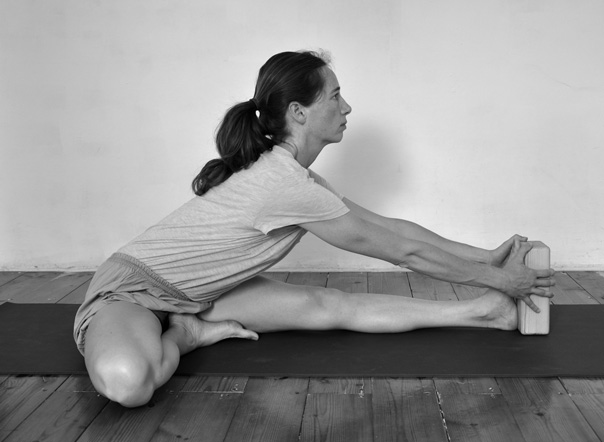
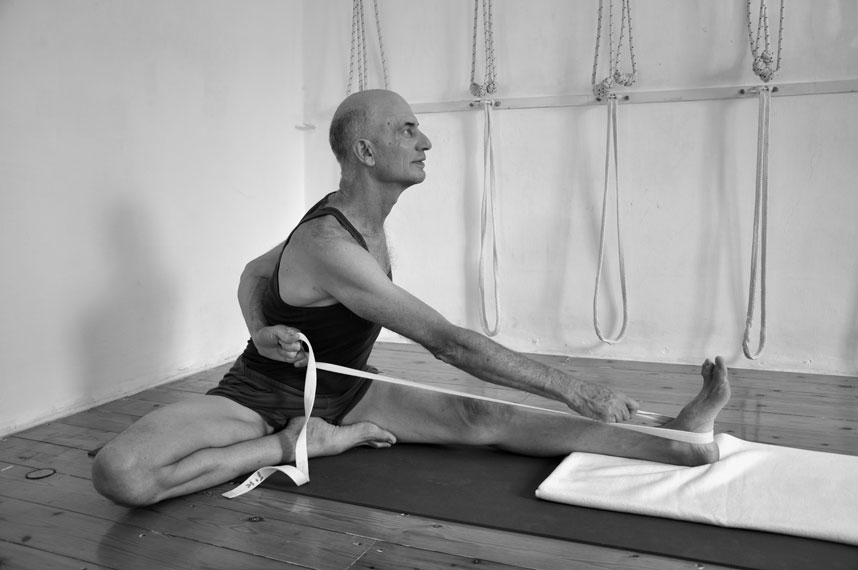
    The above are general comments regarding the entire forward bends family of asanas. However, there are significant differences between the effects of the various asanas in this family. Here I compare Paschimottanasana with Janu Sirsasana.

    paschimottanasana_I
    Paschimottanasana
    janu-sirsasana_I
    Janu Sirsasana

    Paschimottanasana, being a symmetric asana, stretches both legs and both sides of the body evenly. This equal action of both sides of the body creates harmony and alignment. The forward bend action of this asana may be physically more challenging, as we need to overcome the resistance of both legs, but the asana does not create a sense of struggle, because the movement flows in the one direction. The entire torso, from the mid-buttocks to the spine and the head are moving forward. There is no need to reconcile opposing forces; all muscle fibers and awareness are flowing uniformly, like a car driving on a highway.

    Janu Sirsasana, however, is a more complex asana. When you perform it with the right leg bent, the right thigh is behind and doesn’t participate in the move forward; On the contrary, it must roll back. It Pulls the right side of the body back and to the right and the challenge is to balance both sides of the torso. The right side tends to arch and curve, moving the stomach to the right. Therefore, in addition to the forward movement, one should move the trunk laterally and twist it from right to left.

    We often encounter in life such a challenge of having to reconcile two opposing forces and the practice of Janu Sirsasana allows us to examine the way we deal with these challenges. This is an example of how learning to do a complex pose is meant to have effects that extend beyond the immediate practice. It practically teaches us how to use our own powers and abilities in very subtle and complex ways. It is very easy to let the right knee slip forward, but the requirement of the pose is to maintain an obtuse angle between the thighs. This creates movement in the vital hip joint. If we keep this requirement, the asana poses a real challenge and therefore a fertile ground for practice and exploration.

    Inversions

    Inversions are a precious gift given to humanity by yoga! They have profound effects at the anatomical, physiological and mental levels. In fact, in an inverted position, the border between the physiological and the mental becomes blurred. The effect on the control systems of the body: the brain and nervous and the hormonal system, is so deep, that it is difficult to separate the physiological effects from the mental experience of focus, alertness, relaxation and exhilaration.

    You can read more about the experience of inversions here, or in the intro to Props for Yoga III (the book focuses on Inversions).

    Eyal Shifroni - Sirsasana

    Staying in an inverted pose alters the flow of the bodily fluids (blood and lymph fluids), since gravity pulls towards the head rather than to the legs. The head organs, especially the brain and the senses, receive an increased supply of arterial blood, which is accompanied by a marked shift in our internal sensation. Our orientation in space is turned around because we see the world from a new and unfamiliar perspective. This effect is particularly noticeable when practicing Sirsasana outdoors.

    I often practice on the beach. Seeing the sea, and especially the sunset, while standing in Sirsasana is a unique experience. I highly recommend it to everyone! Changing our viewing angle brings about flexibility of thought and the ability to examine everyday issues and challenges from different perspectives.

    At the same time, inversions touch upon deep seated fears and insecurities hidden in the depths of our consciousness. Students often experience psychological barriers in getting into Sirsasana or Adho Mukha Vrksasana (handstand). These psychological hang ups make it difficult for them to get into the asana, and it is only when they succeed to overcome them, that they are able to stay in the asana comfortably, reducing the effort required. Crossing these mental barriers is possible when one overcomes these deep rooted fears and anxieties, which in turn brings about a sense of security, confidence and balance that develops our personality. For being able to deal with such deeply rooted anxieties is of enormous importance. The acquired confidence teaches us to deal with other anxieties which arise in life.

    Advanced practitioners stay in inversions a relatively long time (15-30 minutes in each asana). Such a long stay also develops patience, stamina, concentration and focus. We have to learn to maintain the action of the asana without letting our consciousness vibrate. This develops concentration and mental stability. After such a long stay in the asanas both body and mind are refreshed, and often problems, annoyances and other worries we are engaged in in our everyday life seems less serious (at least for a while…).

    Even in the rare days where I don’t have ample time to practice, I try not to give up the practice of inversions, because I know a half an hour of inversions is sufficient in order to bring about peace of mind and change the course of my day and the way in which I encounter the challenges the day brings. Sometimes I enjoy staying in inversions so much that it is quite difficult for me to come out of the the pose – more than once I had to end the practice to catch a train, but I preferred to stay in Sirsasana and consequently miss the train…

    Two major inversions are Sirsasana and Sarvangasana. These two asanas are contradictory and complementary like Yang and Yin, or in a Yogic terminology: Surya (sun) and Chandra moon. Sirsasana stimulates, awakens and bring you focus, while Sarvangasana quiets and draws you internally (or inwards). In my experience, vision is dominant in Sirsasana, while audition is dominant in Sarvangasana. In Sirsasana, the field of vision is wide and we gaze forward at eye level. This stimulates the eyes and clarifies the vision. However, in Sarvangasana our field of vision is limited, but at the same time the inner ear and auditory canal are opening. This asana increases blood flow to the ears and improves their performance. In Sarvangasana and its variations there is a strong sense of internalization and reflection as well as a tendency to close the eyes. Our sense of sight is our main information source while hearing opens a wide space of less specific stimuli. In Yoga, the space element (ether) is related to sound. Perhaps this effect on our auditory system opens an internal space that creates a soothing and calming effect.

    In Sirsasana (when practiced correctly) the head is held vertically and aligned, all parts of the head receive even amounts of blood flow, and hence all the organs of the head are stimulated. In particular when there is balance between the rear and front parts of the brain. Sarvangasana on the contrary, develops the hindbrain.

    According to B.K.S. Iyengar, the forebrain is considered the part responsible for logical, analytical, and calculating capacities (vitarka), while the hindbrain is considered the creative and intuitive brain (vichara) (See sutra 1.17 and also Table 5 in Light on the Yoga Sutras of Patanjali by Iyengar). Therefore, the two asanas differ significantly in their psycho-physical effects and yet complement each other.

    Sirsasana also differs from Sarvangasana in the breathing patterns and the diaphragms that are activated. In Sirsasana, moving the tailbone in and tightening the buttocks activates the pelvic diaphragm (the pelvic floor muscles). This creates a Mula kriya (suction and elation of the pelvic floor). In addition, when we learn to relax the abdominal area, the abdominal organs are automatically drawn towards the lower back and the respiratory diaphragm (the base of the thorax). This creates Uddiyana kriya (suction of the abdomen and the respiratory diaphragm). In Sarvangasana, when we learn to relax the throat in, the vocal diaphragm is stimulated (at the base of the throat), creating a Jalandhara bandha (the throat lock) – this has the effect of internalization and convergence. In Sirsasana the respiratory diaphragm has a greater freedom of movement and breathing is mainly Samanic, which is, breathing into and through the upper abdomen and lower ribs). In Sarvangasana, however, there is an opening of the upper chest and breathing is Pranic and Udanic, that is, breathing to and through the upper part of the thorax and shoulder girdle.

    Conclusion

    In her Yoga in Action – Preliminary course (p. 24-5), Geeta Iyengar writes:

    “… there are other particular ‘effects’ derived from the asanas practice. These are to be observed in the practice of the asanas. This ‘observation’ needs to be learned and cultivated like any other skill. It does not require any special talent in the execution of the asanas so it is available for all. As correction and precision in the performance develop, the asanas become effective on the body and mind.

    The keen perception and observation that comes from this practice brings to the yoga practitioner stability in the body and clarity of awareness that enriches the whole person.“

    In the Introduction of Light on the Yoga Sutras of Patanjali, B.K.S. Iyengar writes:

    “In the beginning, the effort required to master the asanas. The effort involves hours, days, months, years, and even several lifetimes of work. When effortful effort in an asana becomes an effortless effort, one has mastered that asana. In this way, each asana has to become effortless. While performing the asanas, one has to relax the cells of the brain and activate the cells of vital organs and of the structural and skeletal body. Then intelligence and consciousness may spread to each and every cell.

    The conjunction of effort, concentration, and balance in asana forces us to live intensely in the present moment, a rare experience in modern life. This actuality, or being in the present, has both a strengthening and a cleansing effect: physically in the rejection of disease, mentally by ridding our mind of stagnated thoughts or prejudices; and on a very high level where perception and action become one, by teaching us instantaneous correct action: that is to say action which does not produce a reaction. On that level, we may also expunge the residual effects of past actions.“

    Remember that the external representation of the asana does not reflect its true essence. When the demonstrator is a master – (like B.K.S. Iyengar, in the photos of Light on Yoga) the demonstration expresses some of the true beauty and energetic-mental qualities of the asana. But even in this case, the external image does not reveal everything that goes on behind the scenes. The actual effects are always internal. The statement that Prashant Iyengar made about this issue comes to mind, as he said that “an asana should never be photographed” because the image always misses the true essence of the asana and does not convey the mental experience which is an essential part of practicing an asana.

    B.K.S Iyengar
    B.K.S Iyengar

    Asanas require that we place the mind-body in some challenging postures that may even seem at first, unnatural. They often require the practitioner to deal with difficulties and pressures. The practitioner often experiences strain and stress. This strain causes contraction, tension, locking the jaws or grinding the teeth, and holding the breath. Even skilled practitioners, when first attempting to perform more advanced asanas, experience muscular tension, and strain on the respiratory and nervous systems. The field of asanas is so vast; even a glimpse in photos of Light on Yoga shows us that even after thirty years of practice we can still face new challenges… We are always beginners! But the maturity in our practice is not necessarily expressed in our ability to perform advanced asanas, but rather in our attitude while staying in an asana. When, despite the tension and effort, we learn to maintain a relaxed face, a soft throat, and flowing breath, the experience of the asana changes and internal space is created. The physical strain does not create psychological stress anymore. The ability to direct the breath and relax the sense organs and the brain, allows us to stay in the asana with observation and reflection. We learn not to react to stress by closing and contracting, but rather are able to remain calm, even when faced with a challenging and possibly stressful situation.

    In everyday life, we ​​are continuously confronted with tensions, difficulties, and challenges. But if we do not react automatically and are able to maintain our composure, we will be able to figure out what is the appropriate response for each situation. As a result, our actions will have a different quality, one of greater equanimity and balance. Yoga practice helps to free ourselves from automated habits and conditioned behaviors of both mind and body that stem from a lack of awareness, which is usually not beneficial for us and for those around us.

    When we learn to maintain inner peace we have the freedom of choice. We stop responding automatically and instinctively; we become capable of exercising more peace, balance, and equanimity in situations that life summons us. When we learn to act in this way, our actions become skillful. Acting in this way can bring about a radical change in the quality of our lives and those around us, and increase the joy and peace we experience in our life!
  • Practicing Yoga – Why Do We Do It?

    Practicing Yoga – Why Do We Do It?
    Eyal Shifroni - Practicing Yoga - Why Do We Do It?

    See also related articles on this blog: What Is My Motivation to Practice Yoga? and The Joy of Practicing Yoga.

    That is a very important question because for most of us, practicing yoga is done through the body, and externally it may look very much like gymnastics. That is why many people think yoga practice is done for fitness: to get a better body, be stronger, or become more flexible. Yoga, however, is not at all about that! Asana practice will definitely do well for your body, but this is just a byproduct and not the aim (See the chapter “The aim and the by-product” in Tree of Yoga by B.K.S. Iyengar).

    When practicing yoga, we do things, but what we feel is more important than what we do! We perform actions in the poses in order to feel more, to look inwards further, and to explore ourselves more deeply. The object of this exploration is our entire embodiment: our body, senses, breath, mind, intellect, and self.

    This kind of exploration is not available to us when we are not active physically. We will never be able to carry out this inward observation when sitting on a sofa in a slouch and loose posture.

    Iyengar writes:

    “Of the two aspects of asana, exertion of our body and penetration of our mind, the latter is eventually more important. Penetration of our mind is our goal“.

    (Light on Life, p. 45).

    We shouldn’t be carried away by the external movements, but focus on the actions we do, the sensations we get, and the reactions of our body-mind-breath to these actions.
    What is action?

    Iyengar defines it thus:

    “Action is movement with intelligence. The world is filled with movement. What the world needs is more conscious movement, more action.”

    (ibid. p.28)

    And indeed, in asana, there is a lot of action, but very little movement. But asana practice is not just any action; it’s a very special kind of activity that helps us to explore our internal world, to be more observant, quieter, and more reflective – to penetrate deeper inside. In a good asana, there should be a fine balance between action and relaxation (Sthirata & Sukata or Prayatna Shitilya).

    In chapter 2 of Light on Life, Iyengar sheds light on many deep aspects of asana practice:

    “Balance of activity and passivity transforms the active brain into a witness…”

    (ibid. 36-7)

    “When there is strain, the practice of yoga is purely physical and leads toward imbalances and misjudgment.”

    (ibid. p. 35)

    The ultimate goal of our practice is to know ourselves better, to become more aware, more sensitive. In order to live better, we need to become more intelligent. By ‘intelligence’ I mean here the skill to act better in the world and to lead a more joyful and peaceful life.

    By observing our reactions, our tendencies, our patterns of behavior (or Samskaras) during the practice, we explore ourselves to a deeper extent and we get an intimate connection with ourselves. This can be applied in our daily activities; we learn to reflect on our actions and to analyze them.

    It’s like sculpting where a piece of stone is constantly shaped and refined, but here the sculpture, the sculptor, and the act of sculpting is one and the same – our own selves. Moreover, the sculpture is not a static entity, but a dynamic one that changes over time; it tends to deteriorate if we don’t take good care of it. Iyengar says:

    “If you have a knife which you do not use, what happens to it? It get rusted, does it not? … With regular sharpening, you can keep it sharp forever.”

    (Tree of Yoga p. 28)

    If we don’t sharpen our embodiment regularly and persistently, the body may lose its flexibility and sensitivity, and the mind may become dull, rudimentary and rude. So we constantly have to refine ourselves, to become subtler, nobler, and sharper.
    This is why we need to return to our mat every day, determined to continue the internal quest, to penetrate deeper into ourselves, to transform ourselves through practicing yoga.

    “You should go on analyzing and by analysis you will come to understand. You have to see what messages come from the fibers, the muscles and the skin… while you are doing the pose. It is not good enough to experience today and analyze tomorrow… Analysis in action is the only guide.”

    (Tree of Yoga p. 42)

    “There should be constant analysis throughout the action, not just afterwards.”

    (Light on Life, p. 31)
  • Charging Yourself in Savasana

    Charging Yourself in Savasana

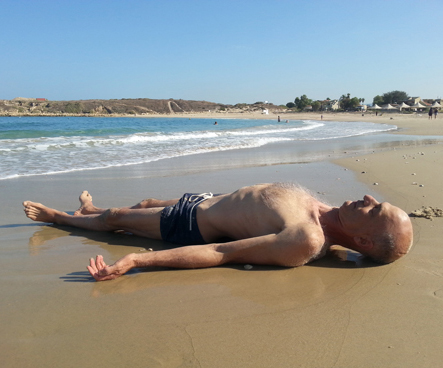
    Never give up Savasana! Even if you are in a great hurry to run to your daily business, spare at least five minutes for this important pose! These minutes are very precious. You are totally detached from your daily activities, worries and obligations; your mental modality changes and you sort of float in a different realm, embraced by Mother Earth and Nature, enjoying the grace of tranquility. This is where you reap the seeds you sow in your practice – take time to savor them! It is important to recognize and nurture these states of tranquility, sublimity, mental stability and clarity.

    Savasana - Eyal Shifroni

    In Light on Pranayama B.K.S. Iyengar writes:

    “Sava in Sanskrit means a corpse and asana a posture. Thus Savasana is a posture that simulates a dead body, and evokes the experience of remaining in a state as in death and of ending the heart-aches and the shocks that the flesh is heir to. It means relaxation, and therefore recuperation. It is not simply lying on one’s back with a vacant mind and gazing, not does it end in snoring. It is the most difficult of yogic asanas to perfect, but it is also the most refreshing and rewarding.”

    (Chapter 30, Para. 1. The emphasis on the last sentence is mine).

    I strongly recommend you to read thoroughly the detailed instruction for Savasana Iyengar gives in this chapter – what a penetration and insight!


    Savasana is the gate for the more internal limbs of Yoga: Pranayama, Pratyahara, Dharana (concentration) and Dhyana (meditation). Only when your Savasana practice is sound and regular can you go deep into Pranayama; otherwise it will be just breathing exercises. Savasana teaches you how to draw your senses inward and concentrate – this is the basis for Pratyahara and Dharana. When these are established, Dhyana follows naturally.

    Savasana is the art of not-doing, not-acting – just being in the present moment. In our hectic way of life it is so important to learn to pause and relax. Deep relaxation is probably the healthiest thing and the best service you can provide for yourself. Our body is a wondrous machine – the internal organs that are responsible for our health do their job orderly without our conscious intervention, yet, stress is harmful for their proper functioning. Stress disturbs digestion, limits circulation, raises blood pressure and disturbs the proper functioning of all the body’s systems in so many other ways. Relaxation is the key to healthy functioning of the body and mind. In Yoga – the Path to Holistic Health, B.K.S. Iyengar writes:

    “If you suffer from stress, you may experience indigestion, irritable bowel syndrome, headaches, migraine, a feeling of constriction in the diaphragm, breathlessness, or insomnia… Yogic methods of deep relaxation have a profound effect on all the body systems. When a part of the body is tense, blood flow to that area decreases, reducing immunity. Yoga works on that area to relieve tension and improve blood flow to the entire body, stabilizing the heart rate and blood pressure. Rapid, shallow breathing becomes deep and slow, allowing a higher intake of oxygen, and removing stress from the body and the mind.”

    Yoga – the Path to Holistic Health, Page 179

    In the first phase of Savasana use your breath; connect to the rhythm of your breath. Inhalation is the realization of the ‘I AM’, when exhaling dissolve that I AM to Mother Earth. Inhale – let be; Exhale – let go. Inhale – let be; Exhale – let go. Follow that rhythm while giving more emphasis to the letting go of the exhalation.

    Then, at some moment stop all conditioning. Do not condition your breath any more. Do not condition your mind anymore – just let go. Stay there, floating, very light and very heavy at the same time. Let the river carry you – do not resist or try to control. When your Savasana becomes deep, you may feel a natural, spontaneous suspension of the breath at the end of exhalation; this suspension brings about a total surrender.

    When we connect our smart-phone to a source of electricity, it shows us the energy level of the battery. In the same way, when you lie down in Savasana measure your level of energy. How much is it? 60%? 75%?

    Stay in Savasana until you are fully charged – up to 100%.

    Today scientists are developing sophisticated chargers that can charge a battery in a few minutes. Can you be totally still and quiet in Savasana to charge and refresh yourself in a few minutes?

    The energy source in Savasana is Mother Earth – it is a vast source of energy, of Prana; but we need to connect to it. The charger is powerful, but the connection is not always that great. What disrupts this connection is tension. Only by total surrender, a complete letting go, can we connect to that energy and charge ourselves. Let go of everything: muscular tension, holding, contraction, thoughts, emotions – everything! Just surrender and come close as possible to Mother Earth. Imagine the big Earth under you pulling and hugging your small body and surrender to that pull of gravity.

    In Savasana we let go of everything – it is a total renunciation. We surrender our roles, our sense of importance, our sense of self, our ego, our entire personality. We reach our ‘ground zero’. Physiologically, our internal activities – the breathing, heartbeat and metabolism, all become infinitesimal; our mental activity slows down, the conciseness becomes void. So in a sense, we experience ‘a little death’, which is not a bad thing, since once we completely surrender ourselves, we allow something new to be created inside us. When we are in a state of complete surrender, the boundaries between ourselves and the environment surrounding us become blur, there is a sense of merging and dissolving into space. In that moment, our individual characteristics weaken and become insignificant and we feel like everyone else, or like no-one in particular. This feeling of merging into Being is an experience of Kaivalya (full emancipation). Kaivalya means “aloneness”, “solitude”, “detachment” or “isolation”. When we feel like everyone else there is no “other” as such, and hence there is this sense of aloneness.

    “.. When fluctuations take place internally or externally, mental and intellectual energies are wasted. In Savasana the internal or emotional upheavals in the mind are stilled…”

    (Light on Pranayama, Ch. 30 Para. 27)

    “Practice Savasana for some ten to fifteen minutes to experience a sense of timelessness. The slightest thought or movement will break the spell and you are once more in the world of time, with a beginning and an end.”

    (Light on Pranayama, Ch. 30 Para. 30)

    Turn off your mind, relax and float down stream

    It is not dying, it is not dying

    Lay down all thoughts, surrender to the void
    It is shining, it is shining

    Yet you may see the meaning of within
    It is being, it is being

    Love is all and love is everyone
    It is knowing, it is knowing

    Tomorrow Never Knows, John Lennon

  • On Equanimity and Yoga in Detention

    On Equanimity and Yoga in Detention

    The world is filled with movement

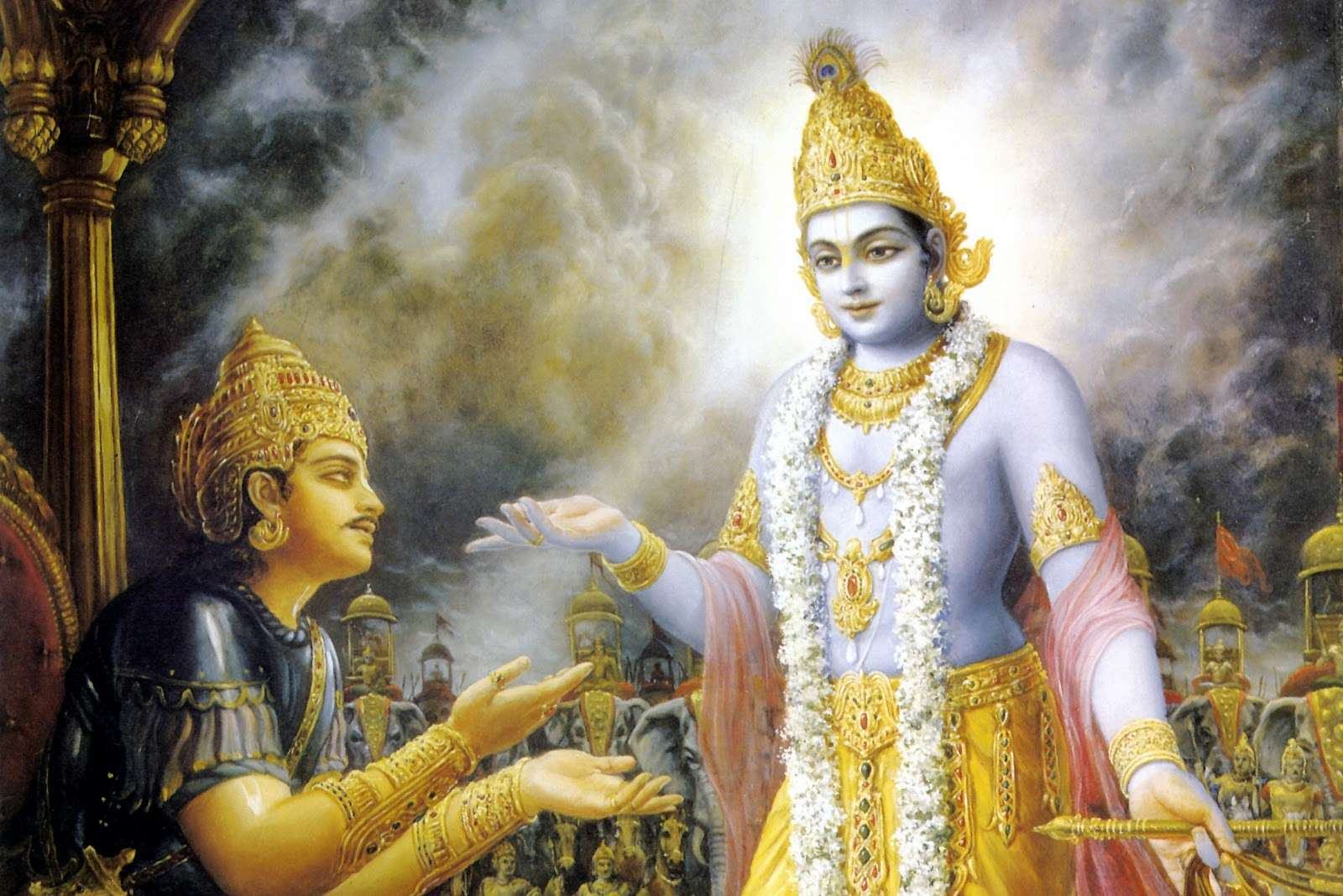
    “Fixed in yoga do thy work, O Arjuna, abandoning attachment, with an even mind in success and failure, for evenness of mind is called yoga.”

    These are the words of the Teacher of the Bhagavad-Gita, Krishna, to his pupil, the warrior, Arjuna, (2.48, English version: Radhakrishnan).

    Lord Krishna and Arjua

    B.K.S. Iyengar wrote in Light on Life:

    “The world is filled with movement. What the world needs is more conscious movement, more action.”  He distinguishes between action and movement as follows: “Action is movement with intelligence.”.

    (page 28)

    Why is there so much movement in the world? Because of restlessness. Because of the illusion that if we move things will improve and difficulties we experience will vanish. When we feel uncomfortable or irritable we tend to move. It could be a physical or mental movement: wanting that something else will happen, a refusal to accept reality just as it is. It happens in life and also in our practice. In postures which require long stays, like inversions, forward extensions and Shavasana, we sometimes experience discomfort or restlessness and feel an urge to move.

    (It’s not that movement is not needed at all, often we need to move in order to make necessary adjustments or corrections. But, often the cause of the movement is restlessness and inability to stay stably in one pose.) In everyday life there is perpetual movement, but there are occasions in which the ability to move is denied, and then we have no choice but to be with ourselves and with our feelings.

    15 long hours in detention

    Such an extreme experience I had earlier this month when I arrived in the United States in order to teach yoga workshops. Upon arriving in the airport, I learned my visa was not the correct one, and shortly after I was forced into detention for 15 long hours, until the next flight home (to Israel). Needless to say, I was in a bad mental state, which was characterized by feelings of terrible frustration, extreme disappointment, self-judgment, self-reproach, worry for my wife who was separated from me, rage, bitterness, and anxiety about what will happen next. My cellphone was confiscated from me, and my freedom to move was absolutely denied. Once I got into the detention room, I took out a yoga mat which is always in my suitcase, and started to practice. I did mostly forward bends to help me calm down and slow down my heart rate and breath. But after I attempted Sirsasana, one of the airport’s policemen decided it was too much and forbade me from continuing to practice, or from speaking with those who shared the same bench (and fate) with me. He didn’t even allow me to read a book. I was left to myself with all these difficult emotions for many long hours. What a startling experience…the speed in which you turn from a respected guest, a yoga teacher who was invited to teach workshops, into a detained offender is mind boggling and you feel a complete sense of helplessness and lack of control. What an incredible Yoga lesson!

    In life there are pleasant times, periods of success, joy and satisfaction; but life also summons other kinds of situations for us, difficult ones, which we do not choose and we don’t even agree to be in. The thing is…no one really asks us…we are conditioned to want the pleasant, the joyful and the delightful, but reality is not like that. It summons us with more or less equal amounts of pleasure and pain, success and failure, profit and loss, praise and infamy. Every human being experiences these upheavals. These changes are inevitable; they are a part of the experience of being alive.

    Yoga and equanimity

    The Bhagavad Gita defines Yoga as equanimity and notes that the Yogi should receive all experiences with the same level of acceptance, and remain unaffected by these dualities.

    The Buddha said that these opposing pairs (pleasure / pain, joy / sorrow, etc.’) are like the winds that come and go and the yogi is like a sturdy tree that stands calmly in all upheavals. “You must accept and inspect pleasant as well as unpleasant situations. You want only pleasant experiences and do not want to experience even a small dose of unpleasant ones. Is that fair? Is that the way of the Buddha?” Is it indeed?

    As I was sitting there in the detention, I remembered all these inspiring words of Krishna and the Buddha and tried to calm down, counting my breaths, observing my emotional turmoil, wondering about the deep meaning of equanimity and suffering. Why do I suffer? What went wrong? I couldn’t really calm down but I kept observing and inspecting myself. What is the source of my suffering? A teacher once told me that if you suffer there must be some clinging and attachment. Let go of the clinging, and the suffering will be gone. What am I clinging to? Why can’t I be poise and tranquil?

    And then for some moments of grace I can look upon the whole situation from a bit of a distance. I realize that this has just happened. It happened not because of something wrong that I did, but because this is just the nature of reality, it tends to surprise us. Unexpected things can happen all the time. There is no point fighting it or blaming myself. It is what it is and that’s it. Life is very fragile and nothing lasts forever.

    And indeed, we cannot change reality, we cannot change the constant flux of changes, but we can change the way we react to change.

    We cannot declare that we are in a state of equanimity and pretend we are indifferent. This is not real equanimity. If we are upset, no show we put on will suffice. Real equanimity is a state of emotional balance, what Yoga refers to as Neutrality. To be in the midst of all things and keep a peaceful, balanced mind.

    An opportunity to observe

    “For evenness of mind is called yoga”  … in order to get there we need to create the inner space, the ability to contain, and this can be done only via practice with observation.

    Yoga practice includes little movement and a great deal of intelligent action, conscious action. We stay in a posture and while we stay we have the opportunity to observe. When we observe ourselves and are mindful to our reactions, emotions and thoughts that arise, things become clearer. Movement does not allow for deep observation, as it creates a veil of distraction. But in staying, we learn to keep the grip necessary to maintain the pose and to confront discomfort. Such a practice expands our container, creates wider space inside. We can better understand our tendency to cling to pleasure and avoid pain. We can get some insight into the nature of impermanence.

    When you pour a teaspoon of salt into a glass of water, the water in the glass turns salty, but if you pour a teaspoon of salt into a large lake, the saltiness of the lake will remain unaffected. We should be like a lake. Our practice should allow us to face extreme situations without getting totally out of balance. It’s not that we don’t care – we can’t be indifferent – but how much we care? Do we lose our balance in every passing wind? Can we remember that everything, even the hard moments are bound to change? Can we see that out of the frustration and the loss, some good things may sprout? Can we face situations that we did not choose or want, and know that we can endure and can still behave wisely and skillfully (“yoga is skill in action”, Bhagavad Gita, 2.50).

    So instead of conducting workshops in the States, I got another deep lesson in yoga…

    I didn’t succeed in remaining calm, but… success and failure are just like winds that come and go… and the yogi stays calm in the midst of all that…

    “I’ve looked at life from both sides now
    From win and lose, and still somehow
    It’s life’s illusions I recall
    I really don’t know life at all” 

    Joni Mitchel, Both sides now
  • The Yogic path – Reflections on Kriya Yoga

    The Yogic path – Reflections on Kriya Yoga
    The Yogic path - Reflections on Kriya Yoga

    In order for us to advance on the yogic path we need to invest energy and effort needs to be exerted. On this path, we are walking very much against the flow, against the tendency to follow our senses, in pursuit of pleasures of transient life, against the tendency to indulge in consumerism and desires. All this requires discipline and effort – these are the components of Tapas – the insistence to persevere in the practice and the path.

    From Wikipedia:

    • Tapas: austerity and associated observances for body discipline and thereby mental control.
    • Svādhyāya: study of the Vedic scriptures to know about God and the soul, which leads to introspection on a greater awakening to the soul and God within, which literally means “one’s own reading” and “self-study”
    • Ishvarapranidhana: dedicating all of one’s efforts to God or surrender to God.
    • Praṇidhāna is used to mean a range of senses including, “laying on, fixing, applying, attention (paid to), meditation, desire, prayer.” In context of Patanjali’s Eight-Limbed Yoga, the word Īśvarapraṇidhāna means committing what one does to a Lord

    _________

    Patanjali writes in the beginning of chapter 2 of the yoga sutras, the chapter on practice (Sadhana Pada):

    “Tapah (tapas) svadhyaya Isvarapranidhanani (are) kriyayogah”.

    Tapas is commonly translated as asceticism and a discipline of mental and physical practice.
    Svadhyaya is the study of sacred scriptures in order to know about the essence of the Self. Literally the meaning of the word is the study of the Self.

    Isvarapranidhanana means devoting the entirety of our efforts and actions to God,
    Dedicating ourselves to him completely.

    When translating more freely we can refer to these three layers as: effort, inquiry and devotion. These are the foundational constituents of the yogic path (and indeed of any spiritual path).

    However, the effort needs to be applied in the right direction and in the right amount and for that there is need for inquiry, research and study. The study of our own nature, of the places we act from, of the things we cling to, the crossroads in which we get stuck – all these require observation and inquiry and that comprises Svadhyaya. The study of the Self and the study of the yogic scriptures in order to reflect upon the nature of things and the nature of man as described by the philosophy of yoga.

    Beyond that, there is need for trust and devotion on the yogic path. What is devotion? Devotion is an action devoid of calculation, an action that isn’t done out of thought on loss or gain. It is an action done wholeheartedly, an action performed out of love and not in order to glorify our ego. When we devote ourselves to the path we are willing to walk it for the very act of walking and not for tangible material fruits. That is the component of Isvarapranidhanani.

    Svadhyaya is the study, it defines the domain of the yogic inquiry. Tapas is how to study, study by action, by doing and observing at the same time. Ishvara Pranidhana is accepting what is being our control.

    The lives of human beings are made up of work, study and love – the three elements will turn into yoga, into kriya yoga once the work is performed as a service or offering; the study is done for the sake of internal inquiry and the love is to open up our hearts to all living beings without calculating gain and loss.

    Once the work turns into selfless service, the study is done for the purpose of liberation and the love is unconditional, then we become Yogis!

    There is a saying:

    “Yoga helps cure what can be cured, bear what can’t be cured and distinguish between the two”.

    Curing what is incurable through Tapas, bearing what is incurable – that is Isvarapranidhanani, and the wisdom to distinguish between the two is acquired through Svadhyaya.

  • What Shall I Write in My Notebook? – Concepts, Attachments and Iyengar Yoga

    What Shall I Write in My Notebook? – Concepts, Attachments and Iyengar Yoga
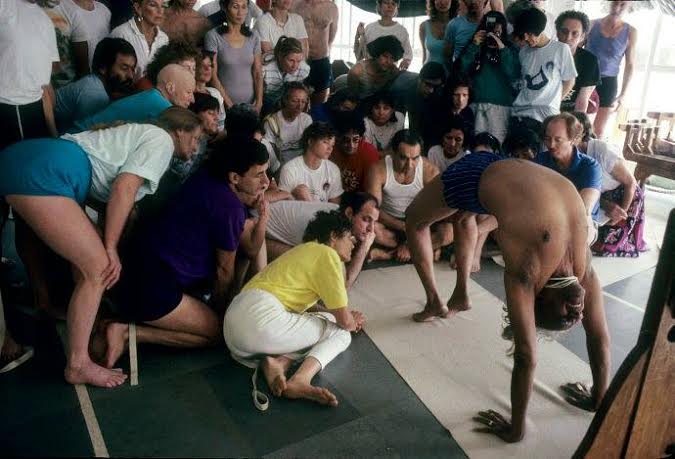
    Iyengar yoga - B.K.S Iyengar demonstrating
    B.K.S Iyengar

    A Zen Story

    In a monastery, two monks argued about a point regarding their master’s teaching. One said yes and the other said no. Finally, they came to their master to explain their understanding of the teaching.
    After the first monk explained why he said yes, the master nodded his head and said that he was correct. The first monk was then very happy and left. The other monk, of course, was not happy. He also explained to the master why he said no. Thinking for a while, the master also nodded his head and said that he was also correct. The monk was then satisfied and left.
    A little monk who was sitting beside the master was very puzzled. He said to his master, “Master, I do not understand. It is obvious that only one of them is correct. They cannot be both right. Why did you say that they are both correct?”
    The master replied calmly, “Hmm you are correct too!”

    Important Note

    This article is intended for teachers of the Iyengar yoga method and deals with the practice of advanced students. I would like to emphasize that while teaching beginners you must present them with clear and non-contradictory instructions. For a beginner there should be only one correct option, and any confusion must be avoided.

    Contradictory instructions

    We, westerners consider ourselves to be very rational, efficient and logical. It is hard for us to accept that an instruction can be correct when its opposite is also correct. We find such seemingly contradictory instructions very confusing; they disturb our sense of order and logic: how can something be right, when its opposite is also right?
    In the Iyengar yoga world we are eager to learn new instructions and ‘points’ about the asanas. When we attend a workshop conducted by a knowledgeable, senior teacher, we sincerely study the new points and adjustments. Often these new instructions are fine and precise, and they create something new in our experience of the poses. This teacher will typically not claim for originality but rather quote Guruji (B.K.S. Iyengar). He would present himself as a conveyer of the instructions learnt in RIMYI[1] from Guruji himself or from his son (Prashant) or daughter (Geeta).
    As teachers, we adopt these instructions enthusiastically; we feel that we have learnt something new and deep about the asanas. So we write the new instructions in our notebooks and teach them to our students as if they were written ‘in stone’.
    When, a few months later, another knowledgeable, senior teacher comes to conduct another workshop – we register, in hopes of enforcing the knowledge we already have. However, often, the new teacher gives just the opposite instructions. Surprisingly, lo and behold, again, we feel that these new instructions are very deep and correct, and they also give us a new experience of the same known poses.
    I am sure that these teachers are all sincere and truthful and that they really learnt their teachings from Guruji. But we are left with the problems: which teacher is right? And more importantly: What should I write in my notebook???
    It may be good advice not to write anything in the notebook at this stage, and instead practice and test these new instructions several times to see how they can fit in our own personal practice. Once these new instructions are absorbed and assimilated into the framework of our cellular, embodied knowledge, they will probably not seem so contradictory to what we already know.

    Conceptual thinking

    You must also remember that in an asana there are actions and counter-actions that work in different directions. Often, in order to create stability and balance you have to perform a set of actions that complement each other. So it could be that, for clarity’s sake, each teacher emphasizes just one action, and neglects the corresponding counter-action.
    However, I think that the source of the confusion is much deeper than that, and it has to do with our relying on concepts and conceptual thinking. Now, concepts are very useful as thinking tools and as means of communication. Concepts create order in the chaos of the phenomenal reality; they are useful tools that help us to organize the infinite number of stimulus we receive from our environment and to build a coherent worldview that enables us to function. But once a concept is created, it has its own magical power; concepts tend to hide the flowing, ever-changing nature of reality; they give us the illusion of permanency. Concepts tend to be fixed and to exist independent of other phenomena. It is convenient to stick to a mental concept, and to believe that it reflects the actual reality. But in truth, a concept can never be the reality itself – but at most – a representation which is an approximation that reflects some aspects of reality. This is useful because reality itself is too complex and cannot be contained in our mental containers, let alone, formulated in our notebooks.
    Anyone who had the privilege of studying at RIMYI repeatedly for several years could see that the teaching there is like a river – and that river constantly flows and changes: “You can never enter the same river twice”. It seemed that for Guruji consistency was not so important; in his teaching he related to the current situation of the person in front of him and gave the instructions that could help that person in the best way. And if these instructions seemed opposite to some instructions he gave some other time – well, that is not much of a concern. As Prashantji often reminds us, there cannot be a standard, fixed set of instructions that will fit everybody at all times. Our practice and teaching should be adapted to the circumstances. It is impossible to enforce just one mode of teaching on all types of students and on all circumstances and situations.

    Asanas are not movements

    Moreover, asanas are not movements but actions. When we stay in an asana we can create different internal actions in order to get different results. Some of these actions may seem to contradict other actions, but at certain times and for a certain purpose they may be just adequate. So you have to perform the actions according to the purpose of doing the asana. Sometimes, you may practice to get stability; at other times to get lightness and agility. Sometimes you may wish to relax and restore yourself, while other times you perform the asana to increase your vigor and potential.
    Let’s make a simple experiment; stand in Tadasana, join your legs and move the inner legs down to the inner feet and press on the inner heels and the big toe mounds. Lift your arms to Urdhva Hastasana and sense the stability you have and the extension you can create in the sides of the body. Now release the pose and after a few seconds do it again, this time lift the inner arches of the feet and from there lift the inner legs toward the inner groins. Lift your arms to Urdhva Hastasana and see how the lower abdomen is easily lifted. Do you feel a sense of lightness in the pose?
    So, should we lift the inner legs or move them down? What shell I put in my notebook?
    Why should we have one answer? Why can’t we accept the reality that different actions that seem opposite when articulated verbally can co-exist very well in the actual experience of the asana and give different internal effects?

    Non attachment in practice

    I think these are the most important questions we should ask ourselves. If we want to observe reality as it is, we must detach from any fixed set of concepts. Attachment to preconceived concepts leads to dogmatism, which is a big obstacle in our spiritual progress.
    The fine, detailed instructions in the Iyengar method are just tools, gates to help us get inside and connect to ourselves. They are not meant to block our sensitivity and our ability to perceive the asana as it is, from moment to moment. They should not be treated so seriously. So often it is better to discard our notebooks, or at least to forget everything that is written there, and to set our minds free from any preconceived ideas or known instructions. That instruction may have worked well in the past, but is not necessarily appropriate for our current situation, or for the students we are facing right now.
    If the confusion created in our minds by contradictory instructions will lead us to a realization that no instruction, or for that matter, no permanent concept, can adequately serve us in all situations and that we should keep our minds free and open, then that confusion is worthwhile. I even suspect that Guruji had intentionally planted some contradictions in his teaching in order to confuse us, to shake our habits and our very ‘logical’ mental settings. To shake our conceptual mode of thinking and to open our minds to the Reality itself! This is a well-known strategy in Zen, in which monks are faced with some paradox (a Koan) like: “What is the sound of one hand clapping?” This serves to shake the intellectual conception in order to take the leap required for the direct perception of Reality.

    [1] Ramamani Iyengar Memorial Institute – the home and center of the Iyengars in Pune