• The Effects of Yoga (In Short…)

    The Effects of Yoga (In Short…)

    The practice of yoga is special – yoga has been around for the past 5,000 a years! The effects of yoga as a path and a system can be far reaching. The yoga sages have established certain principles that hold the potential for a radical transformation of our mind and body and can fill our lives with peace and joy.

    But what is so special about yoga?

    Well, if you look at yoga as merely an exercise method, it’s the most intelligent method. Yoga develops the body in a balanced way – it strengthens both muscles and flexibility. Beyond that (and much more importantly) Yoga not only works on the muscles, but it also works on all systems of the body: digestive, respiratory, circulatory, immune, hormone secretion, and more.

    Our health depends on the proper and balanced functioning of the internal organs and the efficiency of our waste system’s transportation and disposal. Yoga, by the actions of stretching, squeezing, extension, reaches all the internal organs and rejuvenates them. It maintains the flexibility of arteries and thus balances blood pressure, it expands the lungs and helps supply fresh oxygen to all parts of the body (especially the head and brain – in inversions). Yoga balances the hormones and glands operation, retaining all normal bodily functions (including women’s menstrual cycle).

    The Effects of Yoga - Eyal Shifroni

    Yoga does wonder for reducing stress and creating mental peace enhancing the action of the parasympathetic nervous system. Many studies have found links between stress and diseases therefore creating harmony and peace of mind also helps in maintaining health.

    But Yoga is not just an exercise method, yoga develops one holistically, operating on different dimensions of ourselves: physical, mental, emotional, intellectual, moral and spiritual .

    Physical yoga helps to develop strength and flexibility maintaining the integrity of our internal systems and therefore our health, over the years. It helps us to develop mentally, yoga promotes features like persistence, patience, power – desire, joy, and peace; Mental Yoga helps achieve emotional stability and balance, and satisfaction. It helps mental concentration, improves memory, focus and clarity of thought, balanced perspective of reality, and good judgment; Moral Yoga opens our hearts to love people and therefore makes us better people, more sensitive to our environment, more considerate, and willing to contribute to our environment; Spiritual Yoga tells us the truth about our existence in this universe. The effects of yoga in our lives can be thoroughly transformational!
  • Yoga Home Practice Guidelines

    Yoga Home Practice Guidelines
    Yoga Home Practice
    Self-Practice Videos by Eyal Shifroni

    Personal practice is the most important part of yoga. In Class, you learn new things, but it is the personal practice of yoga that is the essence! Therefore, I strongly recommend establishing your own yoga home practice routine. You can start with half an hour once a week, then increase to twice a week and add further sessions as you go until you practice on a daily basis (6 or 7 times a week), even if it’s for 20 minutes a day. Do not let the thought that practice takes time to deter you, take it lightly and you will see the payoff will arrive soon after big time! Below are some guidelines for your practice:

    • It is essential to maintain a margin of at least four hours between your last meal and the time you begin your practice. You can drink something light up to half an hour before practice. You can drink water before or after practice, but it’s not recommended to drink during practice (it fills your stomach and makes movement difficult).
    • Do not start practicing if you are tired or after a day in the sun. Also, do not practice immediately after strenuous physical activity such as running, gymnastics, cycling, or swimming. Leave sufficient time for rest and recovery. In such cases, it is possible to practice restorative poses (with support).
    • Wear appropriate clothes that allow for free movement and will enable you to see the various parts of the body (such as knees and elbows).
    • Yoga home practice should be done when there is no fever or acute illness, in such cases, you need to rest until you body is stronger.
    • Do not hold your breath during practice, breath normally through the nostrils (inhaling and exhaling). Concentrate on performing the posture properly rather than breathing. Use special breathing only after you become familiar with the asana. Once the asana is done properly breathing flows freely.
    • It is recommended to find a quiet practice space and practice every day at the same time. It can be in the morning, evening, or at any other suitable time (on the condition that enough time lapsed from your last meal).
    • During menstruation, women should practice quieting poses and avoid postures that generate heat or entail stopping the natural flow of the blood. For detailed instructions on practice during menstruation please consult with a teacher.
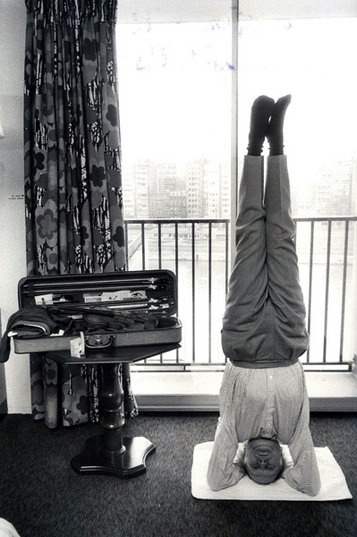
    • Do not give up practicing inversions. These positions are invaluable: they regulate metabolism, balance blood pressure, maintain a proper level of glucose and the chemical balance of the body systems. They bring emotional balance, relaxing and refreshing the brain and the mind. Practice these poses every day (except for women during menstruation). If you do not have a lot of time, practice at least 5-6 minutes Sarvangasana (Shoulder Stand ) and 2-3 minutes Halasana (plow), then relax for a few minutes in Savasana.
    • On your Yoga home practice, try to disconnect from your mobile phone and any other distractions – everything can wait until the end of your session… Be focused on the practice and set time for yourself – the benefit will be much greater than your (temporary) unavailability.
    • If you eat before exercise you will become heavier and limited in your movement. Physical activity requires all your energy so your body automatically stops digestion to divert the energy to the muscles. This obviously violates digestion and is not recommended. 
  • About Success and Equanimity in Yoga

    About Success and Equanimity in Yoga

    There is a gap between the type of values ​​that (consciously or not) we live by in the west and the qualities that are considered desirable and beneficial in yoga. When rationally observing western culture, we can tell it emphasizes characteristics such as competitiveness, achievement, individualism, consumerism, and the pursuit of material gains even at the cost of exploitation, etc. One can also look at the positive aspects: progress, well-being, individual freedom, prosperity, providing opportunities for development, and so on. That’s a very different approach than the equanimity in yoga described in the Bhagavad Gita.

    Anyway we may look at it, one factor unites all of these characteristics: the appreciation we feel towards success. We are addicted to success and admire successful people. Everyone wants to succeed. No one wants to be a failure. Success can mean money, academic accomplishments, or cultural achievements; if I’m “somebody” my name will be remembered.

    But what is success really, and how can it be measured? Success is failure’s partner. We can determine success only in relation to failure. If there is no failure there is no success. So success and failure are intertwined.

    Is it always possible to succeed? What happens when we fail?

    The Bhagavad – Gita states that a Yogi is a person for whom success and failure are equal.

    The western approach is to acquire knowledge in order to succeed and rule the world; to ensure that we are strong and successful. We are bound outward. But the yogi knows he cannot control the world. The world is wide and unpredictable, impossible to control.

    Equanimity in Yoga - B.K.S. Iyengar
    B.K.S. Iyengar

    Instead of controlling the world, the yogi learns to control himself. The ideal is not a success, but rather on our path we seek equanimity in yoga and in life. What is equanimity?

    Equanimity means that regardless of the circumstances, I can stay relaxed and satisfied. Success will not cause my head to spin and the failure will not make me depressed. The yogi knows that life circumstances are changing constantly. Success cannot persist; at some point, it will be replaced with failure, but my own internal state can remain constant.

    You could say that equanimity is the “homeostasis of consciousness”. Homeostasis is a biological system’s ability to maintain constant internal balance when the environment changes. Our body temperature is almost constant, regardless of the outdoor temperature. In both hot and cold conditions we maintain the same body temperature. Equanimity is the ability to stay calm in the face of praise or humiliation, success or failure, achievement or defeat, profit or loss, victory or defeat, and so on.

    In the west we seem to think that we can rule the world via technological progress, however, we do not believe it is possible to control the states of our consciousness. Our moods fluctuate in and out of control and our thoughts wander freely…

    Is it really possible to control our internal state? How can we get to equanimity?

    It’s not easy – and that is exactly the yogic approach: it is necessary to acquire these skills. This is a process that slowly builds over time and practice.

  • B.K.S Iyengar: About the Man

    B.K.S Iyengar: About the Man

    Introduction

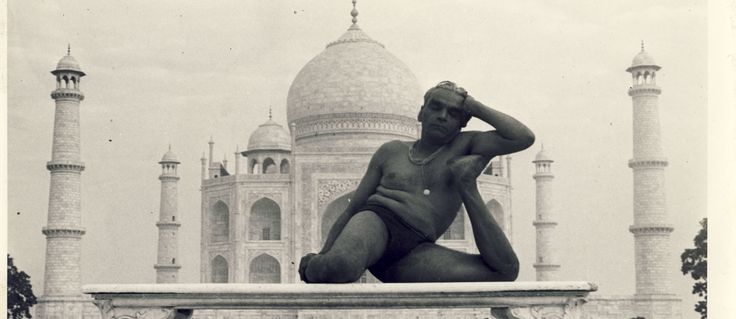
    B.K.S Iyengar (1918 – 2014), is a world-renowned authority in the yoga of our era. He developed a method of yoga based on the ancient spiritual tradition of classical yoga as well as on the scientific foundations of experimentation, comparison, analysis, and rational examination. His method is known as “the Iyengar method” and is one of the most popular methods of yoga in the world today.

    B. K. S. Iyengar
    B. K. S Iyengar

    B.K.S Iyengar was born in 1918 into a poor family in the small, remote village of Belur in the state of South India. As a child, he suffered many ailments, including malaria, typhoid, and tuberculosis. His father died when he was only 9 years old and he did not receive any formal education. Fortunately, his elder sister married renowned yoga teacher Shri T. Krishnamacharya and at 15 Iyengar was invited by him to the city of Mysore to live with his sister and her family and learn yoga from Krishnamacharya. At 18 he was sent to teach in Pune, central India, where he stayed until his last days. In the early years, he lived in poverty and humility and spent most of the day practicing yoga. He used to practice for hours, 10 hours a day and more. In the early 20th century, yoga was not popular as it is today and Iyengar was scorned, but with the help of his dedicated and consistent yoga practice, he was able to overcome his illnesses and develop a healthy body as well as a strong personality. With his talent and persistence, he managed to acquire a reputation as a gifted teacher and healer. Iyengar demonstrated his yoga poses throughout India and gradually became well-known.

    In 1943 he met his wife Ramamni and in 1944 their eldest daughter Geeta was born. Iyengar has five daughters and a son. In 1975, after his beloved wife passed away, he established the Iyengar Yoga Center named in honor of his wife – the Ramamamni Iyengar Memorial Institute, in Pune. These days Geeta, his son Prashant and granddaughter Abhijata lead the center. Geeta is a graduate of Ayurvedic medicine and conventional medicine; Prashant is a man of stature, a philosopher, and an artist; Abhig’ta studied closely with Iyengar and is already is a gifted teacher. All three are teaching centers in Pune and continue to enrich and develop the method of Iyengar yoga.

    World Recognition

    In 1952, B.K.S Iyengar met the great violinist Yehudi Menuhin. Their meeting was a turning point; Menuhin became a devoted disciple and introduced Iyengar to the West. Starting in the 1950’s Iyengar traveled west frequently conducting workshops in Europe, the U.S., and Israel, which he visited in 1996. Iyengar taught people like Bijoy Krishnamurti and the Queen of Belgium (who he taught how to stand on her head when she was 80 years old). Slowly the sickly child from Belur became a charismatic and famous teacher worldwide.

    In 1964 Yehudi Menuhin wrote the following words in the Introduction of “Light on Yoga” Iyengar’s first book:

    “whoever has had the privilege of receiving Mr. Iyengar’s attention, or witnessing the precision, refinement, and beauty of his art, is introduced to that vision of perfection and innocence which is man as first created: unarmed, unashamed, Son of God”.

    B.K.S Iyengar’s ability to work well into his old age was amazing. He was sharp, clear and active. He visited the RIMYI library for a few hours every day where he read letters, went through the publications, and wrote articles and books. No doubt, many years of yoga practice were bearing their fruit for this exemplary person who started out meagerly and managed to build himself up against all odds, achieving the highest levels of growth and changing the yoga map of the world beyond recognition.

  • Thoughts About Ahimsa – Non Violence

    Thoughts About Ahimsa – Non Violence

    This week we discussed in some of our classes the principle of ahimsa – non-violence, or non-injury. This principle is the beginning of Ashtanga Yoga as it is the first principle of the first element (Yama) of the Eight Limbs of Yoga.

    The eight limbs of yoga - Eyal Shifroni
    The eight limbs of yoga

    Presumably, we all want to live violence-free and without harming ourselves or those around us; nevertheless, the full realization of Ahimsa, or non-violence, is difficult and requires thorough observation and practice.

    We need to take into account that our survival instinct can be contradictory to the principle of non-injury. The debate over the fundamental question of whether “man is created good” is ancient and can be looked at through various lenses. Are aggression and violence necessary for survival, or as Mahatma Gandhi said, if everyone acts on “a tooth for a tooth and an eye for an eye” soon we will all be blind (or is it that only spiritually blind people hold this saying to be true). Some studies actually show that altruism among animals is a feature that promotes survival.

    But let’s leave the philosophical/global arguments and examine the following personal questions:

    • Which mental states give rise to the mood of Himsa (injury or aggression) in you?
    • When during practice (or outside of practice, maybe while driving) do you find yourself about to sacrifice your health or well-being?
    • What are the situations or triggers that bring you to the edge, creating anxiety in you that can potentially lead to violence?
    • When can neglect lead to violence?

    I talked with my students about these questions, and some interesting insights arose; we examined situations in life where injury transpires. Practice allows us to observe and study these situations. For example, I may decide to practice a pose that challenges my boundaries, or, for example, stay in a headstand well past my ability. This decision is ‘head’ driven as it ignores my real physical capacity. If practice does not contain honest attention to the real ability of the body, then such a decision could result in injury.

    One can generalize and say that every time I expect or demand something of myself or others, I can potentially create injury. When I demand something from someone else and am pressing them to meet my expectations regardless of their needs and desires, I can potentially create harm because I might hurt their autonomy and free will. On the other hand, expectations can sometimes be positive if they prompt action and serve as positive motivation. It very much depends on the attitude in which the expectation is made.

    Seemingly, if we do not practice, we do not risk self- harm. But is it indeed so? Don’t we impoverish ourselves unintentionally in many other ways in our everyday lives? Practice can be used as a laboratory to help us examine these conditions so that we can recognize them in everyday life and avoid them.

    If we are not attentive and are not mindful, we can do many unwholesome acts that will cause suffering to ourselves or to others. How often, when driving, are you ready to risk yourself and others because you are impatient or just not attentive?

    Going a step further on this thought, if we feel that the practice makes us better, revitalizing our body and mind, then giving up a practice that makes us feel so good is a form of injury.

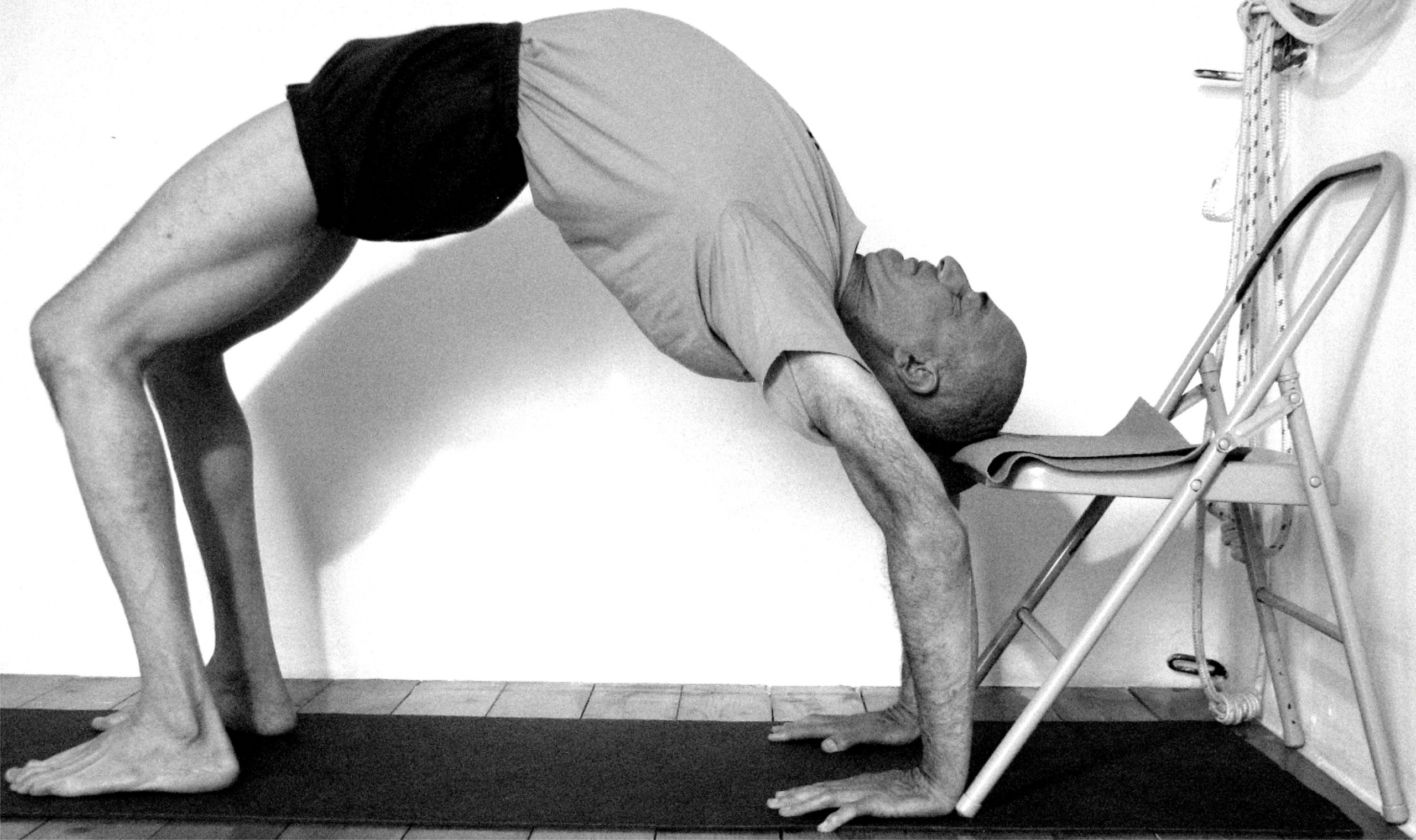
    Neglect can be damaging.  Iyengar writes about this beautifully in his book “The Tree of Yoga” when he says that in an unbalanced stretch there is dual harm: the side that overstretches is hurt deliberately, but the side that is under-stretched is hurt non deliberately because a partial stretch means we are not nourishing the body on that side as we are supposed to.

    Another interesting question is how to maintain my boundaries and not let others hurt me, without being offensive.

    I don’t think there are definitive answers to these questions, and I leave them to you for further contemplation. Practicing yoga in classes and especially at home is an opportunity to look within ourselves and to examine these questions.

  • Yoga Sequences for Self-Practice (From “Props for Yoga”)

    Yoga Sequences for Self-Practice (From “Props for Yoga”)

    Short sequences for beginners, from the book Props for Yoga.
    And here are some self practice guidelines to considers when practicing at home.

    A short self practice yoga sequence for beginners. From the book Props for Yoga by Eyal Shifroni

    Self practice yoga sequence. Forward bends for beginners. From the book Props for Yoga by Eyal Shifroni