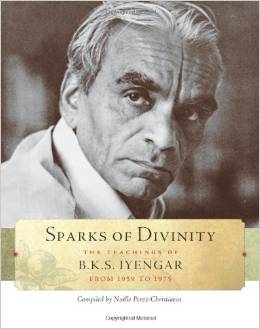
Noelle Perez-Christiaens was one of the first Westerner students of B.K.S Iyengar. She traveled to Pune as early as 1959 to study with him and spent a few years there. The foreword of the book asks:
“Who was this brave young woman who traveled alone to India in 1959?”
Noelle Perez-Christiaens and B.K.S Iyengar
Guruji taught her on a one-to-one basis. She was amazed by his
“precise and refined technique” and by his sayings. She wrote down in her notebook “the master’s remarks about how to see the world, the philosophy of yoga, his devotion to the Divine, and his love of human beings.”
Noelle was charmed by Guruji’s kind personality and by his wisdom, she writes in her diary:
“I would like to stay a long time, to pump all this wisdom that is so simple, so human and so divine at the same time”… “Here I am around a sage who does not know that he is a sage, who has a wife he loves as much as a Hindu can love, meaning ten times more than us…”
The book includes the diary of Noelle Perez-Christiaens from these years; quotations of Guruji from 1959 to 1975 ordered by years and a section about his early life.
Here are some quotations:
About Pranayama:
“When we are aware of the fact that without breathing there is no life, we feel grateful to God, who gives life through breathing. We surrender out life to God during exhalation, and we receive our life from God during inhalation. As long as we do pranayama, we surrender ourselves to this meditation.”
(from 1959, p. 37)
“The yogic pranayama, or breathing techniques, are meditative in their origin and in their effect. Consisting basically of breath inhalation, breath retention, and breath exhalation, their rhythmic movement stills the mind by withdrawing the senses and helps one uncover the depths of the Self.”
(from 1968, p. 84)
About Meditation:
“The brain must be flexible; the body must be rigid as stone. When the brain is perfectly calm, then meditation begins.”
(from 1972, p. 119)
“When in meditation, look with your ears, not with the eyes… Ears bring the art of silence. Eyes bring the art of action”.
(p. 119)
“Meditation is a fine supreme consciousness in which there is no duality”.
(p. 88)
“The energy of the brain descending to the seat of the mind, the energy of the mind ascending towards the brain, where they both meet, is the seat of the soul. And there you must live, and that is meditation.”
(p. 154)
It is astonishing that as early as 1959, when Guruji was only 41 years old, he already had such refined wisdom, and his concise sayings are so beautiful and inspiring to me.
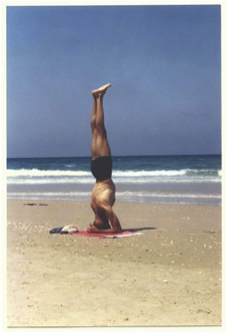
Inversions, in which the body is upside down defying gravity, are undoubtedly a unique characteristic of yoga. The two significant inversions are headstand or Shirshasana (pictured) and Shoulder stand or Sarvangasana. These are considered the king and queen of all asanas. At one point in my life, I practiced Tai Chi in addition to yoga and I truly enjoyed it. There were even rare moments I contemplated devoting myself to Tai Chi at the expense of yoga, but each time this thought arose, I just could not bear the thought of giving up inversions. Indeed, there is no substitute for inversions; inversions are a component central and essential to yoga and are truly one of the gifts that yoga brings to society, humanity, and us individuals. The benefits inverted asanas can offer are tremendous.
Eyal Shifroni – Sirsasana
Many years ago, when I installed the first rope in my home in order to do a hanging headstand, my eldest daughter, who was a small child then, hung upside down on the rope and said, “wow dad, how fun! It just makes life more fun!” Since then, I cannot find a more accurate expression of the feeling you get when you perform inversions: It really does make life more fun!
Whatever nectar flows from the moon which is divine form, it is all swallowed up by the sun. Hence the body decays.
There exists a divine process by which the sun is duped…
If one’s navel is high and palate is low, then the sun is above and the moon below. This position, the inverted pose (Viparita Karani), is to be learned through the instructions of a Guru.
Hata Yoga Pradipika III, 77-79
The above quote from the Hatha Yoga Pradipika describes symbolically the extraordinary benefits of inverted poses. The downward flow of the nectar which is swallowed up, causes the body to decay. Inverted poses reverse, or at least slow this process. Indeed, inverted positions – a unique gift of Yoga – are a great benefit. These poses take us to an inner journey into the core of our being. They touch and heal us on a deep level; they penetrate deep within, where our fears are hidden yet where our powers and joy can be found.
The benefits of inverted asanas
Geeta Iyengar and Lois Steinberg describe the benefits of inversions in the following words:
… In addition to the reproductive effects, inversions also benefit the endocrine, lymphatic, circulatory, digestive, respiratory, urinary, excretory, and central nervous systems. The pituitary, pineal, thyroid, and adrenal glands receive a proper blood supply. Inversions are the greatest poses for balancing hormones, which are also connected to maintaining bone density. Constipation, flatulence, and hemorrhoids are alleviated. The urinary tract, urethra, kidneys, and bladder benefit from the relief given by the anti-gravitational force. Again, mineral loss from the bones is checked when the muscles and bones are going against gravity. The resilience of the lungs is improved, and the body is kept warm. Retention of fluid, edema of the lower legs is reduced. The brain receives a healthy current of blood, is rejuvenated, and the clarity of thoughts predominates. Sleep problems may improve. A state of equilibrium, balance, and health is established with the regular practice of inversion.
…one should not perform inversions during menstruation. Inversions performed during menstruation arrest the menstrual flow. They dry up the uterus and can lead to complications like cysts and fibroids if practiced during menstruation. On the other hand, inversions can control menstrual bleeding when it exceeds the normal duration or if it occurs in-between. They check the flow and strengthen the uterine system. They dry up the area faster than any other asana. One should immediately commence the practice of inversions after the completion of menstruation since it is the time for the re-establishment of hormonal balance. Such a practice will prevent diseases like endometriosis, leucorrhea, and also miscarriages. They help in maintaining the health of the reproductive system.
(Yoga Rahasya volume B, p.29)
Concerning the benefits of practicing inverted asanas during pregnancy she writes:
… pregnancy is the opposite state of menstruation as the fetus has to be retained. Inverted postures should be performed in the first three months when there is a chance of miscarriage, especially for those who are prone to miscarriages and abortions. One can continue to practice them up to the end of the pregnancy. Their regular practice strengthens the spine, improves blood circulation, checks water retention, prevents infections, maintains hormonal balance, lubricates the reproductive passage, checks blood pressure, maintains emotional and mental balance. Inversions are harmful during menstruation and helpful during pregnancy. Avoid inversions during menstruation but practice them religiously during pregnancy. One should continue with the practice of inversions even after menopause in order to keep a check on blood pressure, heart problems, circulatory defects, and aging. We have to learn to be in an inverted position as long as we are in an upright position!.
Ibid., p.29
Inversions are also the gateways to Pranayama practice:
Sirsasana unfolds two diaphragms or hearts. It is a very important asana for understanding the suction and spreading of the pelvic floor, which is the heart of Mulabandha, and the suction and spreading of the abdomen for Uddiyanabandha. The variations in Sirsasana intensify this action. Sarvangasana and Halasana pacify the vocal diaphragm and allow it to spread, whilst unblocking the neck and thus allowing Jalandharabandha to be unfolded. Setu Bandha Sarvangasana awakens all three bandhas.
Inverted poses teach us what is a Yogic mind – an alert, neutral, innocent, non-reactive, and passive mind. Inverted asanas are central in the Iyengar method and long stays in Sirsasana and Sarvangasana are an integral part of the daily routine of every serious practitioner. Iyengar summarized his description of the effects of Sirsasana in Light on Yoga, in these inspirational words:
The regular and precise practice of Sirsasana develops the body, disciplines the mind, and widens the horizons of the spirit. One becomes balanced and self-reliant in pain and pleasure, loss and gain, shame and fame and defeat and victory.
I strongly identify with the following words of Geeta and Lois:
The benefits of Sirsasana and Sarvangasana cannot be over-emphasized. Practitioners of inverted postures experience the effects daily. If circumstances truncate the time for practice, they know to do Sirsasana and Sarvangasana as their benefits would be missed.
Woman’s Yoga Practice
Duration of practicing inversions
These two key inversions complement each other; Sirsasana represents the dynamic, active (Surya or sun) element, whereas Sarvangasana the passive, contemplative (Chandra or moon) element. Hence, in the practice sequence, Sarvangasana and its variations will appear after Sirsasana and toward the end of the session. It is recommended to stay in Sarvangasana and its variations, one and a half times longer than the duration of Sirsasana and its variations.
Duration is a very important factor. To get the full anatomical, physiological, mental, and psychological benefits of Sirsasana and Sarvangasana one needs to stay in them for more than just a few minutes. The internal processes that take place need time to yield effects. As Prashant Iyengar terms it: “you can’t put rice in boiling water and expect it to be ready after just one minute.” Every now and then, I dedicate most of my daily practice to inversions and stay 30 minutes in Sirsasana and 45 minutes in Sarvangasana & Halasana – this is a very deep practice and it changes completely the state of the mind!
Staying for 10 minutes or more in Sirsasana or Sarvangasana is challenging both physically and mentally. Develop your practice gradually and consistently and build up your mental and physical capabilities so you can stay for long durations. Until then you can complement the independent practice of these poses with intervals of practice with props. Iyengar has developed props that allow almost everyone to savor the flavor of long stays in inversions; Rope Sirsasana and Chair Sarvangasana are the most useful and beneficial; but many other props and arrangements of blankets, bolsters, and blocks, help to extend the duration of the pose without excessive effort. These are documented in Volume III of my book Props for Yoga.
Cautions
Avoid practicing inversions if you suffer from:
High blood pressure
Eyes or ears problem
Heart disease
Dizziness or nausea
Women shouldn’t practice inversions during menstruation days
If you have neck problems, you can still practice inversions using props (consult your teacher on the appropriate method)
Yoga Sutras I.2-1.4 of Patanjali describe the essence of yoga philosophy and the source of troubles affecting human existence. Below are these sutras (originally written in Sanskrit, translated into English):
1.2. Yogah chitta vritti nirodhah.
Complete mastery over the fluctuations of the mind is called yoga.
1.3. Tada drashtuh svarupe avasthanam.
Then the Seer becomes established in its true nature.
1.4. Vritti sarupyam itaratra
Elsewhere [the Seer] conforms to the fluctuations of the mind.
The definition of yoga is given in Yoga sutra I.2: yoga is the quieting, restraining, or complete cessation (translating the word nirodhah) of mental activities. But why should we stop the mental activity?
The answer is given in sutra I.3 – because the Seer (Drastr) is placed in its “natural state” (Svarupe). The Seer is essentially the soul, or Atman, the eternal essence, the unchanging core of our being that according to yoga is located at the core of our being and is an uninvolved witness, observing everything but nor affecting neither affected by anything.
Old manuscript of Patanjali Yoga Sutra
But what happens to this Seer when mental activity takes place? Sutra I.4 notes that in such cases, the Seer identifies with that activity or mental fluctuation (Vritti).
In the nonstop chase that is our everyday life, and in our immersion in impressions and shapes, we forget to see the source; we identify with a variety of phenomena and forget the Self. We forget that we are the ocean and identify with one little wave that forms from the ocean for a while just to return back to it.
The epitome of our body, the structure of the body-mind-ego generates energy, just like a wave that spreads in space. The problem starts when we identify with this wave, with its ups and downs, with its hardships and joys, which change quickly, and are not aware that all this is only a temporal manifestation. This is illusory not in the sense that it does not exist, the world exists and is real. What this illusory is the significance and weight we place on these transient phenomena and feelings. It is only when we perceive that we are the ocean, suddenly things fall back into perspective. Sutras I.2-1.4 inspire us to turn our attention to the separate existence of the waves of reality and our reactions to it.
We can compare it to a child playing with a toy: sometimes the game is enjoyable and the child is happy, a moment later something goes wrong and the child gets upset and angry. The game is real – the toy exists. However, when we observe the child’s point of view, what we perceive as skewed is the significance the child attaches to it all: we know that it is just a game, but the child identifies with his game and thinks this is the Ultimate Reality. He is not aware that this is just a game – sometimes pleasurable sometimes not. The Ultimate Reality does not change. The issue is the identification, or rather, the fact that we are not aware of this identification.
Life goes on, and we play different roles we have an age, a gender, a socio-economic class, a status…we can be a husband, a manager, an employee, and so on… In order to function in life, we have to identify with our roles. But if you forget that this is not the essence and think this identification is everything, the ups and downs become frightening. The realm of phenomena seems real and threatening and we forget that the one who sees is the eternal true Self or Seer.
The wave is afraid of its looming end because it believes that when it will crash against the shore it will cease to exist; The wave is not aware of the fact that once it crashes onto the shore, it will be united back with the ocean, and the ocean is eternal and infinite, it has no boundaries and has no features, so there is no way to describe it in words. One can only try to silence all the words and vibrations and immerse in the endless waters of universal consciousness.
“There is no end of craving. Hence contentment alone is the best way to happiness. Therefore, acquire contentment”.
Swami Sivananda
The term Santosha means satisfaction and contentment. Santosha appears in Ashtanga Yoga (the eight-limbed Yoga) as an element of the second limb – Niyama (the rules of conduct between man and himself). It is the second Niyama, and it describes a very important yogic feature. Often, we feel content when we succeed, profit from some venture, or when something joyful and pleasant happens to us. But such joy is not Santosha because it relies on external circumstances that are prone to change. Santosha is an internal kind of satisfaction that is not contingent upon any external circumstances. Therefore, some interpret the term Santosha to be “renunciation of the need to acquire” and not “contentment”.
Santosha is accepting ourselves and reality as it is (and not as we think it should be …). When we accept ourselves and cease to judge, when we are satisfied with what we have and do not want to change anything – that is when we experience Santosha. When we see the glass as half full rather than half empty, when we are grateful and thankful for all we have, instead of thinking about what else we need, we are in Santosha. It is a central yogic feature because without Santosha we will never experience peace; we will always stay restless and search for something else. The road to Chittah Vritti Nirodah (quieting the vibrations of the mind) passes inevitably through Santosha.
Proper practice of asanas brings about Santosha. Iyengar writes in The Tree of Yoga:
“When we are performing asanas we make the blood fall on every one of our cells like water onto a turbine, to release the hidden energy of our body and bring new light to the cells. When the light comes, we experience Santosha, contentment, which is the second principle of Niyama.” (The Tree of Yoga, The Trunk, P. 50) Once we come out of the pose we are satisfied and content. There is a sense of ease and relaxation and we are happy to just be, unconditionally. We do not need to justify our existence in perpetual doing – an experience of Santosha; When we repeat this experience every day, it becomes second nature, and we build a habit.”
One question that often arises in this context is: if we are satisfied, what is it that motivates us to practice and perform? What makes us want to improve? This is a noteworthy question. We all know about the village idiot – he seems happy, but there is a kind of dumb idleness to his joy, not genuine peace and satisfaction. The question is then, what drives a satisfied, moderate person to want to change himself for the betterment of himself and his surroundings?
Here comes the important distinction between the terms of motivation and ambition – these two words indicate a motive for action, but we sense that there is a difference between them. What is this difference?
It is impossible to do any action without aim, but it is possible to do it without ambition. Aim and ambition are not the same. The aim must be for the universal good, for universal use and utility, but ambition always has a selfish motive and purpose. The desires (vasanas) are eternal in us. Ambitions are the sprouts of vasanas”.
Light on Ashtanga Yoga. P. 15
Therefore, Santosha, despite its importance, is not the end of the yogic path – another motive is required, an additional motivation for yogic action. This motive cannot be based on ego and the desire to quench passions. Santosha describes the emotional state of the yogi – he is not subject to doubt, nor is he consumed by remorse and guilt – but in his intellect, he understands that perfection is far. That does not violate his peace of mind, but rather provides him with the ambition to practice and progress in order to change things within himself. The yogi is satisfied with what he has achieved but knows that the road is still long and that in order to completely free himself from suffering and help others break free from their suffering, he needs to reach a higher level.
In The Tree of Yoga Iyengar writes:
“Patanjali divides the five aspects of Niyama into two groups. On the one hand, Saucha and Santosha: physical health and happiness of mind. On the other, Tapas, Svadhyaya, and Isvara-pranidhana, burning desire for spiritual development, self-study, and surrender to God. The first part of Niyama, consisting of Saucha and Santosha, allows one to enjoy the pleasures of the world and be free from disease. The second part, consisting of Tapas, Svadhyaya, and Isvara-pranidhana is known as auspicious yoga and enables one to reach the highest state, to be free, to be completely disassociated from the vehicles of the body, and become one with the soul. Patanjali calls these two stages “Bhoga” and “Apavarga” respectively. Bhoga means to have pleasures without disease; Apavarga means freedom and beatitude” (The Tree of Yoga ‘East and West’ P. 13)
B.K.S Iyengar. The Tree of Yoga
Bhoga is practicing for worldly pleasure. Practice gives energy, making us healthier and stronger, more peaceful and focused. These are all positive things, yet the question is: where do we channel this energy? There is nothing wrong with enjoying life, on the contrary, the ability to rejoice in what life offers us is very important (that is what we actually call Santosha) – but this is still not the end of the road, because life cannot always be pleasant. You cannot go through this life without experiencing a profit, but also a loss; success, but also failure; praise but also a disgrace; pleasure, but also sorrow. The yogic ideal of liberation takes us beyond these pairs of opposites. This requires a deep and thorough perception of life, so Santosha can not be the end of the yogic path.
In his Yoga Sutras, Patanjali discusses the five kinds of vrittis, or fluctuations of consciousness. Vrittis are different types of thoughts or mental activities. What are these five vrittis?
(The mental activities) are caused by valid knowledge (pramana), illusion (viparyaya), delusion (vikalpa), sleep (nidra), and memory (smriti).
Incorrect knowledge is when we think we know something, but are actually wrong. Conceptualization, delusion, or fantasy (vikalpa) is a condition in which our mind creates a perception that is not based on actual fact. A large portion of our thoughts is fantasies and images that are not based on reality. Our mind has the ability to create entire imaginary worlds, based in illusions (viparyaya).
In our daily life, we are constantly immersed in these vrittis. Patanjali writes that “Yoga is the cessation of the movements of consciousness” and that once the activity stops, the “one who sees” or the conscious principle of our being “dwells in its own true splendor” (Sutras 1.2 to 1.3). One can engage in long discussions and come up with various hypotheses about the concept of “cessation of the mental activity” as well as exactly what Patanjali meant by it. In any case, Patanjali does not rule out all mental activity and indicates (in sutra 1.5) “that the mental activity … can be painful or non-painful.”
In our daily life, we want our actions to be based on valid knowledge (pramana) and not invalid knowing (viparyaya) or empty images (vikalpa). While practicing asanas we can, through physical experience, awareness, observation, and correction establish correct knowledge.
For example, when we stretch in Urdhva Baddhanguliyasana, we want to extend the entire spine, in such a way that the back part will be equally extended as the front. But often, due to lack of sufficient shoulder joint flexibility or lack of awareness, we extend the front edge of the spine at the expense of the back, so that the back is actually shortened. This is an example of incorrect knowledge. We think we are extending, while in fact, we are shortening. In reality, we extend our front spine and shorten the back spine. One of the reasons for this is that our body awareness is lacking – we are aware to a greater extent of the front of our body, simply because we see it – what happens in the back, is largely non-existent for us and is therefore invalid knowing (viparyaya).
In order to bring awareness to the back, we can practice the pose with our back to a wall (or a corner of a wall). Then, we can use our sense of touch to understand the positioning of our back. By bringing awareness to our back, we can correct our incorrect knowledge, and learn how to equally stretch our front and back spine, and move from viparyaya to pramana.
Such practice that cultivates awareness can develop valid knowledge about an important part of reality – our body. By correctly perceiving our body’s positioning in space and the various activities we do with it, we are opening the correct perception of what is right and wrong in other parts of our experience. Therefore, a correct practice that is done with reflective observation can repair and provide us, through physical experience, a sense of distinction between right and wrong. It can help dispel invalid knowledge (viparyaya). Such a capability is the basis for establishing pramana – a valid perception of reality.
What makes up Pramana?
Patanjali says about pramana: “valid knowledge is direct (pratyaksha), inferred (anumana) or proven as factual (agama).” When we start to practice, we have no direct perception based on sensory data and we also often have invalid knowledge (viparyaya). At this point we need to rely on external evidence, that is, to listen to what the teacher tells us, or read books on yoga and learn from them (agama). Later, when we begin to recognize the issue, we can draw conclusions or rationally infer about it (anumana). Only when we become skilled and mature can we reach a direct intuitive perception of the reality we experience (pratyaksha).
Iyengar tells of his path of yoga and says:
By reversing the sutras 1.7 of Patanjali, I learned the importance of the sadhana. I took each asana, whether it is Utthita Trikonasana, Tadasana, or Vrschikasana as a spiritual scripture (agama). For me, each asana became a literary book. Knowing that each asana is an archetypical icon of the body, I worked to get that fineness in each one. For this I used the middle guideline of Patanjali, to apply my own logical imagination (anumana). Then, I practiced using the pros and cons in different ways. Suddenly, I experience naturalness, concord, grip, and rhythm with various parts of the body, and lightness in mind. This feel of concord in body and lightness in mind led me to valid knowledge (pramana). This valid knowledge led me to intuitive perception (pratyaksha-pramana).
Plum Village is a great Buddhist center in southern France (one hour drive from Bordeaux). It is a lovely place steeped in the quiet nature of Southern France that allows for relaxation, recreation, and Buddhist practice. The place was founded by Thich Nhat Hanh, a Vietnamese Buddhist monk, and poet who is 87 years old, but is still young in spirit, present in the village and overseeing many of the activities there. Thich Nhat Hanh inspires many thousands and perhaps millions of people all over the world with his gentle and accessible teachings.
Thich Nhat Hanh wrote about 100 books in English about Buddhist philosophy, its implementation in everyday life as well as Buddhism’s attitude to death. After reading some of his books and listening to some of his online conversations, I decided that as long as he lives, it would be incredible for me to travel to France to learn from and be in the presence of a person who literally realized the Buddhist path.
A Leitmotif Thich Nhat Hanh uses often in his writings and lectures is the word mindfulness – attentive awareness and presence in the present time. Unlike Vipassana meditation workshops in which practitioners meditate for many hours, the daily schedule in Plum Village is quite spacious and not completely silent. There are many types of practices: formal sitting meditation, walking meditation, eating meditation, work meditation, listening to live or recorded conversations as well as group sessions. There is an atmosphere that supports mindfulness or presence in every moment and every action you take: chewing food, washing dishes, preparing a cup of tea, listening to a Dharma conversation (a conversation about the principles of Buddhism), and so on. Parts of the day are silent, including meals in which you eat vegan food slowly and pay attention to every chew. Every fifteen minutes a special tune is played which signals participants to stop and return to the present time. When the music sounds, everyone stops in mid activity (even if you are walking, working, chewing, speaking, etc) and takes a few deep breaths to return the sense of awareness of the body to here and now. Over time, it becomes a habit to stop once in a while and realize that there are a body and a breath.
Finding joy in the present moment is a principle in Thich Nhat Hanh’s teaching that is highlighted in Plum Village. Finding joy in what we have here and now: the beauty of nature, fresh and crisp air, birds chirping, being in a supportive community, and more. One of his mantras is: “This is a happy moment” – just stop every now and then and remember that we have plenty to be happy about in the present moment; there is no need to wait for something to happen (or not happen) in the future. Thich Nhat Hanh says that each of us has more than enough conditions to be happy here and now. The problem is that we take what we have for granted and learn to appreciate things only when they are lost to us – then it’s too late. Why not love what we have now? Often in a relationship with another person, we learn to appreciate what we had only when we lose it. Rather, let us learn to appreciate it now and say to our partner (this is also the second goal of his five mantras for a happy relationship:) “I know you are here for me and I am happy “.
Thich Nhat Hanh teaches how breath can be an anchor of Mindfulness – in every moment in your daily routine you can remember to return to a sense of breathing. This sense which is ever-present (if we listen to it) can connect us instantly to the present moment. He wrote several mantras that can accompany the sense of breathing and help us concentrate on breathing.
Thich Nhat Hanh formulated Buddhist ethics with a modern flair. He calls them the “Five awareness training” (Five Mindfulness Trainings). These practices represent the Buddhist vision of spirituality and ethics worldwide. They show the way to true understanding and true love; a path that leads to cure, peace of mind within ourselves and in the world. Memorization and application of these five practices lead to a deeper understanding of being that will put an end to discrimination, intolerance, fear, anger, and despair.
Consider first awareness practice:
“Aware of the suffering caused by the destruction of life, I vow to cultivate compassion and learn ways to protect the lives of people, animals, plants, and minerals. I am determined not to kill, not to let others kill, and not to condone any act of killing in the world, in my thinking, and in my way of life”.
I recommended reading the text of the five awareness sessions with annotations by Thich Nhat Hanh.
In summary, my week in Plum Village was enriching and filled with learning. I encourage all of you to take an occasional break, stop, breathe and look.. (You can see more photos I took on the retreat here)
To provide the best experiences, we use technologies like cookies to store and/or access device information. Consenting to these technologies will allow us to process data such as browsing behavior or unique IDs on this site. Not consenting or withdrawing consent, may adversely affect certain features and functions.
Functional Always active
The technical storage or access is strictly necessary for the legitimate purpose of enabling the use of a specific service explicitly requested by the subscriber or user, or for the sole purpose of carrying out the transmission of a communication over an electronic communications network.
Preferences
The technical storage or access is necessary for the legitimate purpose of storing preferences that are not requested by the subscriber or user.
Statistics
The technical storage or access that is used exclusively for statistical purposes.The technical storage or access that is used exclusively for anonymous statistical purposes. Without a subpoena, voluntary compliance on the part of your Internet Service Provider, or additional records from a third party, information stored or retrieved for this purpose alone cannot usually be used to identify you.
Marketing
The technical storage or access is required to create user profiles to send advertising, or to track the user on a website or across several websites for similar marketing purposes.
 Skip to content