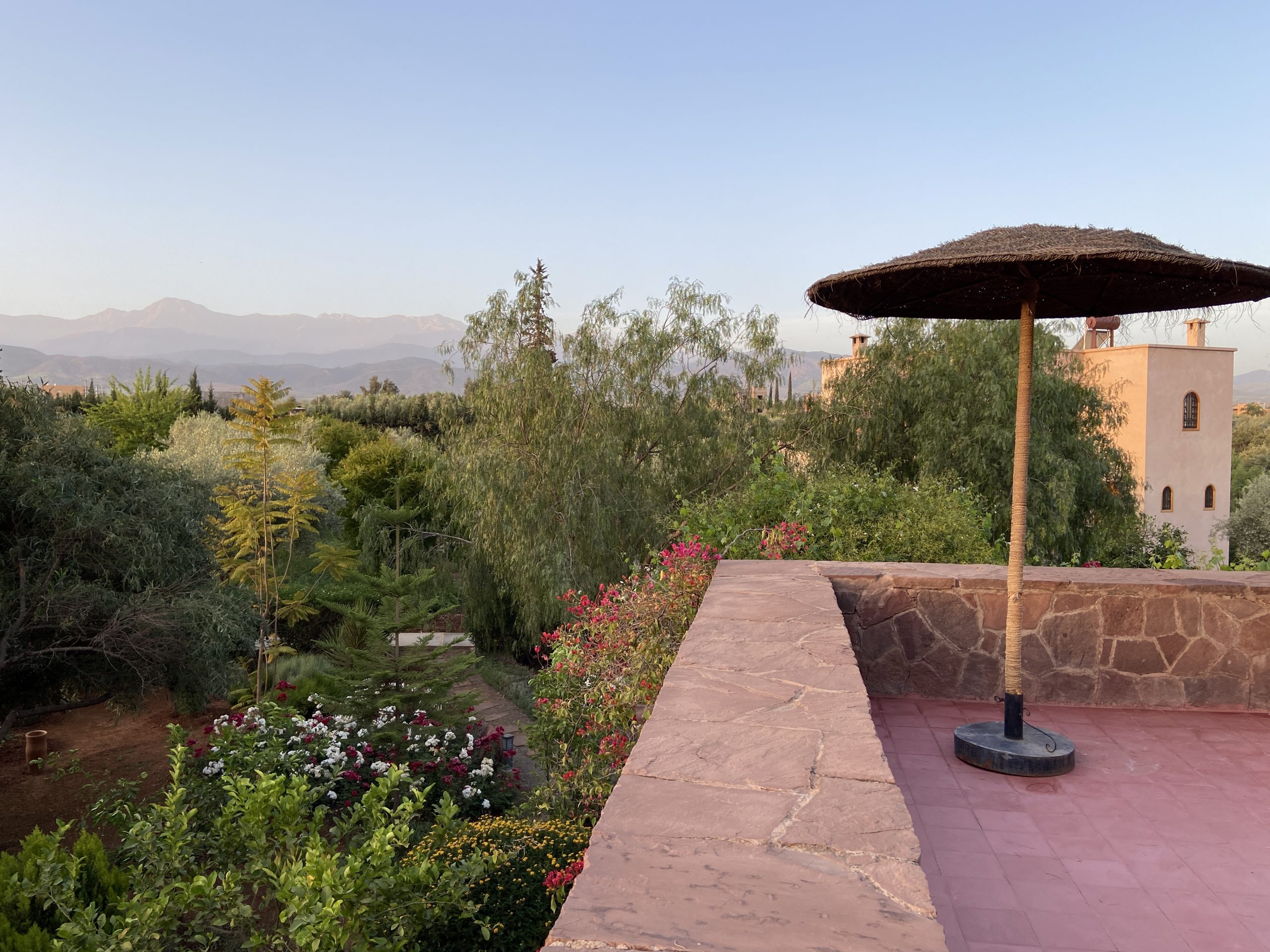
Every May, I return to Bab-Zounia, near Marrakesh, Morocco, for a one-week retreat.
Bab Zouina (the door of beauty) is the vision of Karim Zein. Karim has built this place with his own two hands and made it a little heaven. Karim has a rare and precious blend of the hospitality of the East and the efficiency and precision of the West (especially of Switzerland, where he lived for many years). He catered to all our needs promptly and solved every problem that arose.
Every morning we woke up to the sound of the birds’ chirps and the peacock’s calls and climbed to the roof to practice meditation and Pranayama in the open air, and after a short break with herbal tea and local dried fruits (these were available 24 hours a day), we started 2.5 hours of Asana practice. Luckily, one of the participants was of Indian origin, and she also taught us Vedic Mantras. So the practice included chanting and a discussion of yoga philosophy (which guided the following Asana practice).
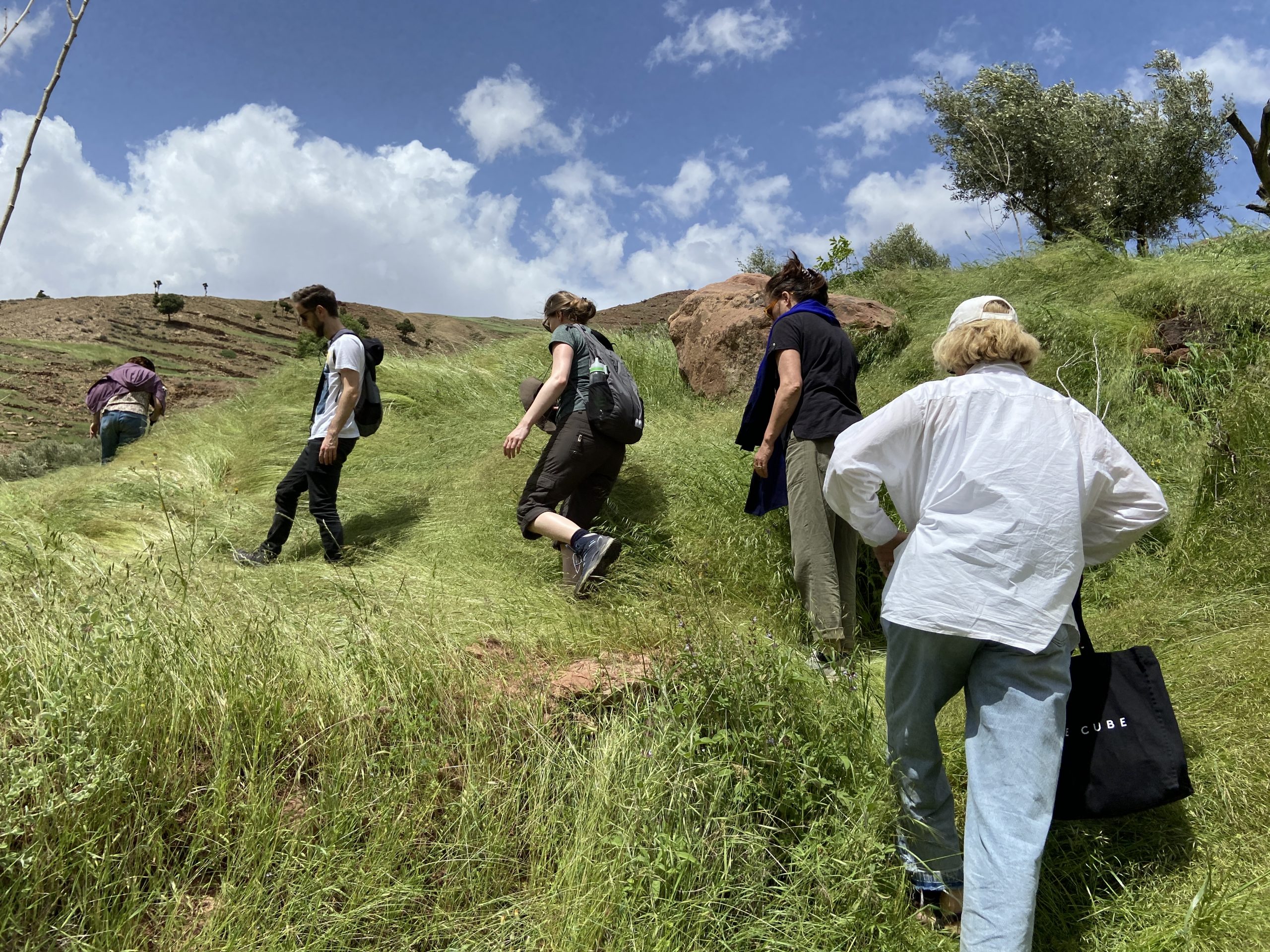
A rich, vegetarian breakfast (or rather, brunch) was waiting for us on the roof and was served with smiles by the very kind and nice local staff. At noon, we went to explore Morocco either on a half-day excursion to the mighty Atlas Mountains, or to the nearby city of Marrakesh, or had leisure time in the local swimming pool, the Hamam, or in a full-body massage.
Refreshed, we started the afternoon practice, which was followed by a dinner on the roof (luckily we were able to see the rising of the full moon!).
And the good news! We have an offer for next year! See details here.
Here are the impressions of some of the participants:
I recently returned from a yoga retreat in Morocco with Eyal Shifroni at the beautiful Bab Zouina, and it was an exceptional experience. From the start, everything was thoughtfully organized. Bab Zouina is a stunning setting, and Karim, the owner, went above and beyond to ensure every detail was seamless and comfortable.
Eyal’s teaching was the heart of the retreat. As a world-renowned teacher, he brings incredible depth, creativity, and clarity to his work, yet remains truly approachable and humble. He has a rare ability to meet each person exactly where they are, making the practice both accessible and challenging at the same time. His thoughtful guidance created a strong sense of individual support within the group.
The vegan food was fresh, nourishing, and beautifully prepared. Brunches were enjoyed on the rooftop in the warm Moroccan sun, while evening meals were shared indoors around traditional Moroccan tables, sitting on the floor, creating a cozy and authentic atmosphere. The sauna and traditional hammam offered a perfect way to relax and restore, and in the evenings, the warmth of the room fireplaces added an extra layer of comfort and calm.
The balance between practice, rest, and connection was ideal, creating a truly supportive and inspiring atmosphere. I left feeling refreshed, clear, and deeply reconnected.
I would wholeheartedly recommend this retreat, and would happily return again.
Malka Nowitz, Israel, May 2026
This Yoga Retreat was unlike anything I had ever experienced before; it had a profound effect on me as I found an inspiring Teacher.
The compassionate leadership of Eyal was the vital element of this Retreat as it flowed through all of us and set the tone for the whole week. Eyal, his wife, and senior teachers made a strong team who spread their love and kindness to all. Eyal’s unique approach combined clarity, precision, humor, openness, and gentle encouragement. Each one of us felt challenged and inspired in a safe and secure setting. I was particularly impressed by Eyal’s knowledge and teaching of the use of props.
Every detail was well taken care of in our small paradise, Bab Zoiuna, which is owned by Karim and Helene. The staff was helpful and attentive, and nothing was too much for them. Karim organized delicious, nutritious meals, and nature hikes where we did walking meditation, fascinating sightseeing, and visits to the local markets and interesting museums. Karim, the host, created a warm and welcoming home for all. It felt like we were visiting old friends.
We made strong bonds and felt a part of a loving Yoga family. I can’t wait to return for the next retreat!
Sonali Sibal, England
Thanks, Eyal, for an amazing retreat at Bab Zoiuna. What an incredible place to practice yoga. I loved the views of the snow-capped mountains, watching the moon rise and the sunset, immersed in the sounds of nature. Meals were delicious and varied, the group was so friendly, and to top it all, your wonderful, inspiring teaching of asana, pranayama, meditation, chanting and philosophy.
What a treat to have a massage, hammam, camel ride, walk in the mountains, visit local gardens, and listen to the Berbers chanting and drumming around the firepit.
It was such a rich experience in all ways, a real feast for the senses, body, mind and soul. I feel very relaxed and recharged. Can’t wait to return next year
Di Sage, England
I want to thank you very much and tell you about the way I experienced your yoga teaching, guidance and support after you encouraged me to overcome my hesitation and join this retreat.
The atmosphere of accepting everybody at so different levels of physical and spiritual depth gave every one of us an opportunity to grow, leaving comparing and competing behind, directing us with your wise words and gentle touch, which made me feel welcomed (even though I don’t know the names of the asanas ) and wanting to participate in all the many hours we met.
It was so amazing for me to not feel any tiredness but rather look forward to the next session! One special moment for me was practicing Salamba Sarvangasana: I forgot to place the belt and felt more tired than an uplifting spirit. You “passed” by, replaced the missing belt with your legs, gripped my ankles, and lifted me into the “unbearable lightness of being”.
Shepherd is a site that contains recommendations about books about a variety of domains. The recommendations are given by experts that wrote books in a certain field; each such expert recommends five books in a very concise format (in return, Shepherd advertises one of the expert’s books). I was asked by this site to recommend books in my field of expertise – (guess what is it…) – yoga.
Selecting five books about yoga was a really hard task since I had to leave out many books I like. I am a student and teacher at the Iyengar school, hence I included two B.K.S. Iyengar’s books – they are the two that made the largest impact on my life and gave me so much guidance and inspiration. I included a commentary on the Yoga Sutras since I think that philosophy is an essential part of the study of yoga. In addition to yoga, I study and practice Buddhism and this adds a deep dimension to my life, so I included two inspiring books by Buddhist teachers.
In this post, I share recommended resources that I find on the net that are useful for the yoga student, from the classic ‘Yoga Sutras of Patanjali’ to modern videos and articles.
Philosophy & Research on Yoga
Videos
Prof. Edwin Bryant is a yoga practitioner and a scholar who studies the yoga sutras. Here is a recommended talk and an interview:
Sat Bir S. Khalsa, Ph.D. is a yogi and a researcher who conducts studies about the physical and mental effects of yoga, here are three recommended video talks he posted on YouTube:
Iyengar Yoga can help tremendously to recover from addictions. This movie contains interviews with practitioners who recovered from addiction using yoga, and this is an article from Boca Recovery Center about it.
Light on Yoga: The Classic Guide, by B.K.S. Iyengar
Light on Yoga is a definitive guide about Yoga, a rigorous discipline for attaining physical, mental, and spiritual well-being. It is aimed at beginners as well as advanced practitioners of Yoga.
Yoga: The Path to Holistic Health, by B.K.S. Iyengar
B.K.S. Iyengar Yoga: The Path to Holistic Health covers the complete teachings of BKS Iyengar for mind, body, and health, and is suitable for every level of yoga ability, age, and physical condition.
This authoritative and practical guide is an indispensable tool to the art and techniques of yogic breathing, for beginners and experienced yoga teachers alike.
In The Tree of Yoga, Iyengar offers his thoughts on many practical and philosophical subjects including family life, love and sexuality, health and the healing arts, meditation, death, and Patañjali’s Yoga Sutras.
The Heart of Yoga: Developing a Personal Practice, by T.K.V. Desikachar
The first yoga text to outline a step-by-step sequence for developing a complete practice according to Viniyoga–Yoga adapted to the needs of the individual.
Health, Healing, and Beyond: Yoga and the Living Tradition of T. Krishnamacharya, by T.K.V. Desikachar & Cravens
The much-sought-after, greatly beloved exploration of the work of Krishnamacharya, teacher of many of twentieth-century yoga’s greatest and most influential exponents, Health, Healing, and Beyond is filled with deep wisdom―an indispensable guide to the philosophy, principles, and limitless possibilities of yoga.
From breathing to inversions to standing poses, see how specific muscles respond to the movements of the joints; how alterations of a pose can enhance or reduce effectiveness; and how the spine, breathing, and body position are all fundamentally linked.
Yoga and Scoliosis: A Journey to Health and Healing, by Marcia Monroe
Yoga and Scoliosis: A Journey to Health and Healing is a deeply soothing form of moving meditation and physical activity. It is a safe way to rebuild strength, stamina, and flexibility, and to address the spinal curvature of scoliosis without surgery.
The Key Poses of Yoga: Scientific Keys, Volume II, by Ray Long
This book offers a scientific approach to understanding the practice of hatha yoga. Through four-color, three-dimensional illustrations of major muscles, tendons, and ligaments, Ray Long describes the practice and benefits of hatha yoga.
The Woman’s Yoga Book: Asana and Pranayama for all Phases of the Menstrual Cycle, by Bobby Clennell
Senior Iyengar Yoga teacher Bobby Clennell brings decades of yoga study and teaching experience to The Woman’s Yoga Book. She offers a comprehensive program of asana (yoga poses) and pranayama (breathing exercises) designed to support menstrual health from menarche to menopause, along with nutritional and lifestyle information for those times off the yoga mat.
Yoga for Breast Care: What Every Woman Needs to Know(Yoga Shorts), Bobby Clennell
In Yoga for Breast Care, senior yoga teacher Bobby Clennell offers a comprehensive program of asana (yoga poses) and pranayama (breathing techniques) designed to support breast health.
Written almost two millennia ago, Patañjali’s work focuses on how to attain the direct experience and realization of the Purusa: the innermost individual self, or soul.
This is the first part out of three in the series of articles about the cultural background of yoga. See the second part and the third part.
Introduction
This is the first, in a sequence of three articles about the historical and cultural background of yoga. In this part, we start from the early period and trace the sacred texts of the Vedas and the transition from the Vedas to the Upanishads.
The Sanskrit Culture
The first translation of the Bhagavad Gita to English was completed in 1785; this translation precipitated an interest in Sanskrit in Europe. It led to philologic research where a great similarity was found between Sanskrit and European languages such as Greek, Latin, and the Slavic languages. The researchers concluded that there is one source for all these languages and that is the ancient unwritten language called Aryan, named after the Aryan tribes that invaded India at the end of the second millennium BCE. The word Aryan means ‘noble’ (a term that the Nazis, as is well known, had adopted and distorted, but that is a different story). These tribes brought with them texts called Veda – collections of knowledge.
Sanskrit culture had developed in India uninterruptedly for over 3000 years. During this time an enormous literary corpus was written, starting with the Vedic hymns, through the Upanishads, the great epic compositions of the Mahabharata and Ramayana, philosophy schools such as Samkhya, Yoga, Vedanta, Laws of Manu, Panini’s grammar, lyrical compositions, scientific literature, and many works of literary drama. This is mainly poetic and romantic literature of contemplation and wisdom.
The Vedas include the widely known prayer Gāyatrī which had been uttered by millions of Hindus every morning for more than 3000 years, and still is in our days.
We meditate on the glory of that Being who has produced this universe; may She enlighten our minds
Translation by Swami Vivekananda
Hellenistic Greece and India present two complementary perspectives of the world; in the Greek temple, we find geometric harmony, an aesthetic of proportions and straight lines – the beauty of the external world. An Indian temple on the other hand looks like a maze of rooms, passageways, and alcoves whose structure is much more complex and whose aesthetic has an inner meaning – the beauty of the inner world.
The central ideal of Indian philosophy is the idea of liberation. While in the west our tendency is to improve our lives by changing reality and improving our conditions of life, in India, the inclination is much more introverted and passive. The belief in India is that one cannot change reality and liberation is achieved by internal change where one experiences the same reality but in a different manner. Or, as Shantideva put it: “it’s easier to put on your shoes than to cover the entire earth with leather”.
What are the Vedas?
The Vedas are four collections of ancient hymns in Sanskrit, comprising the sacred Hindi texts. Tradition views the Vedas as an eternal creation whose source is divine. Researchers are of the opinion that the work has been consolidated in the 2nd millennium BCE, in other words, at least 3000 years ago. The Vedas were not authored by one person and not in a single generation. They were created before there was written language and were verbally transmitted through generations.
It is one of the most ancient documents of human culture in general. The spiritual heroes of the Vedas are not of the priestly sect (even though they were of noble rank in society). They were the saints and seers (Rishis) who saw the spiritual truth through the smokescreen of reality.
They were enlightened saints whose wisdom was expressed in poetry in the most symbolic language, the Vedic hymns. The seers bring the vision of sheer reality to the everyday person in a lyrical language. The Rig Veda, the most important and ancient of the Vedas, comprises 1028 hymns consisting of 10,600 verses.
The author of the Vedas observes nature with joy, adoration, admiration, and gratitude. He feels that the forces of nature; fire, the rivers, air, are life forces and he offers them the sacrificial fire. Man is dependent upon nature and feels a part of it, he loves nature and feels nature loves him in return. (For example, the hymn to Varuna in the Rig Veda, see p. 11-12 in: Bhagavad-Gita, by J. Mascaro)
Since the Vedas were created by seers of colossal spiritual stature, they should be seen as ancient evidence of the spiritual potential of man. Sri Aurobindo, who himself was a seer-poet in modern India, wrote that the Vedas contain the high spiritual essence of the Upanishads sans the intellectual-philosophic language and terminology of the Upanishads. The language of the Vedas is a language of poets for whom experience is palpable, vital, and tangible and not the language of intellectuals for whom the realities of the mind and soul have become an abstraction.
The Vedas include hymns dedicated to various gods. They consist of detailed accounts of gods who are characterized in accordance with a specific role – fire, water, air, earth, war, weather, etc. The Vedic hymns are not an independent element but were part of a complex and very intricate process central to which was a sacrificial ritual performed by the priests’ sect, the Brahmins. The ritual is complex and is highly detailed but essentially the concept is that the gods cannot freely choose whether to reject or accept the sacrifice. This approach is different from the concept of sacrifice in the Judeo-Christian tradition (i.e., see the story of Cain and Abel). According to the Vedas if an offering is made properly and according to all the ceremonial rules, then the god must respond to the request for which the sacrifice was made.
It is an optimistic perception of nature and the universe where man, to a certain extent, is controlling the gods. The word Rita refers to a general law found in the Vedas. Everything and everyone are subject to this universal law, including the gods.
In fact, the role of the gods in the Vedas is different from the role we are familiar with. The belief is in the Vedas, the holy scripture that existed from the moment of time’s existence and will continue to endure as long as time is a reality. They were not given by a certain entity and therefore their validity is intrinsic and not extrinsic. For instance, according to the Mīmāṃsā tradition that devoutly follows the Vedas, the gods have no special status; in effect, it is a godless religion, an atheistic religion.
The late Vedas and the Upanishads
The transition to the late Vedas presents a change in means, not in aim. The late Vedas present a divinity that is impersonal but singular, and yet the offering to this god is made in order to control the world. The offering becomes more abstract but the goal remains practical. The late Vedas show a nascent spiritual outlook and a philosophical recognition that human advancement requires doubt and belief simultaneously. In the Upanishads, these sprouting thoughts develop and reach full bloom.
The Upanishads present a more radical change – a change of goal. The concept of Moksha or liberation appears there. Liberation is perceived not as controlling the world or changing it but as an internal change allowing a different perception of reality. Meaning, that there is a shift from a desire to control the world of phenomena into an attempt to break free of them through changing the perception of reality.
The literal meaning of the word Upanishad is “a sitting down beside”. The Upanishads are ‘secret forest scrolls’. These scrolls seal the Vedas and therefore they are called Ved-anta (the end of Veda) or Vedanta. As with the Vedas, the formulation of the Upanishads was also a lengthy process. In the beginning, they were verbally transmitted and it is generally thought that they were created in the first half of the first millennium BCE. There are 112 Upanishads, 18 of which are important. Tradition recognizes 13 of those as ancient and especially sacred. The two longest and central in their importance are the Brihadaranyaka Upanishad and Chandogya Upanishad, each about 100 pages in length. In spite of its importance, the Isha Upanishad is short and consists of only 18 verses.
The Upanishads encompass a variety of styles, some in poetry but many in prose. Their subject matters vary greatly and are occasionally contained within a meta-story. There is a famous story about a father who sent his son to study the Vedas: The son returned proudly after 12 years of study but when inquired by his father it turned out the studies did not provide him with actual knowledge nor answers to the core problems. This story demonstrates that the views of the Vedas are not valued much by the author.
The development observed in the Upanishads is a movement from extrinsic nature and into the nature of man and from the many to the singular. Man’s big questions are answered by two words: Atman and Brahman. These are two names for truth; the truth of the universe is Brahman and the intrinsic truth is Atman. The Upanishads assert that Atman and Brahman are the same and that AUM is the name for both of them.
What is Brahman?
It is indescribable, it is beyond thought and imagination. It is not something the human mind can perceive or comprehend. The closest idea of Brahman we can grasp is a timeless state of consciousness (with no past, present, or future which are human concepts), a state of Sat Cit Ananda, that is to say, a state where existence (or the truth – Sat), universal consciousness (Cit) and divine bliss (Ananda) are one. One could say that Brahman is the state of being that is at the core of all of reality. The definitions of Brahman found in the Upanishads are negative in nature, that is they cannot be defined positively. Brahman is Neti Neti, meaning ‘neither this nor that. There are also paradoxical definitions, for example, that the Brahman is the smallest as well as the largest thing, that it is everywhere and nowhere, etc. Another type of definition is presented in the story about a teacher who just keeps silent when asked “What is Brahman?”
According to Georg Feuerstein, the essence of the Upanishads revolves around four conceptually connected axes:
The absolute reality of the universe is completely identical to the innermost nature of man, that is, Atman is Brahman, or, the self is identical to the core experience of the All. This is expressed in the Upanishads with the mantra Tat Tvam Asi – You Are That.
The concept of liberation: Only the realization of Brahman/Atman liberates humans from the suffering of the cycle of death and rebirth.
Karma: The thoughts and actions of humans determine their fate, that is the law of Karma. You become what you identify with.
Samsara: A person who is not liberated by the realization of their true nature as a result of divine knowledge (Jnana) is destined to be reborn in either the kingdom of gods, humans, or demons according to their karma.
These are new concepts that do not explicitly appear in the Vedas and from this point onwards characterize the entire Hindu culture (as well as the Buddhist and Jainist cultures that emerged from it). The Mandukya is the shortest Upanishad and it deals with the paradox of the Brahman. It describes four states of consciousness: Waking, Dreaming, Deep Dreamless Sleep and the fourth state is Atman in its purest form. Later in the text, there is an analogy between Atman and the sacred sound AUM. The three sounds of AUM: A, U, M correspond to the three states of consciousness and the word AUM itself as a single sound is the fourth state.
The problem of moral behavior is solved by the Upanishads by perceiving the essence of the Atman, our pure self, as perfect bliss – Ananda. The blessing derives directly from maintaining virtue. Spinoza says:
As mentioned, the essence of the Upanishads is summarized in the words: Tat Tvam Asi, You Are That, or You Are the Essence. The joy of our true essence is always with us but we do not recognize it. We are like the beggar who begged his entire life over a treasure of gold, not knowing the gold is buried right underneath him.
True self-knowledge is the salvation and the antidote for suffering, but it is neither intellectual nor poetic knowledge. It must be knowledge acquired by direct experience. The change that occurred with the Brahmins is the transition from the Vedic world, where the village, the Dharma (order, natural law), family, and offerings are at its center, to an ideal that exceeds this world, the ideal of the Moksha (liberation). This other world, both physically and metaphorically, is the world of the forest. This is where new insights were formulated, the primary of which is the knowledge of the Atma or Atman (pure Self). This is an experience or a personal psychological reality born of introspection. The Atman exists even though it has no concrete expression. The Upanishads recount the famous allegory that likens the Atman to salt diffused in water. It is not apparent but its presence is prominent. This knowing or experience presents a different worldview, that of liberation (Moksha), and it is described as the fourth purpose of life (the others are Kama – lust, the drive for erotic pleasure and reproduction, Artha – the pursuit of material gain and Dharma – the social order).
In the Vedas the offering was material and the brahmins sect systematized the sacrifice rituals to such an extent that the spiritual essence was nearly completely lost. However, there is a human tendency to move from the material to the spiritual. The Vedic idea of sacrifice has gone through refinement and an internalization process. The ascetics (sannyasins) who relinquished material life and the social order had brought up other ideals that are expressed in the Bhagavad Gita.
The three paths to the divine are: transcending thinking through deep thought (Prajña), action and service (Karma), and devotion and love (Bhakti). In the Bhagavad Gita the path of Karma (action), is interwoven with the idea of Bhakti (Love). Love is the mean which illuminates our life and unites the finite with the infinite. This important opus will be the topic of the next article in this sequence.
I have always been attracted to yoga and the wonderful stories about the yogis. When I was in fourth grade and we were learning about India, I taught myself to stand on my head with my legs crossed in the lotus position. During my (compulsory) military service I came across the book Yoga and Health by Yesudian and Elisabeth Haich – one of the first books on yoga to be translated into Hebrew. I started practicing according to the pictures in the book. Later, in 1978, while I was a student in Jerusalem, I started to formally study yoga. At the same time, I developed an academic career, completed a degree in mathematics and a Ph.D. in Computer Science, and worked as a software engineer at Intel. However, my great love was and remains to be – yoga, and this love made me deviate from the otherwise ‘normal’ course of my life and devote more and more time and energy to my path in yoga: to practice, study, and teaching yoga. About 15 years back, I decided to quit completely from computer science, and since then I am a full-time yogi – I never regretted this decision.
My Path in Yoga – Eyal Shifroni
I was exposed to yoga in the Shivananda method. I will never forget the first class I took – I felt something I knew would change my life. I simply knew, without any doubt or hesitation, that this is what I want to do in life. This was toward the end of the first year of my university studies, and during the summer vacation, I worked away from Jerusalem. But it was clear to me that when I return to Jerusalem, I would return to my yoga Sadhana, with great devotion and enthusiasm. I was lucky to come upon teachers that conveyed the spirit of yoga in their personality and teaching. I felt that practicing yoga was like remembering something I knew and forgot. The poses were not really new to me (although I did not really know them) – I just had to re-remember them… At first, it was my own practice that was most important to me, but later I realized that without sharing this gift with others, my path in yoga would not be complete, so I turned to teach as well.
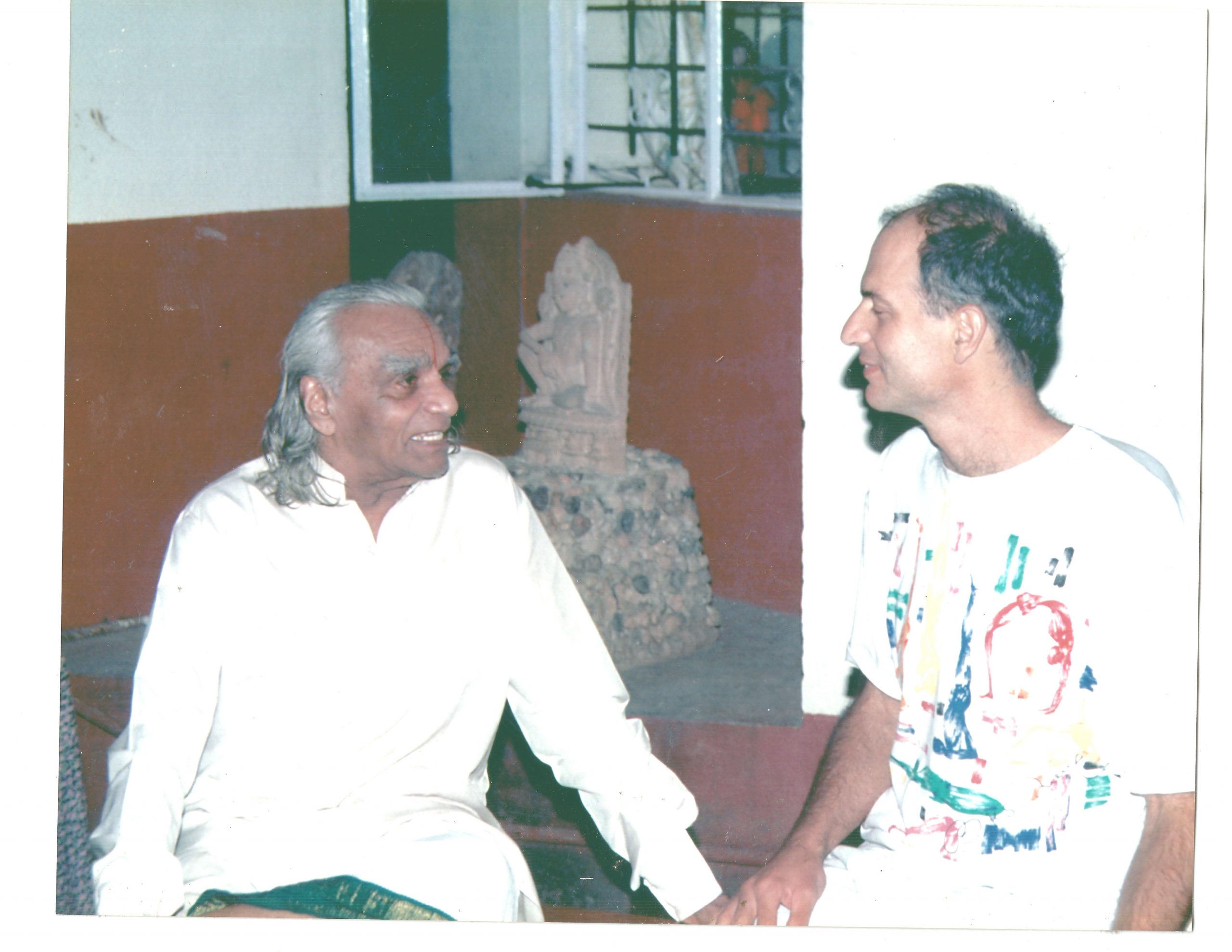
In 1982 I participated in a month-long Shivananda teachers training. In this course, I first heard the name ‘Iyengar’ and someone mentioned that there is a teacher of that method in Jerusalem. As soon as I started to study the Iyengar method, I realized its great benefits. In 1988 I first traveled to the Iyengar Institute (RIMYI), in Pune, India, to learn the method directly from B. K. S. Iyengar, who became my Guru. Since then, I have traveled many times to Pune, to study with Iyengar, his son Prashant and his daughter, Geeta.
B. K. S. Iyengar with Eyal Shifroni
Incidentally, I visited Pune in 2014 when Iyengar passed away and was able to pay my respects and deep gratitude to my Guruji. The cremation ceremony was very touching. Following his departure, the Iyengar method continues to live and develop under the guidance of his son and his granddaughter – Abhijata.
My practice has not changed much over the years. I enjoy practicing outdoors, in nature, especially on the beach, which is close to my home. As I get older these days, I tend to do less dynamic practice, and I like to stay in asanas for a longer time. The inversed asanas (Sirsasana, Sarvangasana, etc) are very important for me, and I spend longer time daily in these asanas. I also devote more time to the practice of Pranayama and meditation.
Eyal Shifroni, practicing at the beach
I have been teaching the Iyengar method for over 30 years and trained new generations of yoga teachers in this unique method. I regularly conduct yoga workshops in Israel and around the world. I write articles and books about yoga. For many years I was active in the Iyengar Yoga Association of Israel and took part in the teacher certification process. I continue to study yoga every day, and write articles on yoga. I wrote 6 books about the practice of yoga and the 7th (Yoga in Nature) is to be published soon. I have also translated the books: The Tree of Yoga and Light on Pranayama of B.K.S. Iyengar into Hebrew.
I love practicing yoga and have been doing it for over forty years. Every morning around 6 am, I start my daily yoga practice; When I have time, I may continue to practice until 9 or more. These are the most precious hours for me. At the end of the practice, regardless of the mental state in which I have started it, I always feel peace and harmony. In my heart, I express my deep gratitude to this ancient tradition and thank the yoga teachers from whom I learned this art which brought so much light to my life.
I believe that yoga practice and teaching should be done out of love for the subject. Every practice or class is an opportunity to learn and create something new. The quality of the class depends upon the quality of the encounter between the teacher and the students. When there is a real connection there is yoga (the word “yoga” means to unite or to connect), and then the class becomes a deep and enriching experience for both the students and the teacher. I feel that the practice of yoga is special, when it is done with awareness, mindfulness, and investigation, it always takes one to the depth of one’s mind and heart. It allows us to welcome the inevitable changes of life, and to meet the vicissitudes of life with greater balance and equanimity. I have experienced over the years a very positive change, improved wellbeing, stable health, more intellectual clarity and emotional stability, and above all, more joy, peace, and love.
As rational and practical people we invest efforts and resources (time, money, and so on) in things that will bear some fruit. This is absolutely reasonable! Why should we invest in something we have no faith in. This applies also to the field of yoga, we are practicing because we believe, consciously or not, that there will be some fruit from this practice. However, we usually don’t bother, or even think it’s appropriate to state our goals in yoga practice. We tend to feel that defining goals is somehow against the spirit of yoga. I argue here, that having explicit goals is very important to our progress in yoga, and discuss the pros and cons of this matter.
Contemplating Goals
I think it’s very important to explore and contemplate the following questions:
Do I have goals in my yoga practice and studies?
If so, what are these goals?
Are these goals aligned with the goals set out in the tradition of yoga?
Contemplating on these issues regularly and trying to come up with answers can orient our practice and align it with the goals set out by the ancient yogis.
While contemplating these questions, it’s also interesting to reflect upon another issue:
What is my reaction to this kind of contemplation? What comes up in my mind when I think about the goals of my practice?
The tradition of yoga defines quite clearly several goals. Yoga is aimed to remove the delusion (avidya) about the nature of reality, in order to decrease, and eliminate our dukkha (existential suffering). More practically, the Yoga Sutras of Patanjali defines yoga as the restraint or cessation (nirodha) of the mental modification and reaction (vrittis). The Bhagavad Gita defines yoga as evenness of mind or equanimity (smatvam, see II.48) and also as skillful action (karmasu kaushalam, see II.50). These definitions give us guidelines to determine whether our practice is in the lines of the tradition we consider ourselves to be part of. Once you define your personal goals in your practice, you should consider if these goals are compatible with the above goals, set out by these texts.
For example, if your goal is to be able to bring your leg over your head (in Eka Pada Sirsasana), or to do any other physical feat, then these are not exactly what the great sages and teachers of yoga had in mind. Not that such goals are bad in themselves, but if this is all you aspire to accomplish in your practice, then it’s not exactly yoga that you are doing. Gymnastics and acrobatics have their role and value (as long as you don’t scarify your health in order to impress or compete), but yoga has a much wider scope and range.
Patanjali clearly addresses the subject of goals in his yoga sutras. One of the obstacles that Patanjali mentions in Sutra I.30 is the non-attainment of a yogic state or the non-attainment of the goal of yoga (alabdha-bhumikatva). We can therefore see that the concept of goals is relevant, and the inability to attain them is considered an impediment.
Reacting to Setting Up Goals in Yoga Practice
Now I come to the last question: how do you react to the idea of setting up a goal to your yogic path? You may find this talk about goals stressful and even un-yogi, because a yogi isn’t supposed to be attached to goals. However, setting up a goal doesn’t mean that we need to be attached to its achievement. Orienting your practice toward a goal doesn’t mean you need to cling to the fruit.
Usually, in our practice we are obsessed with what we can or can’t do: ‘I can do this asana!’; ‘She can do it, but I’ll never be able to’, and so on. We have a judging and comparing mental state. We think in terms of success and failure. We are constantly occupied with evaluating ‘how good we are’, and ‘how well we do’ in relation to others. This attachment to succeeding and aversion to failure stems from our ego. We can have a goal and work toward it without being attached to its achievement.
We don’t need to feel bad or to see ourselves as failures if we don’t reach the goal. We can evaluate our progress without unnecessary emotional reactions. We should also remember that the path is long, and there will always be inevitable ups and downs on the way. But there are many benefits from just walking on the path. It is already an achievement to walk on the path; to come back daily to our mat and practice! And there are many small achievements that we get every day when we practice. We can find joy in them, without clinging to success and without constantly judging and measuring ourselves.
To provide the best experiences, we use technologies like cookies to store and/or access device information. Consenting to these technologies will allow us to process data such as browsing behavior or unique IDs on this site. Not consenting or withdrawing consent, may adversely affect certain features and functions.
Functional Always active
The technical storage or access is strictly necessary for the legitimate purpose of enabling the use of a specific service explicitly requested by the subscriber or user, or for the sole purpose of carrying out the transmission of a communication over an electronic communications network.
Preferences
The technical storage or access is necessary for the legitimate purpose of storing preferences that are not requested by the subscriber or user.
Statistics
The technical storage or access that is used exclusively for statistical purposes.The technical storage or access that is used exclusively for anonymous statistical purposes. Without a subpoena, voluntary compliance on the part of your Internet Service Provider, or additional records from a third party, information stored or retrieved for this purpose alone cannot usually be used to identify you.
Marketing
The technical storage or access is required to create user profiles to send advertising, or to track the user on a website or across several websites for similar marketing purposes.
 Skip to content