• How to Sit Correctly – About the Sitting Poses

    How to Sit Correctly – About the Sitting Poses

    Preface

    The book Props for Yoga II: Sitting Asanas and Forward Extensions includes detailed explanations on how to sit properly using props. Here I bring some excerpts from this book, as well as additions to it.

    The Sitting Poses

    (11) “He should sit in a clean place, his firm seat neither too high nor too low, covered with sacred grass, a deerskin and a cloth, one over the other.”

    (11) “He should sit in a clean place, his firm seat neither too high nor too low, covered with sacred grass, a deerskin and a cloth, one over the other.”

    (13) “Holding the body, head, and neck erect and still, looking fixedly at the tip of his nose, without looking around.”

    The Bhagavad Gita, Ch. 6 (from Radhakrishnan)

    These famous shlokas from the Bhagavad Gita describe how a Yogi should sit. Indeed, sitting is fundamental for yoga practice; we sit for meditation, we sit for practicing Pranayama and we sit for chanting OM at the beginning of every yoga class to prepare mentally for the practice and study. Sitting āsanas allow for long stays with stability, balance, and evenness. They help develop correct alignment, extension, and openness as well as concentration and mindfulness.

    The root of the word āsana in Sanskrit, as, means ‘sitting’ – so, in a sense, we should do all the other āsana – standing poses, forward bends, backward bends, twists, and so on – with the qualities of stability, comfort and balance that are characteristic of sitting.

    We should attempt to sit daily for at least 15 minutes, in order to center down, relax and meditate or practice Pranayama.

    The Main Sitting Poses

    There are many sitting poses, the main ones are listed in Light on Yoga by B.K.S. Iyengar.

    These are:

    • Daṇḍāsana (LOY, Pl. 77) – I abbreviate “Light on Yoga Plate” to “LOY Pl.”
    • Vajrāsana – when one sits on the heels – this is an easier version that prepares one for Virāsana
    • Virāsana (LOY, Pl. 89)
    • Baddha Koṇāsana (LOY, Pl. 102)
    • Sukhāsana or Svastikāsana – this is a simple crossed-leg sitting that prepares one for Padmāsana
    • Padmāsana (LOY, Pl. 104)
    • Siddhāsana (LOY, Pl. 84)
    • Gomukhāsana (LOY, Pl. 80)
    • Siṁhāsana I (LOY, Pl. 109)

    How to Sit

    Sitting is like coming home; returning to ourselves; when we sit properly, not only does the body sit, but also the mind joins in and sits with the body. With our center of gravity closer to Mother Earth, we become stable and quiet. In this relaxed, neutral state we can observe our tendencies: face our impatience, boredom, restlessness, agitation, etc. We can also follow our breath and enjoy being in the ‘here and now, savoring the present (gift) of being present at the present moment.

    In The Hero’s Contemplation, Pisano writes:

    The organs of action (arms and legs) are conditioned to ensure survival. In sitting āsana, the legs are reposed in different ways and learn to become quiet and free from the desire for movement linked to defense, aggression or escape.

    The Hero’s Contemplation, C. Pisano, p. 245

    This quote is equally true for the other organs of action (speech, elimination, and reproduction organs) which also become quiet in sitting.

    The Three Diaphragms

    Proper alignment in sitting means that if we drop an imaginary plumb from the crown of the head its line will go straight down through the center of the chest to the center of the perineum. In any sitting pose, we have to be aware of the positioning of the three diaphragms. The pelvic diaphragm (or pelvic floor), the thoracic (or respiratory) diaphragm, and the cervical (or vocal) diaphragm (which is referred to anatomically as the thoracic inlet).

    These diaphragms form the base of the three main spaces, or cavities of the body. The abdomen, the chest, and the throat. The thoracic diaphragm (which is often just called ‘the diaphragm’) separates the thoracic cavity containing the heart and lungs. From the abdominal cavity and performs an important function in respiration. The vocal diaphragm separates the thoracic cavity from the cervical region and performs an important function in voice generation through the vocal cords. In all sitting poses these three diaphragms should be vertically aligned over each other and be soft, wide, and released. We should sit in a way that expands those three cavities. The various supports used in the Iyengar method are meant to help us achieve this.

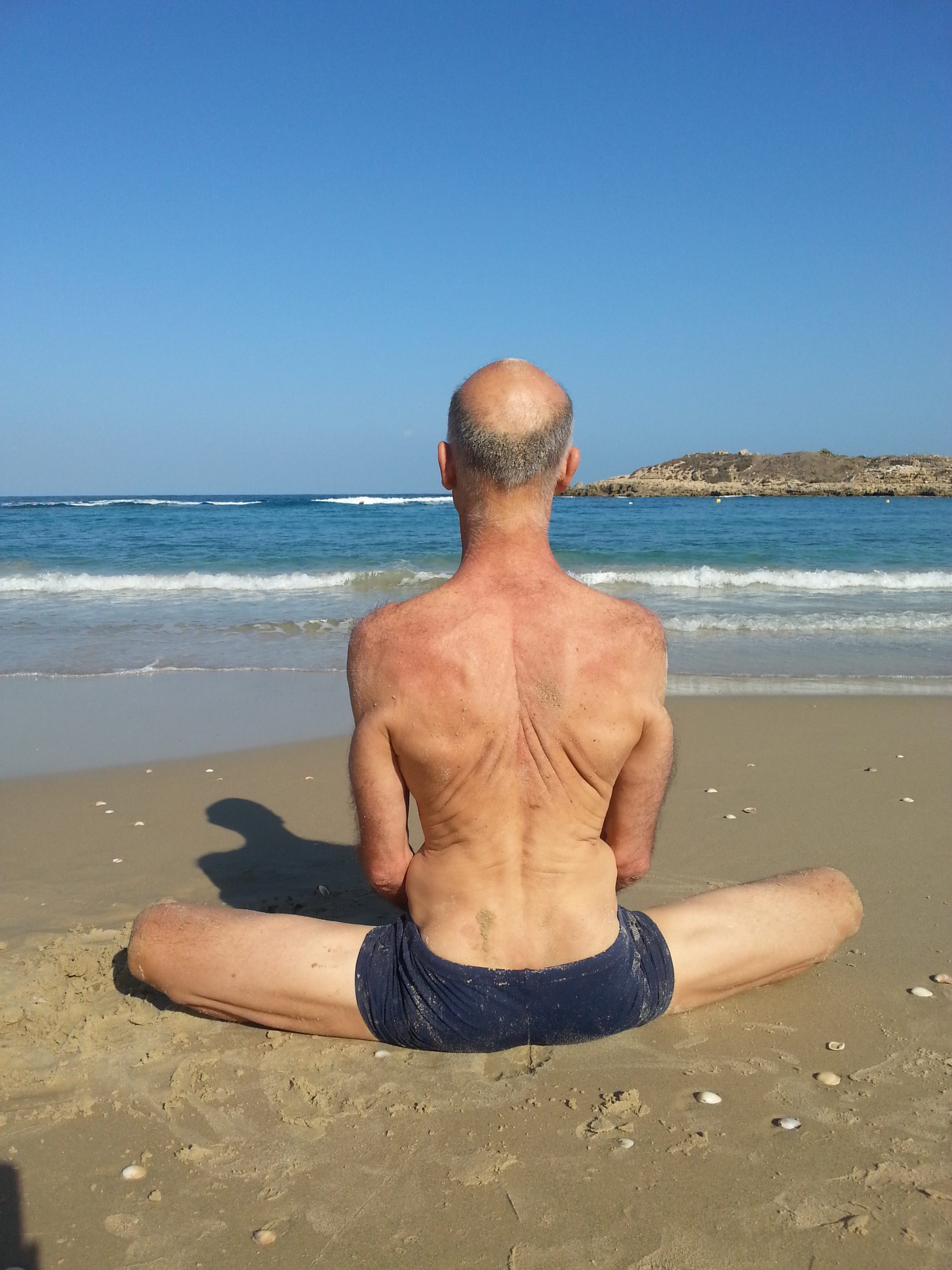
    Baddha Padmasana – a restrained lotus pose

    To ensure left to right alignment we should sit evenly on the two buttock bones (the ischial tuberosity) and extend evenly on both sides. From the pelvis extremities up to the armpits. To ensure front-to-back alignment we should sit on the heads of the buttock bones and lift both the sacrum and the pubic plates. Keeping them vertical and parallel to each other.

    A proper base allows the abdomen and lungs to lengthen, widen and soften. The respiratory diaphragm can then move freely and breathing becomes rhythmic and smooth. Correct sitting will bring about a sense of symmetry, stability, harmony, and poise.

    How to Develop the Capacity to Sit Correctly

    Correct sitting requires flexibility in the joints of the legs (ankles, knees, and hips) and a strong and stable spine. When there is tightness in these places, it is difficult to lift the spine. People with short hamstrings and stiff back groins find it impossible to sit correctly on the floor. These people must sit on higher support in order to sit erect. You will need to raise your seat if you sit on the back of the buttock bones and you cannot lift the spine from the sacrum.

    For many people, achieving comfort in sitting āsana is more challenging than performing standing āsana. When we stand, we can use our feet and legs to align the pelvic area and lift the trunk from the pelvic floor. But when we sit the legs cannot be used in the same way. The actions we need to do in order to extend and stabilize the spine are subtler and more intricate. We need to activate deeper layers of our torso muscles. This is developed as we mature in our practice. However, even beginners can sit for a few minutes. Over time – as flexibility, stability, and strength are developed, the duration of the sitting can be naturally extended.


  • The Historical and Cultural Background of Yoga – Part B

    This is the second part out of three in the series of articles about the cultural background of yoga. See the first part and the third. In this part, I will discuss The Bhagavad Gita and the Mahabharata.

    The Mahabharata

    The Bhagavad Gita is a part of the vast epic of the Mahabharata that originally stretches over a hundred thousand verses. This is the world’s longest literary work, its length greater than the Iliad and the Odyssey combined. The Mahabharata’s central storyline is about a conflict between two factions of a ruling family of the warrior’s sect (It’s recommended to watch Peter Brook’s movie that narrates the story of the Mahabharata). This story about the epic clash over the throne had already been familiar in a certain way in 1500 BCE. The sites of the events such as Hastinapura and Kurukshetra exist in northern India and to this day there are festivals being held there related to the mythic characters.

    It is generally thought that the epic was authored between the 4th century BCE and the 4th century CE. It is a blend of stories spanning eighteen volumes. The mythic author of the work is Vyasa. It is said in the Mahabharata that Vyasa dictated the epic to Ganesha, the elephant-headed God. The central storyline recounts the conflict between the five son of Pandu and their cousins that ended in a blood-soaked war.

    The Bhagavad Gita is an episode from the Mahabharata recounting the conversations of the God Krishna and the warrior Arjuna before the great war. This episode had gone to become a book in itself, considered one of the sacred books of India. So much so that some call it “the fifth Veda”.

    The Bhagavad Gita brings up questions that have occupied Indian philosophy in the past, and still do, chief of which is the question of Dharma or how one should lead their life. Is the material world the expression of all and death is the end of all or is there a purpose and a meaning to human life that goes beyond the world of matter? Another important question is about the relationship between God and man. While God is the master of creation and has the foresight of the unfolding of events, what part does man play? What is the meaning of his actions? What freedom of choice does he have?

    Further questions are about the relationship between the guru and the student and between the householder and the ascetic (sannyasin). The Bhagavad Gita offers answers to these questions.

    Scholars are debated as to the dating of the Bhagavad Gita but the attributes of the language and the fact it shows no reference to Buddhism indicate that it was written before the 6th century BCE. However, the value of the text is spiritual, and as such, it is independent of time, it is always in the here and now.

     The Bhagavad Gita recounts a war between the forces of light represented by the Pandavas and the forces of evil represented by the Kauravas.

    The father of Dhritarashtra and Pandu was the king of Hastinapura, a city located 80 km to the northeast of modern-day Delhi. When the king died Pandu inherited the throne since his older brother Dhritarashtra was blind. Pandu had five sons: Yudhishthira, Bhima, Arjuna, Nakula and Sahadeva.

    Dhritarashtra had 100 sons, the eldest of which was Duryodhana, the manifestation of evil. After Pandu’s passing, Dhritarashtra raised Pandu’s five sons in the palace alongside their cousins. They became great warriors and Dhritarashtra appointed his eldest son Duryodhana as the legitimate heir to the throne. This was the reason for the colossal conflict that led to the Great War.

    The Bhagavad Gita

    The Bhagavad Gita is presented as a double discourse. The narrator, Sanjaya, the charioteer of Dhritarashtra, reports to Dhritarashtra about the preparations for battle and the conversation taking place between Arjuna and Krishna who is the charioteer to Arjuna in the story. Most of the text consists of questions asked by Arjuna and the answers given by Krishna.

    The Bhagavad Gita, unlike the Yoga Sutras of Patanjali, is interested in action. Its main theme is how the yogi should act in the world, without being caught in attachment.

    A lot of symbolism can be seen in the text: The Mahabharata contains 18 books and the great battle where the armies of Duryodhana were defeated lasted 18 days. The Bhagavad Gita contains 18 chapters. It is likely that the war The Mahabharata chronicles are based on a historical event. It is difficult to ignore the symbolic aspect of the Bhagavad Gita. The forces of evil represent the evil kingdom, the evil urge, and the negative tendencies inside us. Will we allow these forces to win over the forces of light? Of course not. And yet, how easy it is not to fight back. How easy it is to find reasons and pretexts to avoid battle! How great are the temptations of the forces of evil!

    The symbolism of the chariot appears in many historical texts (The Upanishads, Plato, Buddha). The chariot where the dialogue takes place isn’t on the side of the forces of darkness nor is it on the side of the forces of light. It is in the middle and reflects the hesitation that opens the epic.

    Krishna himself uses descriptions of war metaphorically when he says at the end of chapter 2: “..smite O mighty armed (Arjuna), the enemy in the form of desire, so hard to get at.” (3.43), And again at the end of chapter 4: “Therefore having cut asunder with the sword of wisdom this doubt in thy heart that is born of ignorance, resort to yoga and stand up, O Bharata (Arjuna).” (4.42)

    The concept of Dharma

    The word dharma has roots in the Sanskrit dhr-, which means to hold or to support. The word Dharma has (at least) 6 translations:

    • Duty or Destiny. It is man’s duty to fulfill his Dharma.
    • Morals
    • Justice and ruling
    • Order
    • Law
    • Religion – here there’s an element of devotion

    The dharma is an umbrella of values enabling the world to exist. Every person holds a small umbrella and eventually protection is achieved. The dharma also applies to the world of inanimate nature, such as for example “the dharma of the sun is to shine”.

    The dharma, therefore, establishes the order in the world and from it also derives a division into Varnas of professions (not casts). The four main ones are Brahmins (including teachers, priests, intellectuals, and students), Kshatriyas (rulers, warriors, and administrators), Vaishyas (agriculturalists, merchants, and the free professions), Shudras (laborers and service providers/servants).

    The dharma, therefore, goes into daily life and determines the professional occupation of each person. It also determines the stages of life:

    • Brahmacārya – student, ascetic
    • Gṛhastha – householder
    • Vānprastha – forest dweller, partially renouncing worldly occupations.
    • Sannyāsa – fully renouncing worldly affairs, ascetic.

    In the Mahabharata there are many instances of gaps of violations of the dharma, creating conflicts that drive the story. The idea of Jati – being born into a Cast (Gandhi was against the Casts, but he did not object to the Varnas). The Varnas are determined according to the person’s nature and not necessarily at birth.

    In the Hebrew translation of the Bhagavad Gita, Itamar Theodore offers a model for understanding the text. It is a three-floor model as follows:

    1. First floor – the human realm – the world of dharma which itself is divided into different levels: standard utilitarianism, dharmic utilitarianism, and duty for its own sake.
    2. Second floor – the world of yoga
    3. Third floor – the liberated realm, Moksha

    Following is a presentation of the ontology and ethics for each of the floors:

    FloorOntology (the “existing”)Ethics
    DharmaPeopleMaterial and spiritual prosperity, an inclination to the good
    YogaThe dismantling of man into soul and matter. There is an eternal soulEquanimity (there is neither a preference for good nor evil)
    Moksha  
    The three floors model

    Western thinking seeks contrasting, dichotomy, and a dialectic process aimed at getting to the truth through elimination. The Indian/Yogi approach seeks a unifying viewpoint and sees polarity as an expression of a lower perception. The leap occurs upwards, into higher consciousness (or into a higher “floor”). This is a different ideal and a different process of achieving knowledge.

    In the post-modern world, with all its possibilities, the polarity-based approach becomes superficial and we lose grip on reality, we lose a stable anchor. This is why in Itamar Theodore’s opinion the yogic approach based on a climb of consciousness offers a great insight into the world.

    a person standing in front of a tree
    Bengali Ficus

    Hinduism can be likened to a Bengal Ficus. This tree grows aerial roots that, with time, turn into trunks. That is why there is a unifying conceptual framework without trampling over the particular and the uniqueness. Therefore, there is pluralism, localization, and multiculturalism.

    References

  • The Historical and Cultural Background of Yoga – Part C

    This is the third part out of three in the series of articles about the cultural background of yoga. See the first part and the second. In this part, we’ll discuss the three Gunas and the Bhagavad Gita.

    The Three Gunas

    Nature (Prakriti), that is, the world of matter, is described by the Samkhya and even by the tradition summarized by Patanjali in the Yoga Sutras as we saw in Part B of this series. The author of the Bhagavad Gita is bound by three aspects or foundational qualities: Tamas, Rajas, and Satva. This is an important contribution of the yoga tradition and the Samkhya to Indian philosophy. These qualities differ to the extent to which desire and consciousness are blended in with them and they incorporate a hierarchy. From low to high, from gross to pure.

    The Tamasic is the murky, the blind, the inert, the instinctive, and the passionate. Almost no organizing or restraining consciousness exists. The Rajasic is eager greediness, a desiring activity pursuing its own fruit. There is an organizing pattern and an ability to plan and restrain impulses for the sake of achieving complex goals. The Sattvic on the other hand is a state of quiet and clear awareness. It is attained by restraining activity and thinking motivated by desire. The Gunas are basic particles constituting the entire world of nature, perhaps similar to the elementary quantum of modern physics. It is important to keep in mind though, that Prakriti is much vaster than the field explored by the natural sciences and it also includes the human consciousness.

    According to the Samkhya and the Yoga Sutras, the yogi’s purpose is to achieve the sattvic state. When one achieves it, one’s sight becomes clear and he or she is not misled by illusions. Having said that, the sattvic quality is only a distillation of nature, the purifying of matter into a fine all-encompassing noble being. However, in the Bhagavad Gita, Krishna presents himself as being above the Gunas; a being that exists beyond the material world, with whom one can connect if one’s abandons all his illusions and selfish attachments. Furthermore, Krishna’s divinity exists in matter itself, it dwells in nature in countless forms and essences. There is nothing the divine is not a part of. Krishna is the sacrifice, the one who makes the offering and the consuming fire. He is the knowledge and the knower.

     Juan Mascaró in his book The Bhagavad Gita writes that a composer, like Beethoven, could have composed the story of the Gita. This could have been a wonderful symphony. In the beginning, there would have been sounds of a war about to break and of a desperate soul about to abandon the battle, tempted to quit the fulfillment of his Dharma. The soul fears death: the death of desires and lusts. It is also afraid of the death of the body. Then, in chapter two we would hear an eternal sound saying that in fact, we are all immortal.

    Then there is a call to action, an eternal action – Karma yoga – an act of selfless service, not for personal gain. This is followed by sounds of eternal silence, this is a vision of knowledge and wisdom – Jnana yoga. As a counterpart to these harmonies, a gentle sound of love emerges. The god receives an offering of love served with a pure heart – Bhakti yoga.

    Later (in chapter 11), the entire universe is revealed as God. This is an occasion full of awe and fear because the God that creates is also the one who destroys. The God of immortality is also the God of life and death. Then there is a vision of God as a man, as a friend to the struggling soul. And later melodies of light, fire, and darkness – the three Gunas, the three forces that drive the universe. At the end of the symphony, the melodies of the previous chapters are woven together into one. The melodies of seeing, labor, and love (Jnana, Karma, and Bhakti).

    The Gita expressed the idea that internal yoga is beyond the texts, the spiritual experience always comes before the written tradition:

    “When thy intelligence shall cross the turbidity of delusion, then shalt thou become indifferent to what has been heard and what is yet to be heard.
    When thy intelligence, which is bewildered by the Vedic texts, shall stand unshaken and stable in spirit (Samadhi) then shalt thou attain to insight (yoga)”. (2.52-53)

    The motto that goes through the entire epic as a thread is Dharma. That is the first word in the text and if we connect the first syllable in the text is ‘dhr’ with the last one, ‘ma’, we arrive at dharma. The 700 verses are therefore situated within the idea of Dharma – the duty, the work, the truth, the conscience.

    Karma Yoga

    The origin of the word Karma is in the root word Kri in Sanskrit. From which the word Kriya is also derived, and in English – creation. Karma Yoga is a sacred action. Just as every inhalation can be a merging with infinity and every exhalation – a letting go and devotion. Each humble action we take in the pure spirit of giving and service can become a sacred act of creation and therefore salvation. ( see Shloka 9.26)

    Karma Yoga is in our hands. We can perform it and it is the way to transcending the ego and our animalistic nature. When we act for the sake of others, we do it out of love, or it is an act that creates love, and therefore Karma Yoga leads to the second layer which is Bhakti yoga. It is possible to read verses in the Gita that are reminiscent of Jesus’s words. See 9.31 and also 6.31, 18.55, and 11.54.

    Love leads to understanding. Without love, one cannot truly and deeply comprehend something and therefore Bhakti Yoga leads to Jnana Yoga. However, the last two are given to us by the grace of God while Karma Yoga is our own action.

    The Vision of the Gita

    The three manifestations of the Brahman: Sat Cit Ananda are found in the Gita. It can be translated to Being, Joy, and Consciousness, in capital letters, or ‘To be, to Know, to find Joy’. The meaning of Being is a state of great bliss in both body and mind, a state where the fluctuations of the mind are ceased and even though there is no thinking, there is a deep sense of presence. It is an experience of a merging with infinity described by the saints and seers of every generation and religion.

    The Gita presents a great vision of hope: no action in the right direction is lost, in the battle for eternal life there can be no defeat unless we avoid the fight. The Gita also conveys a spirit of tolerance, it does not dictate a single doctrine but represents universal truths. For example, Shlokas 4.11 and 9.23.

     The Gita attributes importance not only to work, love, and devotion but also to wisdom: 2.49 and 18.51, 18.55. Wisdom is the ability to discern between true emotion and sentimentality, between true faith and fanaticism, between imagination and fancy, and between true vision and a visual illusion.


  • More about Dukkha, Kleshas and Vrittis

    More about Dukkha, Kleshas and Vrittis

    Introduction

    In a previous article, I explained what are the Kleshas. In this article, I would like to return to this subject and demonstrate how the Kleshas (afflictions) and the Vrittis (in this context: movements of the consciousness) are connected and how to encounter these connections in our practice.

    The Kleshas

    Yoga, like other traditions developed in the East, is meant to overcome the universal experience of Dukkha. Dukkha is a wide-ranging term that refers to any unpleasant life experience. These could be situations that are subjectively not agreeable or satisfactory to us, such as aspects of our experience that we are aversive towards and want gone (which is often impossible), or aspects that we do want to incorporate into our experience but cannot. To put it more concisely, these are our likes and dislikes, or our aversions (Dvesha) and desires (Raga).

    If you ask the common person on the street about their suffering, they may mention an aching back, an annoying boss at work, a desired job that was lost, the betrayal or loss of a loved one and so on. These are all very personal reasons, our life stories. Western psychology focuses on understanding these life stories and learning to behave in a manner that will decrease suffering. Yoga, however, is interested in the deeper, universal causes of suffering. The key factors that cause the existential suffering which is common to all humans. The exploration we do in yoga is quite different than that done in psychological treatment. We are not interested in a specific life situation, but in the underlying layers that generate these situations and stories.

    According to Patanjali, there are five such deep causes, which in Sanskrit are called: Avidya, Asmita, Raga, Dvesha & Abhinivesha (see the previous article to refresh your memory).

    Observing the Kleshas

    Avidya and Asmita are difficult to observe directly. But we can observe and explore Raga, Dvesha & Abhinivesha. It can, and should be done also in our daily activities, but yoga practice can be used as a lab. We take time to be with ourselves and observe our tendencies. Asana practice gives us special access to ourselves – when the mind becomes quiet, we can see more clearly these tendencies. We need to ask ourselves: how do we react to challenges and limitations? How do we deal with our shortcomings and limitations? Do we sacrifice our health and well-being just to achieve something? What is our motivation? Are we driven by ambition? Do we always seek to correct, to improve, or can we be content with the asanas as it is? How do we react to discomfort and pain? Can we be quiet in a pose? Can we observe our thoughts without identifying with them?

    All these and more can be seen in our practice, especially in self-practice.

    In a class situation, we can observe our pride, our tendency to compete, excel or try to impress the other students or the teacher. We want to be noticed; we want to be loved – this is natural. But if our main motive is to impress other people; if we do things just to get positive feedback, then we can easily fall into the dual trap of fame-blame. As long as we get good responses, we are happy, but the moment we are criticized, scolded, or admonished, we lose our well-being and become miserable. The opposite tendency: to avoid trying, to feel inadequate, to be pessimistic about our ability to improve, is the other side of the coin, which is another expression of Asmita (ego).

    Observing Abhinivesha

    Observing these aversions (Dvesha) and attractions (Raga) can teach us a lot about ourselves and about the roots of our suffering and our afflictions. We can also observe Abhinivesha – the basic fear of losing our individual existence. Often when we try to do backends or inversions we face fear. We are not used to being upside-down or to bending backward. In backbends, especially dropping from Tadasana to Urdhva Danurasana, or from Sirsasana to Viparita Dandasana, we can’t see where are going; we go into the unknown – and what is death if not going to the unknown?

    There is also the fear of injuring ourselves, so often we tend to be overprotective and cautious. Of course, we need to be prudent; but often facing fear paralyzes us. Can I observe my reaction to fear and check if it’s proportional to the actual risk? Often, it’s not. There are many safe things that cause fear – for many people Adho Mukha Vrksasana (Full-Arm Balance) is frightening – although they are strong enough to hold themselves. Often just padding the wall with bolster releases this fear. We need to check our reaction to fear. Fear is natural and essential to our survival but are we overreacting?

    By observing Raga, Dvesha & Abhinivesha, we can get to know the Asmita – the phenomenal small self that fears its own termination. The one that makes up all these life stories, all these likes, and dislikes. And once we recognize the Asmita, we can get in touch with who we really are, which according to yoga, is pure awareness – unchangeable and undestroyable. Once the confusion about who we are clears, once we learn to distinguish between the permanent and impermanent, between what gives lasting happiness (Sukha) and what leads to misery (Dukkha), then we conquer the Avidya and get true Vidya (knowledge).

    The Vrittis

    Practitioners of yoga know the term Vritti from the Parivritta asanas. There are few terms in Sanskrit to denote movement. Vritti refers specifically to circular movements. When talking about the movements of the Chitta (the consciousness), it means circular thinking; or reactivity, the Klistha aspect of Vrittis (remember that Vrittis can be Klistha afflictive, or Aklishta – not afflictive). These are automatic, non-wholesome reactions; like bursting anger, that can cause us to say things we later regret or behave in ways we end up regretting. By observing these reactions, we can learn to let go of the ‘automatic pilot’ that often drives our plane and respond in a better way to life’s challenges. B.K.S Iyengar said that it’s much easier to observe the Kleshas than to see the Vrittis directly:

    In the first chapter he [Patanjali] deals with the five fluctuations and disturbances of the consciousness. In the second chapter he speaks of the five afflictions causing miseries or pains. They are on a gross level. Why did he not speak of pains in the first chapter? Because pains can be experienced at once by an ordinary person, whereas fluctuations cannot be experienced by one easily. He explains that the consciousness fluctuates due to pains. By working on the pains, the fluctuations cease and we are led from the external to the internal.

    Astadala Yogamala Vol 1 p. 144

    Observing the Kleshas can teach us about the Vrittis

    Dukkha can stem from realistic difficulties. This is the Pramana Vritti – we perceive the situation correctly, but there is still suffering involved. But more often it stems from Viparyaya (false perception), like when we meet somebody and interpret their facial expression as a dislike, which can be totally wrong. Dukkha can also come from our imagination – Vikalpa. For example, when we contemplate a threatening situation that is non-existent, we still suffer consequent anxiety. Another source of suffering is memory or Smrti – bad memories and traumatic experiences can cause much Dukkha. Finally, even sleep, Nidra can be afflictive when it’s not satisfying or when we have bad dreams.

    In Buddhist teachings, it is said that pain and unpleasant experiences are inevitable, but suffering is optional. We can’t avoid receiving the first arrow, but we don’t need to add more and more arrows, like guilt, blame, and hatred. To be angry with someone is to poison yourself and expect the other to be hurt!

    In Summary

    Asana practice can serve as a lab for observing the Kleshas. By studying them we can also learn about the nature of our consciousness and its movements – the Vrittis. This knowledge helps us to achieve a more quiet, stable, and balanced mind – Chitta Vritti Nirodha. Then we’ll gain more clarity and be more immune to the emotional upheavals that we encounter in our life.

  • Yoga in Nature and Natural Props for Yoga

    Yoga in Nature and Natural Props for Yoga

    A New Book (forthcoming) by Eyal Shifroni & Ohad Nachtomy

    This book stems from our long fascination with practicing yoga outdoors, in the open air, and in natural surroundings.

    Through many years of experience in practicing on the beach or during hikes in mountains and forests.

    We think that practicing in nature adds depth and beauty to the practices of asana and Pranayama. We wish to help you, the reader, to embark on such a practice. For those who already enjoy practicing outdoors, we offer many tools to enrich such a practice.

    There are more books about yoga in nature, but this book has some unique characteristics:

    1. Both authors are long-time Iyengar Yoga practitioners (Eyal is a senior teacher and Ohad is a devoted student). We are accustomed to using props to enhance and deepen our practice. In this book, we show that one need not give up props when practicing in nature. On the contrary, nature provides props that are very effective and can be used in many flexible and creative ways.
    2. Ohad, being a philosophy researcher and lecturer, surveys in his Introduction. The long history of man’s fascination with nature and the deep and intimate connections between man and nature. This explains, at least to a certain extent, why practicing in nature is so rewarding.
    3. The book covers seashores, mountains, deserts, and forests, and contains ample photos and tips for the practice.
    Matthias Jabs standing on a beach
    Vīrabhadrāsana II on the beach
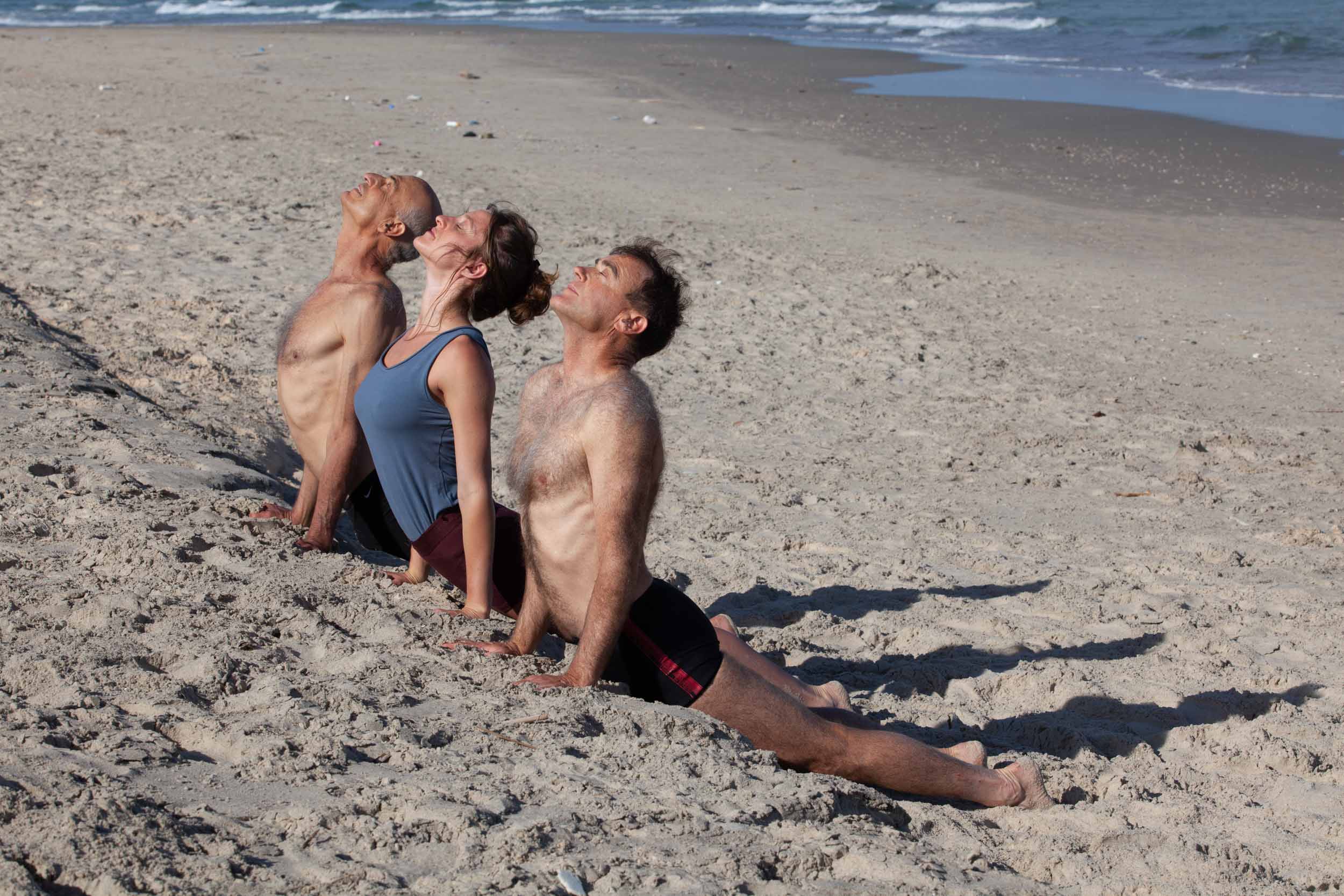
    Eka Pada Rājakapotāsana I, with a small trench for the front foot and a small mound under the buttock

    Here are experts from the Introduction of Eyal:

    Why Practice in Nature?

    With all its technological advances, the modern way of life provides us with many advantages and comforts. Heating and cooling systems allow us to control air temperature; electricity provides us with light; pumps and pipes bring water to our homes; the Internet provides us with a near-endless supply of information and entertainment; and so on.

    All this technology saves us a great deal of time and frees us of worries about our basic needs, such as food and shelter. Despite these great benefits, technology also has its costs. We have become isolated from the abundance of nature and its positive effects on our wellbeing. Alienated from a natural environment, we might even become alienated from our own bodies, which are one of the magnificent and majestic creations of nature.

    Inside Vs. Outside

    This detachment from nature is apparent once we look at modern workspaces. Many people in western countries today work indoors in large production halls. I used to work in such an ‘open space’ when I was a software engineer at Intel. I always felt it is somewhat ironic to call these offices ‘open spaces’. They have no windows through which I could see the sky or breathe fresh air.

    These working conditions took a heavy toll on me; sitting all day, I felt my chest collapsing and tension accumulating in my upper back and neck. I never had enough time for my yoga practice. Working on a computer for long hours can, in the long run, even create scoliosis because of using just one hand for the mouse. So, after less than two years, I left Intel and switched to a more relaxed way of life.

    …

    In one obvious sense, the project of going back to nature is hopeless. After all, we cannot return to an old way of life when humankind was more integrated with nature. And to what period in human evolution do those who advocate a “return to nature” want to go back? We cannot go back to the African jungle, the womb of our species, or live as hunter-gatherers. We also probably cannot live the lives of the ancient yogis, wandering in the Indian jungles. As Jean Jacques Rousseau acutely observed, once we’ve shifted away from it, there is no going back to our natural condition – whatever is meant by ‘natural condition’. Nor is it clear that we would want to go back.

    And still, rather than long to lost past, there is much we can do to reconnect with nature in the present: We can get in touch with our own body, thereby getting in touch with our own nature. We can be more attuned to nature, recalling that it is the ultimate source of all energy and life. We can humbly realize that we are the children of Mother Earth. The conviction we develop throughout this book is that practicing yoga outdoors is an effective way to gain and develop such insights!

    About this Book

    This book aspires to help us regain a connection with our bodies and our nature.

    It does so by suggesting ways in which we can practice yoga in natural surroundings, ways that enrich our natural resources. Each of its three chapters introduces methods for practicing in a particular natural surrounding:

    the seashore (Chapter 1), the woods (Chapter 2), and the mountains of the desert (Chapter 3). In composing these chapters, we have drawn on our many years of regular and dedicated yoga practice in nature: at the Mediterranean beach, near our homes, and in many other natural surroundings, including the desert in the Negev (the southern part of Israel), Sinai (Egypt), and other locations around the world.

    a pile of dirt in a rocky area
    Arching back over a rock in Sinai

    Over the years, we’ve discovered that such practice is a powerful way of recharging the body, mind, and spirit. It retains balance and poise, even when facing the inevitable vicissitudes and downfalls of life. We’ve experienced the deep joy of being alone in nature. Absorbed in a deep forward extension or in headstand, observing the waves from surface level – or, meditating near the sea, feeling the soft breeze on the skin, and listening to the rhymical, meditative roar of the ocean. Or, when practicing in the desert. The touch of cool curved rock against our bodies lets our backs arch on top of it.

    Practicing in natural surroundings has taught me about yoga more than the safe environment of my studio.

    In nature, my body spontaneously opens up, my mind becomes calm and focused, and my practice flows naturally and effortlessly. I can stay in challenging āsanas with less effort and more focus and concentration.

    Somehow, and somewhat mysteriously, my body and mind react spontaneously to the rhythm of the waves and the wind. Nature seems to offer an abundance of energy. Sometimes advanced āsanas that I struggle with at home come easily in nature.

    Yoga in Nature and Patanjali

    I often experience the state Patanjali defines as prayatna śaitilya – a sensation of effortless effort in performing an āsana. According to Patanjali, that is the characteristic of a mature and well-done āsana (Yoga Sutras II.47). It is not entirely clear to me why these natural elements are so conducive to my practice. Yet the effect is clearly felt – I am able to concentrate and connect with myself and enjoy the practice in a way that does not often happen in the studio.

    Immersion in Nature, Immersion in Practice

    Being in nature, in front of the ocean, in the high mountains, or when watching the night stars, one naturally feels small and loses some of one’s self-importance. Nature is so vast and abundant and, when you are open to it, you become more modest and humbler. This is a good mental state for commencing a session of yoga practice.

    However, to be immersed in nature, one needs to quiet one’s mind. Being outdoors is not always enough to acquire a stable and serene mind. If you go out on a noisy picnic, you may not even feel the effect of nature. The noise will probably mask the chirping of the birds or the roar of the sea. Engaging in practice quietens the mind and opens the doors of perception. It is an ideal way for emerging and reconnecting with nature. When you start practicing (in any environment), you need to temporarily cast aside all your projects, tasks, plans, worries, and regrets, and connect to your body and your breathing. Being immersed in nature helps to shift the mind’s focus inwards to find poise within.

    The practice of yoga stills the fluctuations and the automatic reactions of the mind (citta-vṛtti-nirodhaḥ). Going out into nature is a step in this direction. Many people feel that going into the woods or to the mountains helps in quietening the mind. It makes it serene and receptive. And when the mind is quiet, practice flows more easily (sukha).

    Nature Provides Useful Props

    Iyengar Yoga practitioners (like me) might worry that proper practice requires a flat floor, walls, and most importantly, props. No doubt, these all have great benefits in practice. In fact, I use props regularly and teach and write books about their use in our practice. But practicing in nature need not deprive us from the benefits of props. As the following chapters demonstrate, nature itself provides very effective props. And so, we do not need to give up on the benefits of props when we practice in nature. One of the joys of practicing in nature is the search for natural props. Wherever you are, you can find wonderful props. You only need to look for them with attentive and imaginative mind.

    a person standing next to a tree
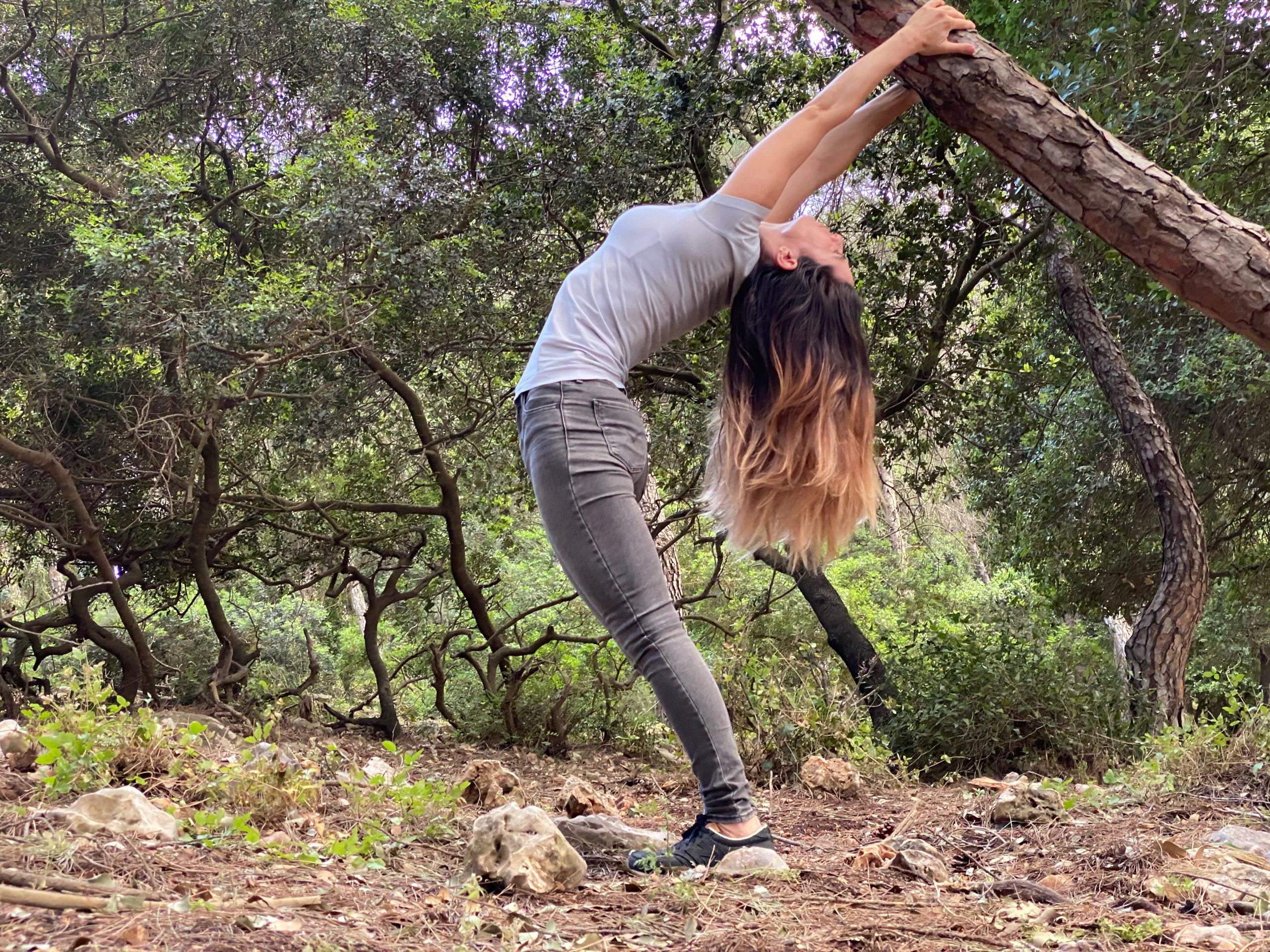
    Holding a trunk to help lifting the chest while arching back

    Over many years of practicing in nature, we have devised many methods for using the sand (at the beach), the rocks (in the mountains), and the trees (in the forest) as props. These methods enhance and deepen our practice. I find these natural props extremely effective, often more so than the artificial ones we use at the studio. The sand especially lends itself easily to creating slopes or pits, which give soft and natural support for many āsanas. The sand proves to be even better than the human-made apparatus we commonly use at the studio. (More about this in Chapter 1). It is our sincere hope that this book will help you combine the benefits of being in nature. With those of practicing yoga, without giving up on the benefits of yoga props.


  • Preparing for Yoga Practice When You Have a Chronic Illness

    Preparing for Yoga Practice When You Have a Chronic Illness

    Yoga is globally considered to be a very helpful tool when it comes to improving overall health. According to research from the University of Calgary, yoga practice can improve physical fitness, cognitive function, and emotional wellbeing for individuals with acute and chronic health conditions. Among chronically ill populations, yoga interventions can also decrease stress, anxiety, and depression.

    However, trying a new activity when you have a chronic illness can be a risk as well. Patients with unique needs often worry that they may do something to make things worse or more painful for them. So how can people with chronic conditions begin yoga safely? Here are some tips to keep in mind:

    Set your Personal Yoga Goals

    We discussed in our post called “What Are Your Goals in Yoga Practice?” how most practitioners feel uncomfortable with defining our goals for yoga progress, but it’s only rational and practical to believe that our investment in the practice will bear fruits. The beauty of yoga is that your goals can be simple, because the practice isn’t tied to ideas of success or failure. It’s easy to find joy in our small achievements. For patients with chronic fatigue syndrome, fibromyalgia, or other chronic conditions, your yoga goals could be to relieve pain, reduce fatigue, improve physical resilience, boost mood, or increase flexibility – even just by a little bit after each session.

    Consult with your Physician

    When you have a chronic illness, you may not be confident that yoga won’t exacerbate your pain or symptoms. For instance, people with hypermobility disorders like Ehlers-Danlos syndrome might not be suitable for the Yin Yoga style, so it’s important to talk to your physician for peace of mind. Fortunately, you don’t even need to leave home just to check with your doctor if you can do yoga, as you can easily consult with them through modern telehealth platforms. Virtual care solution Wheel demonstrates how much easier it is for physicians and patients to share an access point for primary care, labs and diagnostics, as well as behavioral and mental health services. With all this available information, your doctor can determine whether you’re fit for yoga practice or not. You can also ask your physician if there are any positions you should avoid or adaptations to consider, like doing yoga on a chair instead of the floor if you have multiple sclerosis.

    Find the Right Type of Yoga Class

    Not all yoga classes are designed to fit the same needs and goals. Some are for more powerful and intense workouts for aerobics or strength building, rather than relaxing and healing the body. Gentle classes are ideal for people with chronic illness; it also helps to research different yoga styles, as these offer variety for poses, breathwork, meditation, and even lifestyle practices. Some options that suit low to moderate activity and energy levels include hatha yoga, restorative yoga, yin yoga, yoga nidra, and restorative flow yoga. It would be helpful to find instructors who have experience working with chronic illness as well. To get a better idea before your start, try to look into additional resources. The yoga app Down Dog, for example, offers HD videos that give viewers customizable options and alternative poses for various needs. You can see how different types of yoga work before signing up for a session.

    Evaluate how you feel during a session

    A study from the American Osteopathic Association found that mindfulness-based meditation and yoga can greatly improve perceptions of pain, mood and functional capacity among patients with chronic pain and depression, especially when combined with treatments like medication and therapy. Mindfulness and meditation are all about consistent mental effort to check in with oneself and gain perspective, so pay attention during your yoga class. Moreover, evaluate if your yoga practice is in a safe and supportive environment. Is the level of intensity okay for you? Yoga is all about connecting your body and mind to heal — it’s crucial to listen to what your body is trying to say.