• What Is My Motivation to Practice Yoga?

    Introduction

    See also: Practicing Yoga – Why Do We Do It? on that blog.

    Once we establish a regular practice (which is the first very important and not trivial step), we have to constantly check our intentions and motivations: what brings us to the mat? Why do I choose to spend time and invest effort in this practice? Why do I persist despite many difficulties? What really propels me? What do I get from my practice?

    These motivations usually transform as we develop and mature in our practice, yet it’s important to continuously observe and check our present motivations and, of utmost importance, to what extent our motivations are aligned with the goals set out in the tradition of yoga. This is Svādhyāya (self-study).

    Motivations Unaligned with the Goals of Yoga

    Yoga is a journey of self-study and exploration (see my previous articles: Practicing Yoga – Why Do We Do It? and Attentive Yoga Practice and the Psychophysical Lab). In another article, I presented some factors that may inspire us to practice. Here, I want to examine more closely our motivations to practice and to what extent they correspond to those defined by the tradition of yoga.

    You may get tips from teachers that can help keep you motivated. But do these motivations correspond with what yoga really is?

    We may have a mixture of various motivations. Some of these may be hidden. Some motivations have nothing to do with what yoga really is! Such motivations can operate in the back of our minds, and we never consider them or check their validity. Here are two examples of such motivations that I observe in many people and can also recognize in myself.

    Keeping Our Bodies Fit

    You may be practicing yoga in order to keep your body fit and in good form. As I am aging, some of my students who are also aging, shared with me that they feel that their body weakens and their cardio-lung endurance diminishes. They asked me if they should include dynamic, aerobic movements and muscle-building exercises in their practice. My response is that, although keeping our bodies fit – maintaining our heart and lung health- is important, but yoga has much more to offer. I can suggest keeping the yoga practice pure and concentrating on the true, essential goals of yoga. My recommendation is to do aerobic practice at a different time and not mix it with yoga. Go jogging, go cycling, swim, or go to a gym – no problem, nothing wrong with that. On the contrary, it is important to take good care of our bodies, but keep your yoga practice as a lab to study yourself, to develop observation, concentration, clarity, and balance.

    Practicing yoga certainly keeps the body healthy and fit and makes us stronger, lighter in movement, and more flexible. But these are merely byproducts – not the purpose. This is not a motivation aligned with the tradition of yoga.

    Impressing Others

    Another motivation that can sometimes arise is to practice in order to impress and excel. To post nice photos on Instagram, so that everybody will see how good we are. This is a natural tendency; we all want to be noticed, to be loved. However, this, obviously, is not a motivation set out by the yoga tradition.

    In fact, there is nothing wrong with the mere act of posting photos. What is crucial is the motivation behind it. B.K.S. Iyengar demonstrated the āsanas in his books. He made dozens of demonstrations, and his photos decorate many Iyengar Yoga centers (first and foremost, his institute in Pune). But he did not do it to show how good he is, but to promote yoga, and to spread it to as many people as possible. If your motive is not the ego, but the well-being of others, then by any means, posting photos is justified – but check your motive!

    Achieving Advanced Poses

    Some people practice to conquer more and more challenging poses. They compete with their body and push them to their limits. There is nothing wrong with sometimes challenging yourself; it is nice to expand our limits, but if this is the main goal of the practice, then it isn’t a balanced practice. If we are always running after a goal or an image that exists in our mind, and are not open to observing the reality of our body, then we may do Himsa-practice (Himsa is the opposite of Ahimsa – noninjury, non-violence).

    Being on the path of achievement makes yoga a kind of competitive sport, and misses the main value of yoga, which is self-study and self-transformation.

    Observing Tendencies

    We all have these tendencies and motivations; sometimes they are hidden, acting behind the scenes, but Svādhyāya (self-study) means to deeply observe and understand these hidden motivations. I can recognize these tendencies in other people because I can recognize them in myself. Sometimes I want to impress, sometimes my motivation is to have a healthy and fit body, and sometimes I am ready to sacrifice my health and well-being, just to achieve an advanced pose. But when I observe this, again and again, I contemplate the question – what yoga really is?

    So, What is Yoga Really?

    Yoga is self-study; yoga is a study of our Chitta (consciousness) in order to transform it. Kriya Yoga – yoga in action – is to study ourselves in action. We apply ourselves (Tapas); we study ourselves (Svādhyāya); and we surrender ourselves (Ishvara praṇidhāna).

    When we apply ourselves to the practice wholeheartedly, we meet ourselves and study ourselves – there is no other choice. And when we study ourselves, we understand the need to surrender. We see ourselves in a balanced way, without self-centeredness and false self-importance, and then we naturally surrender.

    In yoga, we study ourselves in action. We can and should also do so during our daily activities, yet the time we devote to practice is a time we allocate especially for that, it’s our study-lab. The āsanas are special tools that create calmness, centeredness, focus, concentration, and therefore clarity. Hence, they are ideal for self-study. They were designed especially for that. We have to use this powerful and wonderful tool towards this end.

    We need to ask ourselves: how do I react to challenges? Can I apply the physical actions of the āsana with full intensity, but without creating tension in my breath, senses, and mind? Can I keep my mind intense and alert without fading or oscillating? How do I respond to stressful situations, to fear? To limitations? Can I remain calm and balanced even when met with difficulty or failure? How do I react to pleasure and pain? Can I maintain equanimity, even amid a battlefield (as Arjuna had to while standing between the two armies)?

    As we age, our bodies become weaker, and we cannot do what we used to do. We may experience frustration, especially if our original motivation is wrong. But in fact, the practice remains the same: I apply myself (Tapas), I study myself (Svadhyaya), and I surrender myself Ishvara Pranidhana). This doesn’t change, and we can do it at any age. If this is your true motivation, then you won’t be frustrated by the limitations that aging entails.

  • How to Know and Transform the Chitta?

    Introduction

    In a previous article “How Asana Practice Can Lead to Citta Vritti Nirodhah” I explained the yogic model of the Chitta (the consciousness) and described three steps in which one can quieten the fluctuations of the Chitta and I included various quotes from B.K.S. Iyengar’s books. Here I want to return to this subject, but to suggest a practical method of studying and transforming the Chitta. I recommend, however, that you read the previous article since it serves as a background for understanding the subject.

    Before going into the components of the Chitta, let us review the states of the Chitta.

    Yoga is about studying the Chitta, understanding its functioning and transforming it toward the Nirodha (controlled, silenced) state. But the Chitta is an abstract entity – we cannot see nor touch it, so how can we study it?

    Fortunately, yoga provides us with a model that helps us observe the Chitta and study it. According to yoga, the Chitta is made of three components: Manas, Ahamkara, and Buddhi. I will not go into depth describing these terms here since I explained them in my previous article (as in many books about yoga,  see for example Light on Life, by B.K.S. Iyengar). The Chitta is described to be in one of five states.

    The Five States of the Chitta

    In his classic interpretation of yoga sutra I.1, Vyasa, the mythological interpreter of Patanjali, defines 5 states of the Chitta. These are:

    1. Mudha – stupefied, dull
    2. Kshipta – restless, agitated
    3. Vikshipta – oscillating, distracted
    4. Ekagra – one-pointed
    5. Niruddha – arrested, controlled

    Vyasa regards the first three states as inappropriate for yoga. He then continues: “…But the concentration attained by a mind which is one-pointed, i.e., occupied with one thought, which brings enlightenment, … paves the way to the arrested state of the mind.” (From Yoga Philosophy of Patanjali, by Swami Hariharananda Aranya).

    We can know these states of the mind (Chitta) from our own experience. When we are extremely tired, under the influence of alcohol, or in severe depression, the mind is very dull. In such a state, not only concentration is impossible, but also clear thinking is lacking.

    In the Kshipta state, we experience the ‘monkey mind’. The mind is moving rapidly from one thought to another and from one object to another, never finding a resting place.

    The third state, Vikshipta, is probably the one in which our mind dwells most of the time. It’s oscillating between moments of concentration and distraction. We can be in an asana and be absorbed for a few moments, but then start brooding about the past or the future, and lose our concentration. The mind is oscillating between the Kshipta and the Ekagra states.

    Ekagra is a state where concentration can be maintained for a long time. This leads the mind to a state of Niruddha where we have full control over our minds.

    In our daily practice, we move between states 2 to 5 (in the Mudha state we are not likely to bring ourselves to practice at all). As we go deeper into the practice, we can maintain longer intervals in which we are one-pointed (Ekagra). This is the state we need to develop. The practice is an effort to maintain the Ekagra state as long as possible. The more we are persistent and systematic in our practice, the quicker we can develop and enhance this state.

    The Components of the Chitta

    Let’s return now to briefly exploring the components of the Chitta: Manas, Ahamkara, and Buddhi. The Manas is the part that allows us to function and survive in the world. Ahamkara is, as the name suggests, the I-maker. It is the part that makes us perceive ourselves as separate from others. Finally, the Buddhi (intelligence) is the part that enables us to discern, make ethical judgments, and differentiate right from wrong.

    How the Components of the Chitta are Expressed in Asana Practice?

    Manas, because of its need to preserve itself and survive, moves quickly from one topic to another. This enables us to rapidly identify threats and take the appropriate measures. However, it also makes it difficult to concentrate and calm down. It’s the ‘monkey mind’ that, like a monkey, jumps from one tree to the next, wandering rapidly from one thing to another.

    Whenever we observe, compare or discern, it’s the Buddhi that operates. During practice whenever we are attentive to the sensations in a pose, adjusting to find balance, symmetry and harmony, we work from the Buddhi and develop it. Take Uttānāsana for example (although this applies to every asana).  Whenever you observe the weight on each foot and adjust to make it even, or sense which buttock is more prominent and adjust to balance, you are absorbed in the pose and practice active discernment.

    The Functioning of Manas and Ahamkara

    In yoga, we aim to develop the Buddhi, but we must recognize the other two parts inherent in us. During the practice, we may find ourselves commenting: “Wow, I am so good at this”, “I am bad at that”, “I will never be able to do this”, “it’s too hard”, “it’s too easy”, “this teacher is not nice”, “I don’t like this asana“, “I need to preserve energy for the rest of the day, so I will not invest all my efforts here” and so on and so forth. Similarly, we may get bored and look at the clock to see when the class will be over. All these restless movements of the mind are expressions of Manas’ activity.

    Some of this restlessness stems also from the Ahamkara. Ahamkara (or Asmita) creates our attachments and aversions, our likes and dislikes. It is in charge of all our habits and behavioral patterns (Samskaras). Whenever the ‘I’ comes into the picture, then, on one hand, there is the “me” that thinks, negotiates and evaluates and on the other hand there is the asana. It’s a dualistic state. But when we are totally immersed in the sensations, the actions and the adjustments we make, we forget ourselves and become one with the asana. At such moments, the Ahamkara loses its grip and the Buddhi takes over.

    Observing the Manas and Controlling it

    The Manas creates agitation, distraction and impatience. When the Manas operates, our practice becomes scattered, without order or direction. If we notice this restlessness, the inability to keep our attention on one thing, we witness the Manas. Whenever we think about what we are going to do after the practice, check the time, (in self-practice) check messages on our phone, or get lost in some narrative, then once again – it’s the Manas.  When we recognize this, when we are aware of this, we can immediately become attentive and mindful again. We can set the business of the Manas aside. We can stop the interpretations, the commenting about success or failure and so on. Then there is only sensation, action and observation.

    This is not easy; the Manas is very powerful and we need it to operate, but by returning to the practice, again and again, we can not only study the Chitta but also transform it toward a yogic state. In our practice, when we operate from the brain it’s the Manas that is in action and thus there is no intellectual clarity. Operating from the chest is exhilarating, but can become too emotional and lead to emotional instability. Performing the asanas with constant reference to the spine helps us internalize and become calm and then we operate from the Buddhi.

    A Technique to Silence the Manas and Activate the Buddhi

    In one of his workshops, Birjoo Mehta, a senior teacher from Mumbai, taught the following technique: draw an imaginary line from the top of the right shoulder blade to the bottom of the left one. Then draw another line from the top of the left shoulder blade to the bottom of the right one. Now sense the crossing point between these two lines. When you stand in Tāḍāsana, connect to this point and then do all the subsequent asanas with constant reference to the same point. Keep this point stable and keep your mind observing it as you move from pose to pose.

    Try this technique. I find it very useful. It quickly draws the mind in, making it quiet, and when the fluctuations subside there is a space for the Buddhi to emerge.

  • Understanding Purusha and Prakriti experientially

    Introduction

    Patanjali, following the Samkhya philosophy, used the terms Purusha and Prakriti to describe our essence – our fundamental structure. In a previous article, I touched on these terms in relation to the Kleshas (the afflictions). Many authors write about this subject in philosophical-theoretical terms (see here for example). There are many yogis and scholars explain them theoretically (see for example books by Iyengar and Bryant). However, for the yoga practitioner, it is important to understand these terms on an experiential level. How can we experience these abstract notions in our practice and daily lives?

    Purusha and Prakriti – the Two Aspects of our Being

    Within us, we can recognize and differentiate between two aspects; you can call these aspects ‘spirit’ and ‘matter’. As human beings, we are part of nature, part of the material world, but we can also connect to higher dimensions. We have a mysterious ability to be aware (called Chiti Shakti – “power of consciousness”), we can know the world and know ourselves. We have moments of insight and wisdom in which we see the uniting principle of all creation. You may call it Pure Consciousness or God; Patanjali calls it ‘the Seer’ (Draṣṭu), or Purusha. The other, material facet, is titled Prakriti.

    This may still be too abstract. To make it more tangible, we can think about it at an experimental level. I experience and recognize in myself a force that drives me to evolve, to develop, to experience, to live fully. This force may be Prakriti. It is a very potent energy, a manifestation of nature itself; of life, with all its vibrancy and creative energy. It’s an evolutionary process.

    On the other hand, I experience moments of silence, of calm presence, and clear awareness, and therefore of wisdom. I can go inside and feel the inner, peaceful space in me. The process of going back from the manifested to the unmanifested, internal, primal core is involution. This may be an experience of Purusha.

    In a Savasana done after a good practice session, you may get a glimpse of the inner space of pure consciousness. You are lying down, with your body fully relaxed observing your breath and mental activity. You may notice that the breath becomes very soft and subtle, and there may still be some faint mental activity going on at the surface; but underneath, you can sense the open, wide, empty space of consciousness, you may call it Purusha. Imagine you are lying at the bottom of the ocean, and the wide-depth bottom is still. Even though there are still some waves on the surface that do not disturb the inner quietness.

    Both aspects exist and are real and I can observe and study them in my life and in my practice.

    Developing Neutrality

    In the hustle and bustle of life, I am not always in touch with this calm and clear aspect and most of the time operate by the dictates of the Asmita (the small self). Mostly, I react to situations and people out of self-interest and egoistic motives, or just in a habitual, thoughtless manner – not from a state of clarity and neutrality.

    When we say neutrality, it isn’t in the political sense of the word. It’s emotional neutrality – acting without preferences and self-centered considerations and calculations. Without being affected by the gravitations that pull and push us in our life. It’s an attitude that sees everything with evenness, not affected by our likes and dislikes, our desires and aversions – an attitude of calm dispassion.

    Developing Intellectual Clarity and Emotional Stability

    Iyengar said that yoga should bestow us with intellectual clarity and emotional stability. This can come when we stop acting from the narrow perspective of the ego, stop running after external attractions and excitements (Bhoga), and get in touch with our inner wisdom. With the Seer, or Purusha, the pure consciousness in us.

    We all know this, otherwise, it wouldn’t resonate with us. We just forget it in our business of life. The power of the small self is very strong. We are so self-centered. In everything that happens to us in the personal or global realms, in any event in our life or in the world, there is always the background concern “…and what about me? Do I gain or lose from that?”. The ‘I’ is in the center. We are identified with it.

    This clouds our perception, we don’t see reality as it is, but see it as reflected and distorted through the lens of the small self, the Asmita, and not from our inner pure consciousness, Purusha. We often misjudge people and situations and hence respond in a non-optimal way. This creates suffering in us and others.

    In our practice, we should observe and study these tendencies. The moment we see them, we can understand our pettiness, we can realize how distorted our view is, and then neutrality, evenness of mind, or equanimity, will develop naturally. This brings wisdom and provides us with intellectual clarity and emotional stability. Then we respond better to the challenges of life and act in a more wholesome way that will do good for us and others.

  • Which are the best Iyengar Yoga Blogs?

    So, I am happy to find out that according to the site FeedSpot, our blog is on the list of the 20 Best Iyengar Yoga Blogs and Websites, and not only that, it’s positioned third on that list!

    See the other blogs as well and learn about Iyengar Yoga!

  • Fostering Wholesome Qualities – What is “Pratipaksha Bhavanam”?

    In this article, Eyal will discuss the phrase Pratipaksha Bhavanam which appears in sutra no. II.33.

    Introduction to Pratipaksha Bhavanam

    One can distinguish between two aspects or types of efforts in our yogic Sadhana. The first aspect is concerned with observation and investigation. This is basically a study of reality as it is, especially the reality of our own Chitta (consciousness). It is a more passive activity in the sense that one doesn’t seek to change things, but rather to observe them as they are.

    The other type of effort is cultivating and fostering beautiful wholesome qualities. Generosity (Dana), loving-kindness (Maitri), compassion (Karuna), sympathetic joy (Mudita), and equanimity (Upeksha). (The last 4 are the emotional qualities and conducts prescribed in Sutra I.33). The Yamas (Sutra II.30) are also practiced in order to develop and foster wholesome, ethical social behavior. While the Niyamas (Sutra II.32) are guidelines for developing a stable and calm mentality.

    This more active effort is a must if we aim at becoming fit for the mental transformation required to calm our Chitta (Nirodha) and overcome Dukkha (dissatisfaction, pain, affliction, and existential suffering). The principal rationale for the second, more active effort is provided by Patanjali in Sutras II.33 and II.34. In these sutras he introduces the concept of Pratipaksha Bhavanam.

    What is Pratipaksha Bhavanam?

    Following the presentation of the Yamas and Niyamas, Patanjali provides what may appear as a ‘justification’ for observing the Yamas & Niyamas, but in fact, should be regarded as a technique to help us foster these conducts (or Maha-Vratam – the great vows – a term he uses to describe the Yamas). In Light on the Yoga Sutras of Patanjali, B.K.S. Iyengar explains Pratipaksha as follows:

    “Paksa means to take one side (in an argument), to espouse one view; while Pratipaksa conveys the idea of taking the opposite position.”

    Patanjali states that:

    II.33 vitarka badhane pratipaksha bhavanam

    This is translated by Edwin Bryant as follows:

    Upon being harassed by negative thoughts, one should cultivate counteracting thoughts.

    And by Ravi Ravindra:

    When negative thoughts and feelings arise, the opposite should be cultivated.

    We are all familiar with these types of negative thoughts and feelings that can spiral out of control into obsessive thoughts:  when we envy the achievements or good fortune of others, or when we are angry and blame others for their demeanor when we feel guilty or regret something we did, and even when we fall in love. The Pali term for such circular, proliferating thinking is prapañca[1] (Sanskrit: prapañca – see Wikipedia on that) – the almost instantaneous snowballing of thoughts and associations that gets rolling when we take leave of our mindfulness.

    Sometimes these prapañcas can occupy our minds for days. This has no positive value; it doesn’t do good, neither to us nor to anyone else. Envy, lust, jealousy, anger, hatred, guilt, and delusion are considered in yoga as ‘enemies’ (Ripus). They do not contribute to our well-being nor to the well-being of others, nor to our relationships with other people.

    So, Patanjali advises us to foster and cultivate the opposite. Example: to counter stinginess – develop generosity; to overcome anger – cultivate friendliness, brotherhood, sisterhood, and goodwill; to counter envy, practice sympathetic joy – being happy with the good qualities and success of others; to overcome hatred, foster loving kindness, and compassion; when you feel dismal or depressed, practice gratitude and appreciation of all the good things you have.

    Can we Change our Thinking Patterns?

    You may think that we can’t really control our thoughts. True, we don’t have complete control, but we do have some degree of influence. We can use our intelligence and discernment to change our thinking patterns. If such a change wouldn’t have been possible, then there would be no sense in practicing yoga. True, this isn’t easy, but practice means repeating over and over again, and then again. By repetition, one can gradually replace negative habits and patterns with positive ones. This is known to anyone who practices any skill or art. The adage “practice makes perfect”, may be overstated, but it’s not without truth. We can improve in anything that we put our mind to, provided that we have a clear intention, strong motivation and we are ready to invest effort and overcome difficulties.

    This is also proven by modern neuro-science. It is empirically established that using certain nerve paths in the brain strengthens them. Those that are not being used often gradually weaken.

    Yet this is not easy and the effects may only be felt or seen in the long term. Therefore, Patanjali provides us with techniques that can motivate us and help us overcome obstacles.

    How to Tackle Disturbing thoughts

    On the basic level, Pratipaksha Bhavanam can be interpreted as follows: ‘when your mind is occupied by disturbing thoughts (papanca), think about something else. Occupy yourself with a different thought, or with a different object. It can also mean simply: ‘do the opposite’; if you are inside your home – take a walk, if you are meditating with closed eyes – open your eyes; if you are alone – seek positive company, and so on. These strategies do not always work when the papancas stem from deeply rooted emotions.

    Therefore, Patanjali also provides a more fundamental technique in Sutra II.34, where he explains why Pratipaksha Bhavanam is so essential:

    vitarkah himsadayah krita karita anumoditah lobha krodha moha purvakah mridu madhya adhimatrah dukha ajnana ananta phala iti pratipaksha bhavanam

    This was translated by B.K.S. Iyengar as follows:

    Uncertain knowledge giving rise to violence, whether done directly or indirectly or condoned, is caused by greed, anger or delusion in mild, moderate or intense degree. It results in endless pain and ignorance. Through introspection comes the end of pain and ignorance.

    And by Ravi Ravindra in this way:

    Cultivating the opposite is realizing that negative feelings, such as that of violence, result in endless suffering and ignorance – whether these feelings are acted out, instigated or condoned, whether motivated by greed, anger, or delusion, whether these are mild, medium, or extreme.

    Pratipaksha Bhavanam or cultivating the opposites doesn’t mean that we should suppress negative feelings, this isn’t what Patanjali suggests. B.K.S. Iyengar puts it like that (I added the underline to emphasize the main points):

    “If a person is violent, he is violent. If he is angry, he is angry. The state is not different from the fact; but instead of trying to cultivate the opposite condition, he should go deep into the cause of his anger or violence. This is Paksabhava. One should also study the opposite forces with calmness and patience. Then one develops equipoise.” (ibid)

    a person walking up a hill

    One of the tools that can stir us away from the ‘story’ we built up. The papanca, is observing our body’s sensations during such ruminations. Once you observe sensations, such as, for example – your rising body temperature, your accelerated heart rate, or the contraction in your chest or throat – you already detach from the narrative you inhabit. This enables the creation of some space to ‘go deep into the cause of anger or violence‘ – as Iyengar had put it.

    One more tool that Patanjali provides in II.34 is contemplating the results of acting out of anger, violence, etc. Before acting, contemplate the outcomes of the action. Consider whether the action you are about to do will bring hostility and suffering. If it becomes obvious that the action will bring “endless suffering and ignorance” as Patanjali states, then you will be strongly motivated to cultivate the opposite tendencies (Pratipaksha), i.e., actions that bestow joy, peace, and harmony

    Instead of suppressing and ignoring existing negative emotions, Patanjali suggests we follow these two steps:

    1. Deeply study the causes and conditions that give rise to negative emotions, like anger and violence.
    2. Contemplate the results (or fruits – phala, in Patanjali’s language) of acting out of these negative emotions

    B.K.S Iyengar further explains:

    “The principles that prevent Yama and Niyama are to be countered with right knowledge and awareness. When the mind is caught up in dubious ideas and actions, right perception is obstructed. The Sadhaka has to analyse and investigate these ideas and actions and their opposites; then he learns to balance his thoughts by repeated experimentation.” (ibid)

    (A sadhaka is a spiritual seeker who is actively engaged in a sadhana – a spiritual practice)

    Studying Paksha and Pratipaksha in Practice

    I find that, from all the families of asanas, the inversions, and especially Sirsasana, express Pratipaksha Bhavanam. First, the mere action of getting upside-down, is opposite to our customary posture (when standing or walking). But, on a deaper level, Sirsasana often allows us to view things from a different angle, not only physically, but to really change our views about ourselves and our mood. Often when I feel confused or dejected, I know I need to practice Sirsasana. Once I do so, I see things with more clarity and I know how to continue the practice, and also how to respond better to challenges I face at the moment.

    B.K.S. Iyengar is unique among the interpreters of the Yoga Sutras in that, as a man of practice, he always suggested incorporating practical methods and provided applicable guidelines within the practice of asana and Pranayama:

    “While practising the Asana, the sadhaka must carefully and minutely observe and adjust the position of the muscles, muscle fibers and cells, measuring lightness or heaviness, paksa or pratipaksa, as required for the performance of a healthy and well-balanced Asana. He adjusts harmoniously the right and left sides of the body, the front and the back. Learning to interchange or counterbalance the weaker with the intelligent side brings about changes in the sadhaka: he grows, able to observe equipoise in the body cells and the lobes of the brain; and calmness and sobriety in the mind. Thus, the qualities of both paksa and pratipaksa are attended to. By raising the weak or dull to the level of the intelligent or strong, the sadhaka learns compassion in action….”

    And he concluded in these beautiful words:

    “The internal measuring and balancing process which we call paksa pratipaksa is in some respects the key to why yoga practice actually works, why it has the mechanical power to revolutionize our whole being. It is why Asana is not gymnastics, why pranayama is not deep breathing, why dhyana is not self-induced trance, why yama is not just morality.”

    Vyasa’s Commentary

    Vyasa (the first and foremost commentator of Patanjali, so much that some researchers even think that Patanjali and Vyasa are actually the same person) wrote a picturesque commentary on Sutra II.33, in which he compares acting on perverse thoughts (those that run contrary to the yamas) to a dog licking his own vomit:

    “When the knower of Brahman experiences feelings of hatred etc. and is tortured by the agonizing fiery passions which lead to wrong course of conduct, such as ‘I shall kill him who hurts me, I shall speak untruth, I shall take things belonging to others, I shall commit adultery with his wife, I shall take things belonging to others,’ he should encourage contrary thoughts. He should contemplate: ‘roasted on the pitiless burning coal of the cycle of births, I took refuge in the virtues of Yoga by promising security to all living beings. After having abjured such perverse thoughts, I am behaving like a dog in betaking myself to them. As a dog licks hos vomits, so it is for me to take up thoughts and lines of action discarded by me as evil.’ …”

    (From: Yoga Philosophy of Patanjali by Swami Hariharananda Aranya, 1981)

    Thus, Vyasa concludes his commentary on Sutra II.34:

    “Thinking thus of the inevitable evil effects of perverse thoughts and deeds, the mind should never again be engaged in them. Perverse thoughts are to be forsaken through their contrary thoughts.”

    I find this both very useful and very inspiring!


    [1] In the Buddhist teachings, there are many discussions of prapañca, and how to handle it. See for example https://encyclopediaofbuddhism.org/wiki/Prapa%C3%B1ca

  • Farewell to a Dear Friend and Teacher

    Farewell to a Dear Friend and Teacher

    A Tribute to Faeq Biria

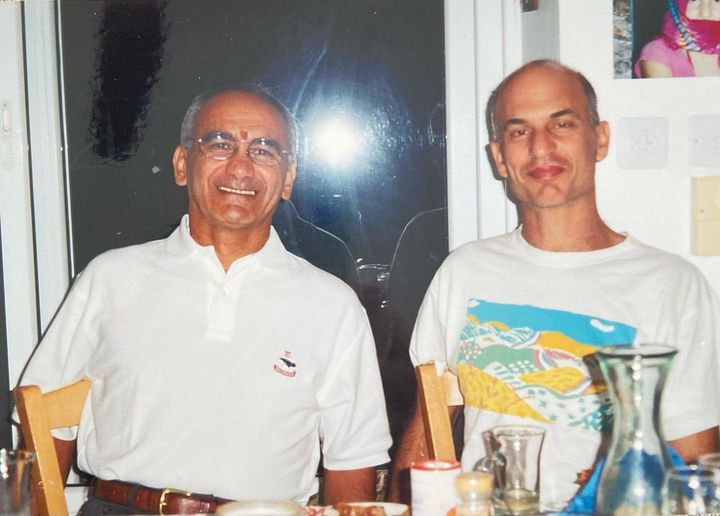
    Elie Hobeika et al. posing for the camera

    Back in April, we lost a great teacher. On that Saturday, when the message arrived, it stunned me.  For a while, I couldn’t find the right words to honor Faeq’s memory. Still, I find myself thinking of him often and missing him, so I decided to post some words.

    Faeq was an extraordinary person with great, almost super-human capacities and talents. He was of high intellectual caliber and incredible sensitivity. I always felt there is no use trying to conceal anything from him, as he sensed and perceived everything. When he hugged – a thing which he did a lot – you could feel his physical strength. He was amazingly strong and stable. You could see it by the way he carried his body; I once observed him from behind when he was sitting and thought how his erect and stable spine reflects so well his composure and his strong mind. It’s unbelievable that a malady could conquer such a strong person. Yet, I am certain the merit he earned will live on in the many of us who loved and learned from him.

    He loved people and people loved him. He was a successful blend of East and West: a warm Eastern heart with an analytical Western brain. He often said that we, his Israeli students, also combine the good qualities of East and West, and he liked to come to teach in Israel and did so for many years.

    He loved life and had a strong passion for life. He had what we call in Hebrew a strong ‘Yetzer’ this is a hard term to translate, roughly meaning a fundamental, core-driven passion for life. It is derived from the same root of the words ‘Yetzira’ (creation) and ‘Yetzur’ (creature).  It is an intrinsic life force. Inherently, man manifests the constant battle between the ‘good’ Yetzer and the ‘bad’ one (see, for example, the story of the Bhagavad Gita – as well as many Jewish and universal folklore tales).

    There is a Hebrew proverb: ”who is a hero – the one who conquers his Yetzer.” A human being whose enlightened, good side conquers his primordial low instincts. Faeq was a hero – he conquered his strong Yetzer. I remember once, during teachers training he taught in Israel, we were about to begin practice when someone brought a fresh cold watermelon from the kitchen – the best possible refreshment in the hot Israeli summer. It was tempting to take a bite from this watermelon, so I took one and told him to take a small slice. He turned to me, smiled, and said – “no, not at my age”. He renounced that urge, knowing that it’s not good to ingest food or liquids right before or during practice.

    In the memorial held in honor of Faeq, Prashant Iyengar said that he was like a towering tree bearing fruit, with seeds that bear seedlings, that grew to be trees of their own right. I feel blessed and proud to be part of this beautiful forest.

    May his memory will always illuminate our path!