• Neutrality and the Ego of the Asana

    Neutrality and the Ego of the Asana

    Prashant Iyengar said that yoga brings about neutrality of the mind.

    What did he mean by that?

    I’ll try to explain my understanding of this phrase and suggest how it may be applied in our

    practice. In this, I’ll draw from some ideas presented by Birjoo Mehta in a workshop he taught in May 2018 in Israel.

    What does it mean to have a Neutral Mind?

    Mental neutrality shouldn’t be understood in a political sense. It’s not being neutral

    politically. Rather, it’s having a mind that is not biased and has no prejudice. A mind that is

    fresh and clear and can assess any situation without preconceived ideas or views.

    A neutral mind doesn’t have preferences or likes and dislikes that stem from self-centered

    ideas.

    Here is an example: suppose you are going to share some resource, say, share a cake with two people. Suppose you like one of the two more than the other, you may tend to be

    biased, and cut a bigger slice for the one you like, depriving the other person of their fair

    share. This kind of biased behavior will lead, sooner or later, to Dukkha (suffering). This is

    injustice and sooner or later the person who gets less’ will develop resentment and anger.

    Neutrality means emotional balance and stability. If you are very emotional, you’ll not make

    the optimal judicious and wholesome decisions. Your emotions will bias your judgments. This again will lead to suffering.

    B.K.S. Iyengar said that yoga should bestow us with “emotional stability and intellectual

    clarity”. Alignment became such a central principle in his system of yoga, since alignment

    brings mental neutrality. A neutral mind is not biased, it doesn’t take sides, and hence makes

    judicious, right and impartial decisions. This means acting according to the Dharma. Such

    behavior results in minimal suffering for oneself and for others.

    According to yoga, the part of the Chitta that creates the small self is Ahamkara (literally, the

    I-maker). The Ahamkara builds our life story, our tendencies and preferences. A strong

    Ahamkara produces a narrow and self-centered view and a selfish attitude. A person dominated

    by self-centeredness will act out of their own interests, ignoring others’ needs and

    emotions. They will develop self-importance and be ready to sacrifice the well-being of

    others for their own sake.

    As a side note, it is interesting that the second Noble Truth of the Buddha – the cause of suffering, states that the carving to become, to express oneself and to be important is a

    source of suffering (as well as the desire not to become, which is the opposite expression of an ego). When the Ahamkara is dominant there will be a strong desire to become famous and important; to gain wealth and power and so on. This will, in the long run, certainly cause Dukkha.

    How does this relate to our Asana Practice?

    Every asana has attributes, shape and form; we can say that this is the “ego” of the asana – its

    discriminating features. That’s how we differentiate one asana from another. As long as you

    are caught in the specific details and technicalities of the asana, you are with “the ego of the

    asana”.

    However, Patanjali’s definition of an asana doesn’t mention any form or shape. He doesn’t

    specify techniques, and doesn’t mention backbends, forward bends, or inversions. Sutras

    II.46-47 define asana as follows:

    1. Sthira sukham asanam – Asana is perfect firmness of body, steadiness of intelligence and benevolence of spirit
    2. Prayatna shaithilya ananta samapattibhyam – perfection in asana is achieved when the effort to perform it becomes effortless and the infinite being within is reached.

    These are the essential characteristics of any asana – sitting, standing, twisting and so on. In

    any asana the mind has to be tranquil, steady, sublime and exalted, and one should reach a

    balanced state, in which there is no mental effort, i.e., there is no need for willpower. This is

    a neutral state of mind in which the ego is transcended and the “infinite being within is

    reached”.

    How to reach a balanced Asana?

    When the asana is done with correct alignment and the right degree of extension one becomes

    absorbed in it. Then the specific attributes and characteristics of the asana are less important.

    The experience is of absorption, spaciousness, egoless and neutrality – no matter what

    asanas are being performed. Birjoo said that when the asana is done from the head it becomes intellectual, when it is done from the chest, it may become emotional, but when it is done from the spine the mind becomes balanced and neutral. The technique he gave us is to make a cross in between the shoulder blades: draw a line from the top of one shoulder blade to the bottom of the other, and another line top of the second shoulder blade to the bottom of the first, and fix your attention on the crossing point of these two lines.

    Iyengar also mentions the importance of the awareness of the back of the body (see Core of

    the Yoga Sutras, p. 148-151). Doing an asana with constant reference to the spine, brings one to the core and creates poise and absorption. Then, upon concluding the asana, one doesn’t feel: “I

    did Utthita Trikoṇāsana”, or “I did Ūrdhva Dhanurāsana”, but rather: “I did an asana!”

    Acting without leaving Samskaras (subliminal residues) In Sutra 7-8 of the fourth chapter, Patanjali talks about the effects of actions:

    7. Karma ashukla akrisnam yoginah trividham itaresam – A Yogi’s actions are

    neither white nor black. The actions of others are of three kinds, white, black, or gray.

    8. Tatah tad vipaka anugunanam eva abhivyaktih vasananam – These three

    types of actions leave impressions that become manifest. 

    This means that the Yogi’s actions are transparent and leave no residues, so his or her mind is not conditioned by past actions. Yogi’s act without desire and without self-interest, they are not afflicted by delusion (Avidya), ego (Asmita), desire (Raga), aversion (Dvesha), and fear (Abhinivesha). Such actions do not create Samskaras. When one performs an asana with a neutral state of mind, then it doesn’t leave any specific Samskaras (or Vasanas, using the terminology of in III.8) in one’s body and mind. There is only a sublime, exalted, pristine state, and in that state one is not affected by the dualities: Tatah dvandva Anabhighata (as Patanjali says in II.48)

  • About “Props for Yoga Vol IV – Backbends”

    About “Props for Yoga Vol IV – Backbends”

    About the Book

    The 4th volume of the “Props for Yoga” series introduces the effective utilization of props to enhance and refine the practice of backbends. With detailed step-by-step instructions, accompanied by abundant photos and useful tips, practitioners can optimize their backbend postures.

    The book is a practical guide that covers backbends at various levels, ranging from fundamental to highly advanced poses, ensuring that it caters to the diverse needs of all practitioners.

    The book has 6 chapters:

    1. About Backbends
    2. Basic Backbends
    3. Advanced Backbends
    4. Going Further in Advanced Backbends
    5. Warm-Ups and Wrap-Ups Asanas
    6. Sequences

    About Beckbends -An Excerpt from Chapter 1 of the Book

    In an interview, B.K.S. Iyengar gave during a backbend intensive he taught (in November-December, 1991, he said these beautiful and inspiring words about backbends:

    “For a yogi, backbends are meant to invert the mind, to observe and to feel—first the back, then the consciousness and the very seer. Through the practice of backbends, by using the senses of perception to look back, and drawing the mind to the back portion of the body, one day meditation comes naturally. In other poses, the attention on the back is not given to such an extent and the mind moves outside. Backbends have principles of their own and learning the workings of the mind and intelligence in backbends naturally leads one towards the real aspects of life and the higher aspects of yoga. Because I feel that one who knows, and who looks into the back can look into God. And that’s the reason I gave these backbends…

    All around training is also essential, that is, the body, mind and soul have to be understood. Inversions work on certain parts of the body; standing poses work on certain parts of the body, also twistings and balances work on certain parts. But the interpenetration of the spinal nerves and spinal muscles are not touched in any other poses as they are in backbends. When we speak of the extension of the spine in backbends, it is the anterior layer of the spine which elongates, not the posterior. When you do forward bends, you are creating space on the posterior vertebral column of the spine. When you twist, you are creating room or space on the lateral parts of the spine, but so far, there are no movements to extend or expand the interior portion of the spinal vertebrae except backbends. Hence the importance of backbends cannot be measured at all. Because the anterior extension of the spine is unknown. The moment you start the backbends you are in the unknown world. Your body may be known, but your inner spine is unknown. You are entering the unknown world. So you can understand that it cannot be done by everyone…

    And now to speak of the emotions—when you do backbends, what happens to the emotional center? Does it not open more? Does it not go to vastness? So as we say that the empty cup alone is useful, you are creating tremendous vastness so that it can accumulate [absorb and withstand] all types of pressures and strains. So emotionally there is no chance for a person who does backbends to get depressed or distressed. The beauty of backbends is that the person not only remains intellectually… stable… Backbends give stability, or maturity, where there’s ripeness in the brain, ripeness in the emotion. So we cannot become victims easily, those who very accurately do backbends. You can take catastrophes with a calm mind, which others cannot do. Others have to build up, but for us it becomes a natural process. We need not build up. That’s the beauty of backbends… Emotionally we can never be disturbed, for the emotional center has become an extrovert. When you do Viparita Daṇḍāsana, your head looks backwards. But your conscious mind stretches everywhere. So you must study the subject this way. You go on studying. Then you know not only is there a freedom to the spine, there is a freedom to the spirit.”


     Backbends keep the body vital and agile and make the mind fresh, joyful, and light. Backbends are uplifting and induce optimism and joy; hence, they are useful antidotes for gloominess, pessimism depression and despair. They also help us to age gracefully and retain our clarity and good spirit.

    Backbends have an important role in the yogic path. they help us to overcome obstacles (antrāyās, see sūtras I.30-31) such as: styśna (lack of perseverance), samśya (doubt), ālasya (laziness), anavasthitvāni (inability to maintain the achieved progress) and help us to overcome the symptoms of duḥkha (sorrow) and daurmanasya (despair).

    B.K.S. Iyengar wrote about the effect of Dhanurāsana:

    In this posture the spine is stretched back. Elderly people do not normally do this, so their spine get rigid. This āsana brings back elasticity to the spine and tones the abdominal organs. In my experience, persons suffering from slipped discs have obtained relief by the regular practice of Dhanurāsana and Śalabhāsana without being forced to rest or to undergo surgical treatment

    Light on Yoga, page 102

    Referring to a variation of Ūrdhva Dhanurāsana (called Viparīta Chakrāsana in Ūrdhva Dhanurāsana, he wrote:

    It tones the spine by stretching and keeps the body alert and supple. The back feels strong and full of life. It strengthens the arms and wrists and has a very soothing effect on the head…

    Light on Yoga, Pl. 488 to 499, page 365

    Geeta Iyengar writes:

    … Asanas in this section stretch the spinal column in a concave movement and are very important, as the anterior spine extends in backbends making the blood circulate more freely. The opening of the chest in these particular postures energizes the lungs and breathing becomes deep with the result that oxygenated blood circulates all over the body

    Yoga – A Gem for Women, p. 125

    And then in the “overall effects”, she adds:

    The concave movement of the spine in these āsanas is somewhat unusual which is not normally found in our everyday life. They tone and train the spine and the muscles of the back to bend backwards. They rejuvenate the spine and develop physical strength and vitality. They bring freedom of movement and are ideal for those suffering from stooping shoulders, hunchback, slipped disc, stiff spine, rheumatism and backache

    ibid. p. 219

    She continues by stressing the mental effects of these āsanas:

    Dullness and depression vanish with practice of these āsanas, they bring courage and willpower and give mental courage to bend backward

    ibid

    For the more advanced, Ūrdhva Dhanurāsana and Dvi Pāda Viparīta Daṇḍāsana, she mentions the effects of using props:

    Weakness of the mind with attendant anxious states and depression is predominant among women… These two āsanas are excellent for these conditions. They have a magical effect on the mind. When practiced with support they relieve tension, relax the nervous system and rest the brain… they are of great help in keeping the body supple and active, the mind sharp and alert, the conscience clear and the soul pure

    p. 224

    In the Iyengar Yoga tradition, it is customary to teach backbends in the third week of the month and Prāṇāyāma in the last week of the month. Many teachers are familiar with students who dislike the third week (often they are the ones who like the fourth and vice versa…). This is understandable. Backbends are movements that we rarely do in our adult daily life. We bend forward (even if only to tie our shoelaces), and we twist (e.g., turning back to see who called our name). So, backbends often raise the fear of harming one’s back. Also, some of the backbends, e.g., arching from Śīrṣāsana to Viparīta Daṇḍāsana, raise an instinctive fear of going to the unknown, since when we do not see where we are heading.

    However, the determined student will find that, with practice, one can overcome such fears, develop confidence and even start liking the challenge of backbends. In this way, backbends help to combat the afflictions (kleśas) of dveṣa (aversion) and abhiniveśḥ (fear) (see sūtra II.3) and develop a better discernment (vivekakhyate) regarding our abilities and limitations.

    B.K.S. Iyengar used dynamic backbends when working with addicts:

    For addicts … I choose the āsana and the Prāṇāyāma which removes the emptiness, defeat and dejection in them. The standing āsana, inversions and backward extensions are very effective. Relaxing āsana like forward extensions do not help them much as their minds go towards depression. … Asana such as Ūrdhva Dhanurāsana, Viparita Daṇḍāsana, Viparita Chakrāsana … exhilarate and bring cheerfulness in them.” (Aṣṭadaḷa Yogamālā, Vol 4, p. 102)

    I find these words relevant to all of us. Practicing backbends is very effective when we feel gloomy or sad or with low energy. They increase the circulation and tone the nervous system: “if you do backbends, you draw blood to the entire spinal muscles

    Aṣṭadaḷa Yogamālā, Vol 5, p. 219

    Of course, one should always maintain a balanced practice since:

    if only backbends are performed, then the spinal muscles get acclimatized to such movements and rebel against forward bends or balancing āsana

    Aṣṭadaḷa Yogamālā, Vol 7, p.339


  • How Yoga is Used to Develop a Better Understanding of One’s Weight and Body

    How Yoga is Used to Develop a Better Understanding of One’s Weight and Body

    This article is written by Leah Quinn.


    Thanks to perceptions of its physical, mental, and spiritual benefits, yoga is growing in popularity around the world.

    A 2022 survey published in the International Journal of Yoga asked those unfamiliar with the practice what they thought of yoga — and the three most common perceived benefits were cited to be an improvement in physical health, cognitive functions, and mental health. Many of these respondents also considered yoga as an exercise activity and were greater in number than those who perceived yoga as a spiritual activity.

    And all of these perceptions are correct! Yoga seeks harmonious balance and health of the body and mind. In fact, because yoga is such a balanced and moderate activity, every individual can practice yoga to physically, psychologically, and spiritually understand their weight and body as they gracefully age.

    Does this sound intriguing? Let’s take a closer look at how yoga is used for better understanding one’s body and weight below.


    Understanding Yoga and its Benefits

    There is a tendency to focus on the physical aspect of the practice because the different poses in yoga require you to use your own body weight as a form of resistance. This helps you gently build muscle and improve your metabolic rate. People who are overweight or come from a sedentary lifestyle can easily find the right asanas that are forgiving on the joints.


    As we’ve detailed in our previous article, however, the potential of yoga practice for improving our lives is boundless. Through constant practice of asanas, where you experience concentration and serenity, you will be able to obtain a radical transformation of your entire personality that manifests itself in behavior.

    Here, yoga has you constantly asking yourself, “What is my body feeling, and why is it feeling this way?” This pursuit of mindfulness helps you identify sources of suffering. This allows individuals who struggle with binging tendencies, for example, to become disciplined and recognize triggers or cravings as transient. It also becomes easier to forgive oneself for blunders in one’s healing journey — thus cultivating a caring attitude (Maitri), compassion (Karuna), encouragement (Mudita), and emotional stability (Upeksha) towards oneself and others.

    Pairing yoga with other interventions

    Yoga can easily be paired with other interventions to streamline the process of understanding your weight and body. For one, yoga can be easily combined with other exercises that focus on developing awareness, such as Pilates. This increases the amount of time you spend paying attention to your bodily sensations.


    Others can opt to supplement their body and weight-healing journey with medication. Medications aren’t magic cures for weight loss and only work to suppress appetite. Many people are also wary of such medication, with a common concern being do weight loss pills work? Even with certain medications being FDA-approved most people have a firm stance on the answer, and as a result, they only follow “natural” or “synthetic” treatments. However, the two can easily work in tandem as long as the medicine is recommended by your doctor. Experts overwhelmingly recommend medication usage alongside lifestyle modification interventions such as yoga to promote more disciplined weight management over the short- and long-term, particularly for those struggling with obesity.

    Many people still understand diets to be a solely physical process and question whether psychological interventions help with weight loss. However, the primary cause of obesity is confirmed to be the inability to control overeating. Approaching obesity as an eating disorder and using goal-oriented psychotherapy — alongside yoga — to reorient triggers and redirect cravings towards healthier alternatives has scientifically shown the highest effectiveness in weight loss.


    Practicing yoga and mindfulness

    There are many different styles of yoga, and it is common to ask: “Are there different beneficial roles of yoga depending on the style?” Research has found that adults who are obese, or overweight, and have practiced either restorative hatha yoga or more vigorous vinyasa yoga lost significant amounts of weight by the end of the trials.

    The effects of yoga are never necessarily proportional to how poses appear externally. That’s because we can better understand our weight and body through yoga only by practicing concentration, listening, attention, and awareness.

    We practice Iyengar Yoga, where meditation is believed to follow naturally from the practice of asana and pranayama. If you’re unsure where to start, you are welcome to join our beginners friendly online courses Yoga with Chairs, or Yoga with Props – which introduce the fundamentals of Iyengar Yoga. Together, we can learn how to develop sensitivity and consideration toward our bodies and minds.

  • Some Notes and Quotes about Kriya Yoga

     Any person who is not lethargic can practice yoga, be he young, old very old, sick or weak. One who is intent on practice will obtain yoga, not one who is idle. Yoga is not obtained by the reading Scriptures, nor by wearing the dress of a yogini, nor by talking about it. Practice alone is the course of success.

    Hatha Yoga Pradipika, 2nd chapter

    This Kriya Yoga or yoga of action is the key-point of Sadhana (practice). It is a master key, which is applied in every step of practice from the base to the zenith as the aspirant climbs up on the path of yoga

    Aastadala Yogamala, Vol I, p. 171

    Tapas

    Tapas is the quality of application, focus and effort. It is the heat we apply to go forward, to experience. Tapas is cleansing and purifying. It requires that we overcome obstacles within ourselves.

    What is Tapas? Tapas is usually translated as austerity, but its meaning is better expressed as burning desire. It is a burning desire to cleanse every cell of the body and every cell of our senses, so that the senses and the body may be made permanently pure and healthy and leave no room for impurities to enter into our system

    The Tree of Yoga, B.K.S. Iyengar

    “Tapas means tremendous discipline, tremendous cleanliness to purge the weaknesses in every human being…

    Aastadala Yogamala, Vol IV, p. 110

    In Tapas we experience directly. In doing so we burn off past impressions which limit us, and our ideas of what we are capable of changing. Through action (tapas) we can refine our consciousness -change and grow.

    Svadhyaya

    Svadhyaya is checking oneself to see if the principles of yoga are followed. In order to follow these principles, one has first to decide whether one’s own pattern of behavior is aligned with them or not. If not, one has to prepare one’s thoughts and actions in accordance with them, and remove those faults which hinder one’s Sadhana

    Light on the Yoga Sutras of Patanjali

    Then Patanjali speaks of Svadhyaya. After disciplining ourselves by certain actions to get ourselves purified, he makes us understand ourselves from body to the self as self-study. He leads us to know ourselves through our behavior with neighbors. By this we understand the modes and moods of our mind… Studying ourselves and the ways and movements of body and mind would form a book. How am I behaving with my neighbors? How is my neighbor behaving with me? Should I react? What is the way to come together in a communion?

    Aastadala Yogamala, Vol IV, p. 110

    In the practice, self-study is the quality that allows us to put aside judgments in our moment-to-moment performance of asana and pranayama to observe our interaction with the pose. In this way, it is a much more flexible quality than tapas – more watchful and forgiving. It is only when you are in the experience of asana, rather than the instruction, and you experience the doing and your interaction with the doing, that time disappears.

    Ishvara Pranidhana

    Ishvara Pranidhana is a deep recognition of the one that sustains us and gives meaning to every level of our lives. It is a kind of inner belief in the sense of where we place our hearts – the recognition that God exists in everyone, in everything, and in every situation. It is the recognition of the wondrous mystery of all existence and deep gratitude for the very existence of our lives, for all the great abundance we were born into, for being able to live, breathe and feel. All these are not self-evident.

    Beyond that, there is a need for trust and to devote oneself to the yogic path. What is devotion? Devotion is an action devoid of calculation, an action that isn’t done out of thought on loss or gain. It is an action done wholeheartedly, an action performed out of love and not in order to glorify our ego. When we devote ourselves to the path, we are willing to walk it for the very act of walking and not for tangible material fruits. That is the component of Isvarapranidhanani.

    Svadhyaya is the study, it defines the domain of the yogic inquiry. Tapas is how to study, study by action, by doing and observing at the same time. Ishvara Pranidhana is accepting what is being our control.

    The lives of human beings are made up of work, study and love – the three elements will turn into yoga, into kriya yoga, once the work is performed as a service or offering; the study is done for the sake of internal inquiry and the love is to open up our hearts to all living beings without calculating gain and loss.

    Once the work turns into selfless service, the study is done for the purpose of liberation and the love is unconditional, then we become Yogis!

    There is a saying:

    Yoga helps cure what can be cured, bear what can’t be cured and distinguish between the two

    Curing what is incurable through Tapas, bearing what is incurable – that is Isvarapranidhanani, and the wisdom to distinguish between the two is acquired through Svadhyaya.

    Kriya Yoga in Practice

    • The Choice of the sequence of practice – the practice should be balanced according to these 3 components.
    • In the Asana – in every asana, there should be these 3 components.

    We can do the asana for Work, for Study, or to be Absorbed and surrender.

    Adjustments –Observing & Reflecting – Surrounding

  • Dealing with Pain in Yoga Practice

    Dealing with Pain in Yoga Practice

    In the post: Iyengar Yoga FAQ, I briefly discussed the issue of pain during practice; here, I want to elaborate on this topic. There are two pivotal statements B.K.S. Iyengar made about dealing with pain:

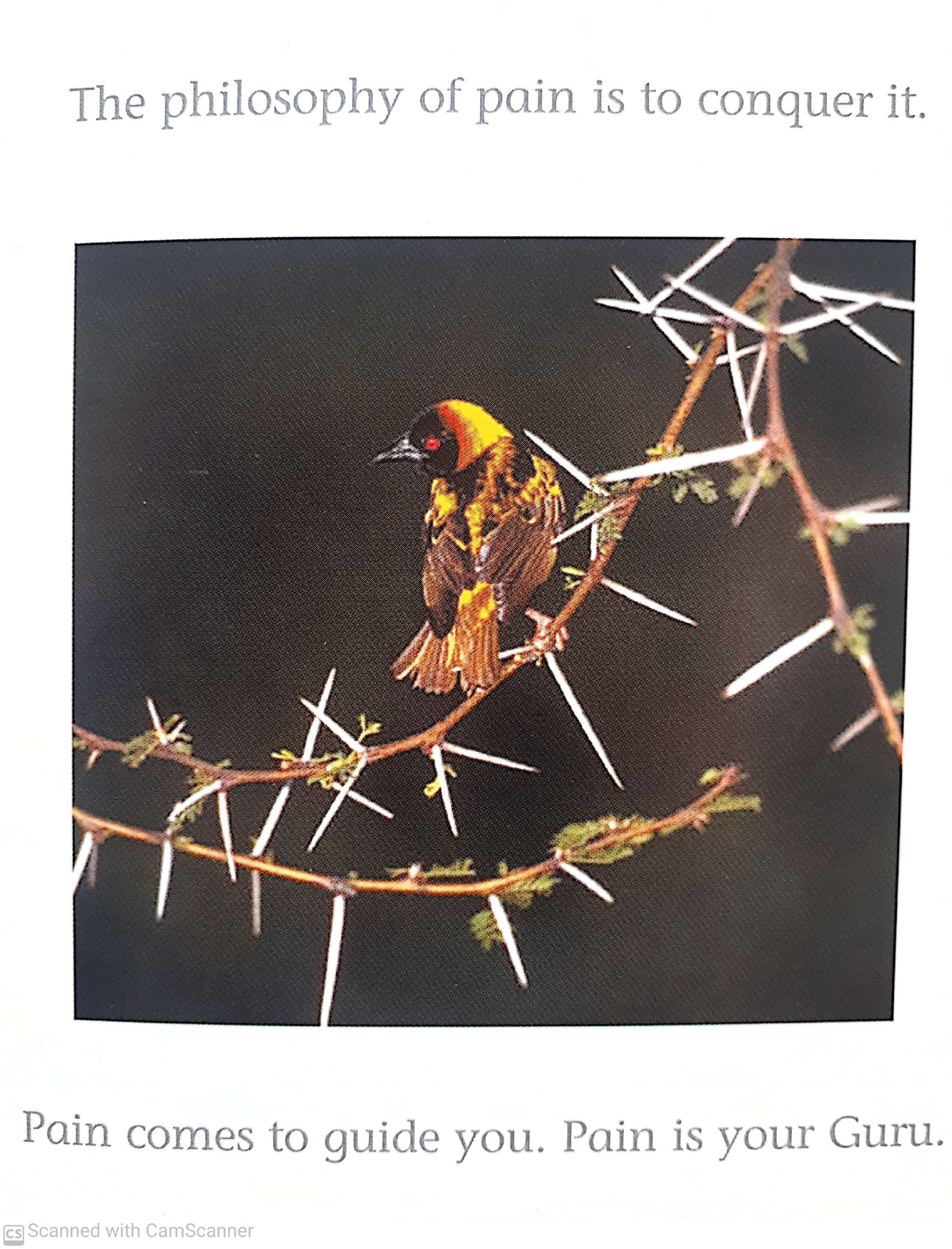
    • Pain comes to guide you. Pain is your Guru.
    • The philosophy of pain is to conquer it.

    These two statements complete each other and together provide wonderful guidance on dealing with what we inevitably meet in practice and in life – pain. Let me explain:

    Pain is a Guru

    We don’t often think about pain as a welcomed friend or teacher, and we don’t like this uninvited guest. At best, we say that one needs to bear the pain. Some even say: ‘no pain, no gain’ (which I don’t agree with). But we don’t treat pain with reverence and respect as we do our Guru! So, why did Iyengar say that pain is a Guru?

    Think about the opposite situation, in which we won’t be able to sense pain at all. That would be catastrophic, we wouldn’t know when we injure or hurt ourselves. When practicing, we wouldn’t know how much we can stretch and how long we can stay in challenging asanas!

    In fact, there is a rare condition, called “Congenital insensitivity to pain (CIP)”  in which a person cannot feel (and has never felt) physical pain. Wikipedia says that: “Because feeling physical pain is vital for survival, CIP is an extremely dangerous condition. It is common for people with the condition to die in childhood due to injuries or illnesses going unnoticed”.

    So essentially, pain “comes to guide you”. We have to listen to the pain and understand the message it sends us. This doesn’t mean that we should always avoid pain, but we should treat pain with respect and respond to it appropriately.

    B.K.S. Iyengar about dealing with pain

    The Philosophy of Pain is to Conquer it

    This second statement by B.K.S. Iyengar completes the first. According to my understanding, it means that we shouldn’t be afraid of pain. Pain is a normal (and as we read, a vital) experience.

    We can stay in an asana, even though we experience pain. We can observe the pain and study it:

    I think that we can distinguish between two types of pain:

    • Pain that tells us that something goes wrong.
    • Inevitable pain which is part of a transformation process.

    The first type invites us to look inside and explore what is that we do which is wrong and creates unnecessary pain. Iyengar gives us some clues:

    When you are overstretching somewhere to get the optimum movement, have you ever noticed that you are also giving too little attention to other parts of the body?

    …In concentration, you are likely to forget some parts of the body… that is why you get pain in certain parts of the body. It is because unattended muscles lose their power and dropped. But you will not know that your are dropping them, because they are precisely the muscles in which you have momentarily lost your awareness

    If you have any kind of problem, you have to observe what is happening in the pose. Is there alignment, or is there nonalignment?

    … It is not good enough to experience today and analyze tomorrow… Analysis and expermemintation have to go together.

    …Analysis in action is the only guide. You proceed by trial and error. As the trial increases, the error becomes less.

    B.K.S. Iyengar, The Tree of Yoga, “Effort, awareness and Joy

    Pain may develop for two reasons:

    • Ambition
    • Insensitivity

    If you practice to compete with yourself or with someone else, you are likely to injure yourself and suffer pain. As Iyengar said: “the wanting is in the head, but the body can’t do”. If you practice to impress or achieve then you are not really practicing yoga, but some kind of competitive sport. This is over-ambition and this will eventually lead to injury.

    Admittedly, even if you are not ambitious, you may still injure yourself because of insufficient sensitivity and attention (as Iyengar so beautifully explained in the quote above – and I recommend reading the entire chapter). However, if your practice is exploratory, and you observe and analyze whatever happens in your body-mind when you perform the pose, then you will most likely be able to correct yourself and avoid causing severe injury. Luckily, the body can heal itself from minor injuries (provided that you don’t keep practicing wrong). Over time you will know your limitations and vulnerability and develop a sensitivity that will allow you to avoid injuries and unnecessary pain.

    Even when your practice is correct and not ambitious, you will still experience pain. But, this is a different kind of pain, which every practitioner learns to recognize and even enjoy. This is a pain that occurs while stretching an untrained muscle or opening a contracted region of the body. This kind of pain is non-harmful, and disappears once you come out of the pose.

    Every change, in practice or in life, may involve a certain amount of pain. Often it is hard to change a harmful habit (like smoking), and one needs willpower and ability to withstand a certain amount of pain and discomfort. When you want to go deeper in practice, you inevitably meet resistance. If you learn to stay in the pose, to soften and breathe, then after some time the pain will dissolve (if it doesn’t, then it’s the other kind of pain – the one that causes injury and which tells you that something goes wrong).

    Often we can grow and develop from pain. Facing difficulty and pain can be a catalyst for self-study and self-transformation. It’s not in vain that spiritual traditions hold that Dukkha (existential pain, see more about Dukkha) is necessary, since if we are unaware of the suffering that life involves we would never want to walk the difficult path of spiritual liberation. So, as Iyengar suggests, we need to move through and cross the pain to conquer it in order to develop and grow!

  • A Feedback from my Workshop in Bogota

    What is it about

    On the first day of my recent workshop in Bogota, Colombia, I asked the participants to reflect on the following three questions:

    • Past: Why did you start to study yoga?
    • Present: What is your current motivation to continue practicing, and did the motivation changed since you had started?
    • Future: How do you project on your path in the coming years? Do you progress in yoga? and in relation to this: What does it mean to progress in yoga? How can we define and measure progress?

    Fanny’s Answers

    Dear Eyal, 

    Thank you again for the workshop in Bogota! It was really interesting. It was a great combination of asanas and reflection. I learned a lot on both aspects. 

    So, I tried to reflect on the 3 questions you gave us during the workshop, and I will share my answers with you. 

    So my name is Fanny, I am French but live in Colombia (in Cali) for 13 years now.  

    1. Why did I Start? 

    I start 2 years ago. Before I used to run. 

    Actually, several times friends of mine teaching or practicing yoga invited me to practice with them and I used to resist. I had the image of people doing yoga:  a little bit of ‘show off’ and that it was not for me. 

    And then came the pandemics…. And in Colombia, the rule was: if you want to run you have to put on a mask…. And it was impossible for me…. So, I stopped running. 

    After a time being in lockdown…. I felt very trapped in my house… And eventually, a friend told me that she was doing yoga with a teacher in Cali prudentially (secret practice because at that time it was forbidden)! And she is an Iyengar teacher. I was so happy to find a way to go out of my house, that I ‘jumped’ on the opportunity. And I started practicing with her. Once a week and then 3 to 4 times a week.  

    So I started yoga as an escape from the lockdown! As a way to go out of my house, see people, and do something with my body. But I feel that yoga came to me when I was ready to receive it and appreciate it.  

    2. Why do I do it now? 

    Now, my relationship with yoga has evolved a lot. The lockdown stopped, so I started to run again, but I kept practicing yoga.  

    I find yoga very important for learning humility (start something from zero, be bad at something, and start progressing), I find it good for my body (I am very tall, and not very flexible…) and my posture. But also the mental aspect, to hold postures beyond the pain, gain an understanding of my body, give it more respect, be more connected with it, evolve… 

    What also happened is that our Teacher in Cali left for the United States…. So it put me (and all the students) in front of our real interest to go on (with or without the teacher)… and to face self-practices. While I was practicing with her, I didn’t practice alone, at my home. I didn’t find the motivation to practice without the teacher. 

    Thanks to her departure, I achieved to start self-practice: I bought props, and installed ropes on the wall…. And I started to practice alone. So for me, it meant that I am not in the same place as initially when I started practicing yoga.  

    I also started to practice with an Iyengar teacher online. At first, I found it very difficult… to practice that way, the distance created… the digital aspect. And, it was also difficult to practice with another teacher, another approach, a different way of teaching…. The link built with the first teacher was very strong… and it was difficult to create one with another teacher (and more through virtual interaction).  

    Once overcome this feeling, I found it was a good thing. Not to be attached to the teacher but to the practice. To be able to practice despite the change of teacher and online …… 

    3. How do I measure progress? 

    In the beginning, the objective was to reproduce (more or less) the posture shown by the teacher and to hold the posture. Then, I measure progress when I felt my body is entering posture better or when I can hold postures for more time. 

    Now, I feel that I understand more and more all the subtilities of each posture, how to put the arm, each part of the feet, how to breathe… I feel progress in the sense that I understand more and more all the details that were shared by the teacher. Also, I feel sometimes that I achieve being in the present in asanas, especially in Shavasana. 

    I feel progress when in the street, I remember to move my sacrum in, to lift my chest, to roll my shoulders down… when yoga starts to be with me beyond the practice. 

    Thank you again for the workshop, and for the questions!

    Hope to practice again with you.

    Best, Fanny