Some people need the adrenaline from extreme activities like bungee jumping or mountain climbing. They feel alive and forget their worries only when engaged in such activities. We, the yogis, do not need extreme activities to feel joy. Asana practice can show us that there is joy in attending to simple activities, without extravagance or expense, and without relying on extreme stimuli or adventure. Releasing tension from the body and quieting the mind gives rise to spontaneous joy.
We can draw immense joy simply from a feeling of sound health and calmness. I often ask students to reflect on their state of mind at the end of class and compare it with how they felt at the beginning. Usually, worries and problems seem less significant by the end of the class. We become absorbed in the ‘here and now,’ and we do not give disproportionate and unrealistic importance to future worries. We can appreciate the health and happiness we have at the moment. Mark Twain has a beautiful quote: “I’ve had a lot of worries in my life, most of which never happened.” Yoga helps us to rest in the present moment and take care of what needs to be taken care of, without overdoing it.
We learn to appreciate the subtle and refined joy of staying calmly and passively in a pose while observing the gentle touch of the breath in the membranes of our nostrils. We don’t need to jump from cliffs or dive deep into the ocean to be happy. While these activities are not inherently bad, being dependent on such things can disturb our happiness. When we are quieter and more focused, we can also enjoy the wonders of nature and the beauty of art. These are simple joys that do not require expensive means and do not generate more cravings.
Of the two means to restrain the Vrittis (the compulsive-reactive movements of our mind), the second one, Vairagya, is relevant here. Vairagya is the opposite of Raga, attachment. It means desirelessness, non-attachment, renunciation. When we are desireless, we do not crave anything; we are happy with what we have and do not feel that something is missing. It is the feeling that ‘everything is perfect, just as it is’—a rare feeling in daily life, but one we often experience after good practice.
How to Develop Vairagya?
In our practice, we can observe our tendency to want more or to want something we do not have. We may crave to do the pose as the student next to us is doing or as we see in a photo of someone else. Or we may wish there were fewer people in the class so the teacher could give us more attention. Or we may want to open the window for some fresh air, etc.
Observing our tendency to focus on what we miss and what we dislike is a big obstacle to joy and well-being. By observing this tendency, we can learn to focus more on the abundance we have and to worry less about what we miss.
Santosha and Aparigraha
This is the practice of Santosha (contentment), the second Niyama in Patanjali’s yoga sutras. Craving indulgence and depending on external, elaborate enjoyments create uneasiness in the mind. When we achieve the object of our desire or the experience we crave, there is temporary relief, and we experience joy. But this joy is short-lived, as our minds will soon start to crave something else. The relaxation we experience by attaining the object of our desire is only temporary.
Patanjali includes in the Yamas the practice of Aparigraha or non-craving, non-possessiveness, and non-hoarding. Aparigraha means living a simple life without unnecessary possessions and consumption. This opposes being consumed by the pursuit of success, fame, fortune, etc. There is a saying: “What we try to possess, possesses us”. In Hebrew, there is an adage that goes (in the best translation I can think of): “The more you have, the more you worry”.
Aparigraha and Santosha are two sides of the same coin. Aparigraha is a restraint, and Santosha is the positive practice of fostering contentment. It is a practice of gratitude for what we have, which helps us not to be over-agitated by inevitable losses, pain, failures, etc.
How to Develop Santosha and Apragiraha?
Both Santosha and Aparigraha are important components of asana practice. A mindful practice teaches us not to crave ‘success’ or be devastated by ‘failure’ in a given pose. Cultivating contentment with where we are in a given pose involves not being shaken by the fact that we are in a different place every day with our practice. Some days we can nail the arm balance, some days not; some days our balance feels perfect, other days we’re just off. When we relinquish (or lessen the strength of) the attitudes of attachment and aversion, a sense of equanimity naturally arises.
Summary
Yoga connects us to ourselves and quiets the endless scampering of our minds. From this quietness, we can derive great joy—not the pleasure of obtaining something or achieving a goal, but the simple joy of being alive and the basic appreciation of each new breath. A feeling of health, energy, delight, and tranquility is all that is needed to transform a moody mind into a joyful one.
I have written extensively on Patanjali’s Yoga Sutra (e.g., The Essence of Yoga Philosophy and How to Know and Transform the Chitta). It has always struck me how extensively B.K.S. Iyengar utilizes the practice of asana and pranayama to elucidate philosophical concepts from Patanjali’s Yoga Sutra. It appears that Iyengar not only practiced each of the 196 sutras but also comprehended them through his experiential engagement with the practice. He takes the sutras from an abstract, philosophical realm to a tangible experience in the body and mind.
While there are numerous interpretations of this concise and condensed text, I am unaware of any other interpretation that employs practice to illustrate profound philosophical insights to the same extent as Iyengar does. In this regard, his interpretation is both unique and exceptional, offering yoga practitioners a wonderful means to understand and assimilate the otherwise challenging sutras.
This uniqueness is also expressed in Godfrey Devereux’s Foreword for “Light on the Yoga Sutra of Patanjali“: “Here, in his presentation of Patañjali, that door is flung wide open. This is especially clear, even to the least academically minded student, in his profound and practical interpretations of the sutras relating to Asana and pranayama. Here, especially, Iyengar’s genius comes as a great gift of clarity and insight that can only deepen the understanding and support the practice of any keen student.”
In the following sections, I present quotes from Iyengar’s interpretation in the book “Light on the Yoga Sutra of Patanjali.” These quotes are drawn from the interpretation of Samadhi Pada, Sadhana Pada, as well as the first three sutras of Vibhuti Pada, completing the Ashtanga Yoga. Through these quotes, I illustrate how Iyengar’s practical illustrations bring philosophical ideas into the realm of experience. I emphasize the occurrences of the word Asana to underscore how much the interpretation is rooted in and based on the experience gained from Asana practice.
The Quotes
From the Introduction
“The seeker is taught to perform Asanas so that he becomes familiar with his body, senses and intelligence. He develops alertness, sensitivity, and the power of concentration.”
In explaining the somewhat ambiguous concept of Asmita he uses Śīrṣāsana (headstand) to illustrate how Asmita can play a positive and negative role in our evolution:
“The chameleon nature of asmita is apparent when we set ourselves a challenge. The source of the challenge lies in the positive side of asmita, but the moment fear arises negatively, it inhibits our initiative. We must then issue a counter-challenge to disarm that fear. From this conflict springs creation…
Asana, for example, offers a controlled battleground for the process of conflict and creation. The aim is to recreate the process of human evolution in our own internal environment. We thereby have the opportunity to observe and comprehend our own evolution to the point at which conflict is resolved and there is only oneness, as when the river meets the sea. This creative struggle is experienced in the headstand: as we challenge ourselves to improve the position, fear of falling acts to inhibit us. If we are rash, we fall, if timorous, we make no progress. But if the interplay of the two forces is observed, analysed and controlled, we can achieve perfection. At that moment, the asmita which proposed and the asmita which opposed become one in the Asana and assume a perfect form. Asmita dissolves in bliss, or satcitananda (purity-consciousness-bliss).”
Asanas are explained in the framework of the yogic disciplines:
“Asana (posture) results in balance, stillness of mind, and power to penetrate the intelligence. Through Asana we learn to know the body well and to distinguish between motion and action: motion excites the mind while action absorbs it.”
The effect of well-done asanas is being in the present moment:
“Asana has two facets, pose and repose. Pose is the artistic assumption of a position. ‘Reposing in the pose’ means finding the perfection of a pose and maintaining it, reflecting in it with penetration of the intelligence and with dedication. When the seeker is closer to the soul, the Asanas come with instantaneous extension, repose and poise.
When effortful effort in an Asana becomes effortless effort, one has mastered that Asanas, In this way, each Asana has to become effortless. While performing the Asanas, one has to relax the cells of the brain, and activate the cells of the vital organs and of the structural and skeletal body. Then intelligence and consciousness may spread to each and every cell. The conjunction of effort, concentration and balance in Asana forces us to live intensely in the present moment, a rare experience in modern life.
This actuality, or being in the present, has both a strengthening and a cleansing effect: physically in the rejection of disease, mentally by ridding our mind of stagnated thoughts or prejudices; and, on a very high level where perception and action become one, by teaching us instantaneous correct action; that is to say, action which does not produce reaction. On that level we may also expunge the residual effects of past actions. The three origins of pain are eradicated by Asana as we progress from clear vision through right thinking to correct action.”
…
“At this subtlest level, when we are able to observe the workings of rajas, tamas and sattva in one toe, and to adjust the flow of energy in ida, pingala and sushumna (the three principal nadis, or energy channels), the macrocosmic order of nature is perceived in even the smallest aspects. And when the student then learns how the minutest modifications of a toe can modify the whole Asana, he is observing how the microcosm relates to the whole, and the organic completeness of universal structure is grasped.
…
Asanas act as bridges to unite the body with the mind, and the mind with the soul. They lift the sadhaka from the clutches of afflictions and lead him towards disciplined freedom. They help to transform him by guiding his consciousness away from the body towards awareness of the soul. Through Asana, the sadhaka comes to know and fully realize the finite body, and merge it with the infinite – the soul. Then there is neither the known nor the unknown and only then does the Asana exist wholly. This is the essence of a perfect Asana.”
Sutra I.17
Illustrating the concept of samprajñata samadhi (cognitive Samadhi) in the interpretation of sutra I.17:
“Take, for example, the performance of an Asana, or movements of breath in pranayama. In the beginning, these are done at a physical level. As understanding deepens, the body is penetrated internally, its movements are connected with the intelligence, and the Asana is grasped as a single unit in all directions: front to back, top to bottom, side to side. It is absorbed and held by the body’s intelligence for the soul to perceive.”
Vitarka, Vicara, Ananda and Asmita are explained through Asana:
One learns that one’s body is the bow, the Asana is the arrow, and the target is the soul. When the Asana is perfected, the target is struck: the field and the knower of the field are united. The logic and reasoning of the Asana are fulfilled. The sadhaka, having lost the consciousness of the Asana and of his body, is one with himself. His Asana, his breath, his effort and his very being are one with the millions of cells in his body. He has reached sasmita, the auspicious state of asmita.
Patañjali generally addresses us at several levels at once, so it is not unreasonable to explain vitarka, vicara, ananda and asmita in relation to Asana.
… Finally, when the conscious mechanism by which we consider and perform Asana comes to an end, the process reaches a resting point. The Asana then rests only on the inner self which is in poise: the only support is asmita.
Sutra I.37
In the interpretation to I.37 that suggests that “… by contemplating on enlightened sages who are free from desires and attachments, calm and tranquil…”, Iyengar writes:
“In the same way, one can also contemplate each stage of an Asana or each movement of breath in order to bring the citta to a state of desirelessness.”
Sutra II.8
Sutra II.8 defines Abhinivesha – clinging to life. Guruji’s interpretation shows how practice can help us overcome this basic affliction:
“While practising Asana, pranayama or dhyana, the sadhaka penetrates deep within himself. He experiences unity in the flow of intelligence, and the current of self-energy. In this state, he perceives that there is no difference between life and death, that they are simply two sides of the same coin. He understands that the current of self, the life-force, active while he is alive, merges with the universe when it leaves his body at death. Through this understanding, he loses his attachment to life and conquers the fear of death.”
Sutra II.32
This sutra defines the first Niyama, Sauca (Cleanliness)
“Cleanliness or purification is of two types, external and internal. Both are necessary. Taking a bath is external purification; performing Asanas and pranayama is internal.”
Sutra II.33
This sutra presents the concepts of Paksa and Pratipaksa:
“Paksa means to take one side (in an argument), to espouse one view; while pratipaksa conveys the idea of taking the opposite position. Let me turn to the physical plane to help the reader understand and experience the sense of these two words.
While practising the Asana, the sadhaka must carefully and minutely observe and adjust the position of the muscles, muscle fibres and cells, measuring lightness or heaviness, paksa or pratipaksa, as required for the performance of a healthy and well balanced Asana. He adjusts harmoniously the right and left sides of the body, the front and the back. Learning to interchange or counterbalance the weaker with the intelligent side brings about changes in the sadhaka: he grows, able to observe equipoise in the body cells and the lobes of the brain; and calmness and sobriety in the mind. Thus the qualities of both paksa and pratipaksa are attended to. By raising the weak or dull to the level of the intelligent or strong, the sadhaka learns compassion in action.
…
The internal measuring and balancing process which we call paksa pratipaksa is in some respects the key to why yoga practice actually works, why it has mechanical power to revolutionize our whole being. It is why Asana is not gymnastics, why pranayama is not deep breathing, why dhyana is not self-induced trance, why yama is not just morality. In Asana for example, the pose first brings inner balance and harmony, but in the end it is merely the outer expression of the inner harmony.
…
The student of yoga who learns to balance himself internally at every level, physical, emotional, mental, by observation of paksa and pratipaksa, frees himself from this hellish to-ing and fro-ing and lives in harmony with the natural world. Because he is stable, he can adapt to outside changes. The flexibility we gain in Asana is the living symbol of the suppleness we gain in relation to life’s problems and challenges.”
Balancing the Nadis:
“Through paksa and pratipaksa we can balance the three energetic currents of ida, pingala and susumna, the three principal nadis, or channels of energy. Imagine the calf muscle as it is extended in TrikonAsana, the Triangle Posture. Initially the outer calf surface may be active or awake on one side, dull on the other, and its absolute centre completely unaware. Then we learn to stretch in such a way as to bring the excess energy of ida equally to pingala and susumna or vice versa. So there is an equal and harmonious flow of energy in the three channels.”
Sutra II.46
Defining Asana:
“Asana is perfect firmness of body, steadiness of intelligence and benevolence of spirit.
The definition of Asana is given as follows: whatever Asana is performed, it should be done with a feeling of firmness, steadiness and endurance in the body; goodwill in the intelligence of the head, and awareness and delight in the intelligence of the heart. This is how each Asana should be understood, practised and experienced. Performance of the Asana should be nourishing and illuminative.
…
Asanas should be performed without creating aggressiveness in the muscle spindles or the skin cells. Space must be created between muscle and skin so that the skin receives the actions of the muscles, joints and ligaments. The skin then sends messages to the brain, mind and intelligence which judge the appropriateness of those actions. In this way, the principles of yama and niyama are involved and action and reflection harmonize.
In addition the practice of a variety of Asanas clears the nervous system, causes the energy to flow in the system without obstruction and ensures an even distribution of that energy during pranayama.
Usually the mind is closer to the body and to the organs of action and perception than to the soul. As Asanas are refined they automatically become meditative as the intelligence is made to penetrate towards the core of being.
Each Asana has five functions to perform. These are conative, cognitive, mental, intellectual and spiritual. Conative action is the exertion of the organs of action. Cognitive action is the perception of the results of that action. When the two are fused together the discriminative faculty of the mind acts to guide the organs of action and perception to perform the Asanas more correctly; the rhythmic flow of energy and awareness is experienced evenly and without interruption both centripetally and centrifugally throughout the channels of the body. A pure state of joy is felt in the cells and the mind. The body, mind and soul are one. This is the manifestation of dharana and dhyana in the practice of an Asana.
Patañjali’s explanation of dharana and dhyana in sutras III.1–2 beautifully describes the correct performance of an Asana. He says ‘the focusing of attention on a chosen point or area within the body as well as outside is concentration (dharana). Maintaining this intensity of awareness leads from one-pointed attention to non-specific attentiveness. When the attentive awareness between the consciousness of the practitioner and his practice is unbroken, this is dhyana.’ In II.48, when Patañjali says that the pairs of opposites do not exist in the correct performance of an Asana he clearly implies the involvement of dharana and dhyana.”
Sutra II.47
What is a perfect Asana?
“Perfection in an Asana is achieved when the effort to perform it becomes effortless and the infinite being within is reached.
Perfection in Asana is reached only when effort ceases, instilling infinite poise and allowing the finite vehicle, the body, to merge in the seer. The sadhaka can be considered firm in his postures when persevering effort is no longer needed. In this stability, he grasps the physiology of each Asana and penetrates within, reaching the minutest parts of the body. Then he gains the art of relaxation, maintaining the firmness and extension of the body and consciousness. In this way he develops a sensitive mind. With this sensitivity, he trains his thinking faculty to read, study and penetrate the infinite. He is immersed in the boundless state of oneness which is indivisible and universal.”
Sutra II.54
Explaining pratyahara
“For example, while performing an Asana the intelligence of the body extends outwards, and the senses of perception, mind and intelligence are drawn inwards. It is the same in the performance of pranayama. This is pratyahara.”
Sutra III.1
Explaining Dharana:
“For example, most people, even most yoga practitioners, are under the impression that Asanas are merely external and physical. This sutra removes that misconception. Patañjali defines concentration as the focusing of attention either within or outside the body. If, in performing an Asana, one directs the organs of action and senses of perception towards the mind, and the mind towards the core, the external sadhana is transformed into internal sadhana. If the limbs, the senses of perception, the mind and the discriminative intelligence are then yoked and fused with the energy of the soul, this becomes the innermost sadhana. If one performs each Asana zealously, fusing with integrated attention the parts of the body, the wandering mind and the discriminative intelligence with the soul, is this not a spiritual practice?
…
In Asana, our initial commitment or passion lifts itself, through concentration, to the level of total absorption.”
Sutra III.2
Explaining Dhyana:
“Ekatanata implies an unbroken flow of contact between the sadhaka’s consciousness and his sadhana. We can see, therefore, that dhyana may be achieved in both Asana and pranayama.
In Asana, there is a centrifugal movement of consciousness to the frontiers of the body, whether extended vertically, horizontally or circumferentially, and a centripetal movement as the whole body is brought into single focus. If the attention is steadily maintained in this manner, meditation takes place.”
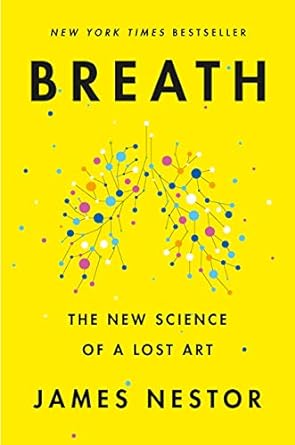
The book “Breath – The New Science of a Lost Art” by James Nestor (published in 2020) is a description of both a personal healing journey for the author, who suffered from respiratory problems for many years, and a comprehensive global exploration of the vital, and in his opinion – less researched – function of breathing. At the end of the book, there are numerous references to groundbreaking research that the book presents.
After reading this summary (or, better still, the book itself), and understanding the need to breathe slowly, you may want to use an online tool that helps to establish slow and balanced breathing. I used it and can recommend it. It’s here: https://www.alveoslabs.com/breathe
I also strongly recommend establishing a regular practice of Pranayama, which is essentially slow, deep breathing done with awareness. This online course can help you embrace this practice.
The central claim of the author is that people nowadays do not breathe correctly, and this adversely affects their health. According to the author, breathing is a central and vital component of our health and well-being, and it is not a passive, automatic action but something that needs to be done correctly. On average, we take 670 million breaths over our lifetime. With each breath, we inhale 25 sextillion (25 with 20 zeros after it) molecules, and we do this 25,000 times a day. It is worthwhile to know how to use these breaths optimally.
Due to the importance of the subject and its relevance to yoga, I have decided to provide you with a summary of the book.
Part One: The Experiment
The book begins with a description of an experiment conducted by the author and another person named Olson, in which they compared breathing through the nose with breathing through the mouth. For 10 days, the participants exclusively breathed through the mouth (with blocked nostrils). During this period, a researcher named Naik from Stanford measured various physiological parameters, such as gas tests, inflammation markers, hormone levels, smell, and lung function. The same protocol was applied for the next ten days, during which the subjects breathed exclusively through the nose.
The book describes numerous negative effects of mouth breathing, both subjective (feeling bad) and objective. For example, during mouth breathing, the author’s snoring volume increased by 4,820%, and he experienced an average of 25 episodes of obstructive sleep apnea. He also woke up more frequently during the night to urinate. Fragmented sleep leads to kidneys producing more fluid, creating a sense of thirst, and an increased need to urinate.
Snoring and sleep apnea can lead to attention disorders, concentration problems, diabetes, high blood pressure, cancer, and more, according to the author. In his view, any degree of snoring is not normal.
The description of the experiment is revisited throughout the book and accompanies it; the author describes how nasal breathing improves all the tested parameters, heart-lung functions, and overall well-being. During the ten days of nose breathing, his systolic blood pressure dropped from 142 to 124, and heart rate variability increased by over 150%, while levels of carbon dioxide rose by about 30%.
Furthermore, as revealed in an experiment on Rhesus monkeys, after six months of mouth breathing, the monkeys developed a downward growth pattern, narrowing of the dental arch, and a gaping mouth. Another study found that rats forced to breathe through the mouth developed slightly fewer brain cells and took twice as long as the control group to navigate a maze.
Part Two: THE LOST ART AND SCIENCE OF BREATHING
The second part of the book progresses through chapters titled “Nose,” “Exhale,” “Slow,” “Less,” and “Chew.” The third part, called Breath+, describes special techniques of hyper-normal breathing.
3. Nose
In the chapter “Nose”, the benefits of breathing through the nose are described. The nose is crucial as it cleans the air, warms it, and moistens it for easier absorption. While many are aware of this, most people are not conscious of the nose’s role in issues such as posture disorders and how it serves as a trigger for hormones and various chemicals that reduce blood pressure and aid digestion. Nose breathing responds to the cycles of the autonomic nervous system, influences heart rate, opens blood vessels, and stores memories.
Alternate Nostril Breathing
The Shiva Swarodaya, a Tantric text from over 1300 years ago, describes how one nostril opens while the other closes throughout the day. Modern research found that the right and left nostrils function as a kind of thermostat, regulating temperature and blood pressure, and influencing the brain’s supply of chemicals that affect mood, emotions, and sleep patterns.
The right nostril acts as a gas pedal, accelerating circulation, warming the body, increasing cortisol levels, raising blood glucose levels, and more. This occurs because breathing through the right nostril stimulates the sympathetic nervous system.
In contrast, inhalation through the left nostril has the opposite effect, acting as a brake. The left nostril is linked to the parasympathetic nervous system. Breathing through the left nostril diverts blood flow to the opposite side of the frontal lobe, influencing creative thinking and contributing to the formation of mental images and negative emotions. A study on a schizophrenic woman found that significant dominance of the left nostril led to excessive stimulation of the “creative” part on the right side of the brain, potentially contributing to vivid imagination.
The body functions most efficiently when both systems are in balance, transitioning smoothly between action and rest, between daytime vigilance and nighttime rational thinking. The book mentions the purification practice of Nadi Shodhana, involving alternate nostril breathing.
Conchae, Pituitary, and Turbinate Sinuses
The turbinates are six maze-like bones (three on each side) that begin at the opening of your nostrils and end just below your eyes. Rich in blood vessels of varying sizes, lymph nodes, and secretion glands, they play a significant role in warming, humidifying, sensing, filtering, and nourishing the unique tissue of the nasal passages. By regulating the airflow through narrow passages, the conchae ensure that inhaled air comes into maximum contact with this unique tissue.
The nasal turbinates are in constant motion, advancing more than five millimeters per minute, collecting debris inhaled through the nose, and transporting it to the back of the throat for disposal by the pharyngeal muscles. This process is facilitated by microscopic cilia or hair-like structures. The microscopic cilia move at a rate of 16 beats per second, creating a wave that propels the mucus away and contributes to the movement of the turbinates.
The pituitary sinus releases bursts of nitric oxide (a vasodilator) that have a vital role in increasing blood circulation and delivering oxygen to cells. Nitric oxide affects immune function, weight regulation, blood circulation, mood, and sexual function, with nose breathing can enhance the supply of this gas sixfold, potentially allowing the body to absorb 18% more oxygen compared to mouth breathing. Breathing through the nose regulates the nitric oxide levels in the body, and therefore, significantly influences the immune system, weight, blood circulation, mood, and sexual function.
George Catlin, an adventurer, artist, and writer, conducted, in the early 19th century, exploratory journeys in the American West and documented the lives of Native American children. He was impressed by their robust health, perfect teeth, and forward facial structure, which he attributed to the habit of nose breathing acquired from infancy. Catlin describes how mothers would carefully close the baby’s lips after each feeding, explaining that mouth breathing weakens the body, distorts the face, and creates tension and diseases, while nose breathing maintains body strength, preserves facial beauty, and prevents diseases.
4. Exhale
The chapter on the nose added information to me and reinforced my knowledge, and my intuitive feeling of the importance of breathing through the nose. However, the following chapters bring messages that can be surprising, though upon reflection, align nicely with the practice of Pranayama. These chapters describe in order the importance of exhalation, slow (gentle) breathing, and even less breathing.
The chapter “Exhale” begins with a description of the importance of lung capacity: A study that collected data from 5200 subjects over 20 years found that the strongest indicator of lifespan is not genetics, diet, or daily activity level, but lung capacity. Our ability to take full breaths is “literally a measure of living capacity.”
Naturally, lung capacity decreases with age. Between the ages of 30 and 50, lungs lose 12% of their capacity, and by the age of 80, 30% is lost. However, lung capacity can be preserved and even increased through stretches and breathing exercises. Free divers notably increase lung capacity significantly.
The connection between breathing and posture is described, and the story of a woman named Katharina Schroth, a teenager who lived in Dresden, Germany, in the early 1900s. Schroth had been diagnosed with scoliosis, a sideways curvature of the spine. Katharina cured herself through breath exercises and went on to heal hundreds of women suffering from scoliosis using breath only.
“What the bodily form depends on is breath (chi) and what breath relies upon is form,” states a Chinese adage from 700 AD. “When the breath is perfect, the form is perfect (too).”
Under normal circumstances, our bodies complete a full circulation of blood every minute, or 7500 liters of blood on average per day. This is necessary to supply oxygenated blood to cells and remove waste from them. Circulation speed and strength are influenced by chest pressure. The chest is a pump that circulates blood, driven by the diaphragm contracting about 50,000 times a day.
A healer named Carl Stough worked with asthmatics and athletes, emphasized the importance of breath, and successfully improved their performance.
5. Slow
The claim in this chapter is that the amount of carbon dioxide in our body is important and is usually too low. Olson (a partner in nose vs. mouth breathing research) makes a seemingly absurd claim: “Inhaling smaller amounts of air and containing larger amounts of carbon dioxide in the bloodstream can increase the level of oxygen in body tissues.”
He states that “regardless of the breathing rate, the body will always have enough oxygen; what the body needs to function properly is not faster or deeper breaths, but carbon dioxide.”
Henderson, a researcher at Yale in the 1930s and 1940s, found in experiments that for a healthy body, there is no benefit to excessive or pure oxygen breathing; it may even lead to oxygen deficiency. He concluded that “carbon dioxide is the main hormone in the entire body; it is the only one produced in every tissue in the body and is likely to act on every organ. In fact, carbon dioxide is a more fundamental component of living matter than oxygen.”
When we breathe at a normal rate, our lungs only absorb a quarter of the available oxygen in the air. The majority is exhaled back. When we take longer breaths, we allow the lungs to supply more oxygen in fewer breaths.
Prayers and mantras from different cultures last for 5-6 seconds. For example, the Buddhist mantra “Om mani padme hum.”
In a 2001 study on subjects practicing mantra and Christian prayer cycles, it was found that the average number of breaths in each cycle was “almost exactly” the same, 5.5 breaths per minute. Anytime the subjects breathed in this slow pattern, blood flow to the brain increased, and the body systems entered a state of coherence, where the functions of the heart, blood circulation, and the nervous system were synchronized for maximum efficiency. When the subjects returned to spontaneous breathing or speech, this integration gradually dissipated.
Ten years later, two professors and doctors from New York concluded that “the most efficient breathing rate was… inhales with a duration of 5.5 seconds followed by exhales of the same length, totaling almost 5.5 breaths per minute. In the book published in 2012, they describe the amazing results of this practice: “Even if one practices such breathing for only five or ten minutes a day, far-reaching results are achieved.”
6. Less
This chapter continues to surprise and argues that most of us breathe too much. The remedy is to breathe less! Yogis train themselves to reduce the amount of air they consume at rest, not to increase it. Chinese physicians from two thousand years ago advised limiting breathing to 13,500 breaths per day, which is 9.5 breaths per minute.
The lungs of an adult can typically hold an average of 4 to 6 liters of air. Even if we breathe at a rate of 5.5 breaths per minute, we can still easily breathe twice the amount of air needed. The key to optimal breathing, and the associated health benefits, endurance, and longevity it brings, is to inhale and exhale a smaller number of times with a smaller volume of air. “Breathe, but breathe less”. (The perfect breath is to breathe 5.5 breaths per minute, totaling 5.5 liters of air.
The godfather of less-is-more was a pulmonaut born in 1923 on a farm outside Kyiv, in what is now Ukraine. His name was Konstantin Pavlovich Buteyko. He found that patients suffering from asthma, high blood pressure, and other diseases consistently breathed too much.
In a 2014 study led by Dr. Elisha Morte, the respiratory functions of 120 asthma patients were measured. For four weeks, they maintained their levels of carbon dioxide in their bodies at a healthy rate of 5.5%. When the gas level dropped, they breathed less until it rose again. After a month, asthma symptoms disappeared or significantly decreased.
Researcher Packman explained that when we breathe too much, we expel more carbon dioxide, causing the blood pH level to rise to a more alkaline range. Breathing slower and holding more carbon dioxide internally lowers the pH level, making the blood more acidic. Almost all cell functions in the body occur at a pH level of 7.4, our optimal point between alkalinity and acidity. When we deviate from it, the body makes efforts to return to it. However, over time, these efforts to restore the pH value above may harm health.
“The yogi’s life is not measured in the number of his days but in the number of his breaths,” wrote B.K.S. Iyengar. I have read once that yogis say each person has a predetermined number of breaths to take in their lifetime, and as we breathe slower, life is extended.
7. Chewing
It turns out there is a connection between chewing, airways, breathing, and our health. A researcher named Price compared the dental health, airways, and overall health of populations worldwide. He examined communities of children who consumed traditional diets against those who switched to modern processed diets. He found that when the traditional diet of hunter-gatherers, including roots and game meat, was replaced by a processed modern diet, there was more than a tenfold increase in dental problems, crooked teeth, and obstructed airways among boys, leading to generally poor health.
Vitamin deficiency can explain tooth decay and weakened bones, but not the sudden occurrence of mouth choking and airway obstruction characteristic of modern societies.
What is lacking in our diet is the constant pressure generated by chewing. Our ancestors used to chew for hours a day, every day.
Various attempts exist to solve this problem and open the airways. Simple and immediate methods are presented, such as surgical nose procedures – which may cause severe problems, and various orthodontic devices for widening the mouth.
Devices for Opening Air Passages:
There is a device called CPAP (Continuous Positive Airway Pressure) that delivers bursts of air through obstructed airways to the lungs. This device assists those suffering from moderate to severe sleep apnea, but many people find it challenging to use.
Dentists and orthodontists have developed orthodontic devices to widen the mouth and open the airways. Devices called “monoblocks” and “bublocks” are described.
A dentist named Belfor developed an expansion device called “Homeoblock,” resembling a palate that stimulates the chewing pressure. This device replaces 3-4 hours of daily chewing with bone and wood bark chewing, as our ancestors used to do.
There are stem cells that can turn into any cells according to the body’s needs. The more one chews, the more stem cells are released, capable of producing more bone for the jaw. Chewing, therefore, improves the bone density of the jaw.
The author used Belfor’s palate and added, within a year, 1658 cubic millimeters (volume of about 5 cents) of new bone in the jaw and the right eye socket. Additionally, 118 cubic millimeters of bone along the nose and 178 along the upper jaw were added.
In a footnote, it is mentioned that there is no obligation to use the Homeoblock, as one can simply chew on hard natural foods and gum for jaw improvement.
Part 3: Breathing+
In this section, breathing techniques requiring effort and training are described. These extreme techniques are not for regular breathing but rather hyper-normal breathing, which may cause discomfort. The author argues that when these techniques are practiced voluntarily, pushing the body consciously into extreme states for a limited time, they can improve health and enhance life.
The summary of this chapter will be shorter. The main theme is that:
Breathing is more than air intake and gas exchange; it influences almost every internal organ, signaling when to ignite and when to switch it off. It affects heart rate, blood pressure, digestion, mood states, perceptions, arousal, and nausea. Breathing is a switch that controls the autonomic nervous system.
As known, the autonomic nervous system is divided into the parasympathetic – “rest and digest” and sympathetic – fight, flight, or freeze. Many nerves related to the parasympathetic system are located in the lower parts of the lungs, which is why slow breaths are so relaxing. In contrast, many nerves of the sympathetic system spread in the upper part of the lungs. When breathing short and fast breaths, this system is activated, putting the body in emergency mode to deal with danger and threat.
8. More on Occasion
The techniques in this part are not of the slow and gentle type and are not suitable for everyone. Some of them deviate significantly from the pranayama type we practice in the Iyengar method, such as prolonged breath holds or very slow and deep breaths. However, when practiced voluntarily for a short time, these techniques can radically transform lives.
Some of these techniques involve rapid breathing over time to create a state of hyper-ventilation – the expectation of the body with oxygen. Others involve very slow breathing or breath-holding for several minutes.
The Tibetan breathing technique called Tummo (Inner Fire) was developed by a wandering monk to survive the freezing cold of the Himalayas. The adventurer Alexandra David-Neel, who traveled alone in India and Tibet in the early 20th century, learned and used this technique, and documented it in her book “My Journey to Lhasa.”
Porges, who studied the vagus nerve for years, found that slow breathing relaxes the parasympathetic system. Conversely, many rapid and intense breaths activate this system, putting the body into emergency mode to cope with danger and threat.
Researchers and anthropologists who traveled to the Himalayas reported monks wearing only one layer of clothing, warming themselves in freezing stone monasteries during the day, and immersing themselves in circles in the cold around their naked bodies at night. A researcher named Benson conducted a scientific study on this phenomenon and published the surprising results in the journal Nature.
In the 2000s, a Dutchman named Wim Hof used this technique to achieve amazing feats. He stayed in an ice-filled bath for almost two hours and broke 26 world records in a decade. In 2011, an experiment injected him with a toxin called endotoxin, which usually causes vomiting, headaches, fever, and more. Hof breathed several Tummo breaths and showed no signs of fever or nausea. His technique is outlined in the book, and there are also many instructions online.
Another breathing technique called Holotropic Breathing was developed by a Czech psychiatrist named Stanislav Grof. He successfully treated patients with anxiety disorders, depressive disorders, schizophrenia, and more.
These techniques are based on reducing the flow of oxygen to the brain. Generally, about 750 ml of blood flows through the brain per minute. A few minutes of excessive breathing may reduce brain flow by 40%. This is done by inhaling more carbon dioxide, causing the production of blood vessels. This sends stress signals throughout the body.
There is no complete explanation of why and how such breathing helps people overcome post-trauma and mental problems, and how it improves the health and immunity of healthy people. Still, the results speak for themselves.
9. Hold It
This chapter opens with a description of the amygdala, a part of the brain that helps make decisions, processes emotions, and also signals danger, initiating a fight or flight response. Experiments have shown that it is not the only mechanism of the fear response. High levels of carbon dioxide also induce anxiety.
As mentioned, the need to breathe is activated based on the level of CO2 through nerves called chemoreceptors. Chemoreceptors have flexibility, and it is possible to train to increase their range. This fact is used to treat anxiety disorders through inhalation of air containing relatively large amounts – up to 35% – of CO2.
Fears are not only a mental problem, but they also have a physical manifestation, and it may be possible to treat them by training chemoreceptors.
Pranayama with breath holding raises the levels of carbon dioxide, thus increasing the range of chemoreceptors. This is also advice from the great Master, B.K.S. Iyengar.
People suffering from anorexia, anxiety, or obsessive-compulsive disorders are characterized by consistently lower levels of carbon dioxide and a much greater fear of stopping their breathing. Slow breathing can raise the levels of carbon dioxide and thus prevent anxiety attacks.
10. Fast, Slow, and Not at All
Tibetan monks practice a gentle version of Tummo, breathing slowly and less, reducing metabolic activity by up to 64%. In this state, they can raise their body temperature and stay warm in temperatures below freezing.
Breathing is more than just ingesting oxygen, expelling carbon dioxide, and coaxing nervous systems. Our breath also contains another invisible energy, more powerful and affecting than any molecule known to Western science. The yogis call this energy – Prana.
Researcher Albert Saint-Georges attempted to provide a scientific explanation for Prana. He claimed that what distinguishes inanimate objects like rocks from birds, bees, and leaves is the level of energy, or the “excitability” of electrons within those atoms that make up the molecules in matter. The more easily and often electrons can be transferred between molecules, the more “desaturated” matter becomes, the more alive it is.
The more oxygen life can consume, the more electron excitability it gains, the more animated it becomes. When living matter is bristling and able to absorb and transfer electrons in a controlled way, it remains healthy. Therefore, to maintain the health of body tissues, one must saturate the body with oxygen. Breathing slowly, less, and through the nose balances the levels of respiratory gases in the body and sends the maximum amount of oxygen to the maximum amount of tissues so that our cells have the maximum amount of electron reactivity.
De-Rose, a yogi from Brazil, explored ancient pranayama techniques describing deep breathing, breath-holding, and Bandhas. It emphasizes the benefits of breathing “all the way in and all the way out”.
Epilogue
A summary of what we have learned about various breathing techniques, including regular breathing (nose, slow, less), and advanced breathing techniques (such as Tummo or Wim Hof’s method).
Hosted by Katerina Fiadziuk, “The Fourth Niyama (Svādhyāya)” is an insightful series where senior Iyengar Teachers share their perspectives on this Niyama and the path of yoga. I recently had the honor of being interviewed, and you can listen to the first part here, and the second here, or on Spotify.
You are welcome to share your reflections on the themes discussed.
In this book, we (Ohad and Eyal) broaden the scope of our exploration and take it to the outer world. In our previous book: The Psychophysical Lab – Yoga Practice and the Mind-Body Problem, we explored the relationships between the mind and the body, while in Yoga in Nature, we explore the relationship between man and his environment. We show that one can reconnect with nature by practicing yoga outdoors and that this practice takes one deeper into one’s core. In addition, we demonstrate that natural props for yoga are often more flexible and adaptable than the studio-props.
In this post, I bring some excerpts from my introduction to the book and include some samples from the book to illustrate how nature offers useful and effective props.
Why Practice in Nature?
With all its technological advances, the modern way of life provides us with many advantages and comforts. Heating and cooling systems allow us to control air temperature; electricity provides us with light; pumps and pipes bring water to our homes. The Internet provides us with a near-endless supply of information and entertainment; and so on. All this technology saves us a great deal of time and frees us of worries about our basic needs.
Despite these great benefits, technology also has its costs. We have become isolated from the abundance of nature and its positive effects on our well-being. Alienated from a natural environment, we might even become alienated from our own bodies, which are one of the most magnificent and majestic creations of nature. This detachment from nature is apparent once we look at modern workspaces.
The Effect of Working in an Industrial Environment
Many people in Western countries today work indoors in large production halls. I used to work in such an ‘open space’ when I was a software engineer at Intel. I always felt it was somewhat ironic to call these offices ‘open spaces’ when they have no windows through which I could see the sky or breathe fresh air. These working conditions took a heavy toll on me. Sitting all day, I felt my chest collapsing and tension accumulating in my upper back, shoulders, and neck. I never had enough time for my yoga practice. Working on a computer for long hours can, in the long run, even create scoliosis because of using just one hand for the mouse. So, after less than two years, I left Intel and switched to a more relaxed way of life.
The importance of maintaining a close connection with our natural environment is stressed by Georg Feurstein, in his book The Deeper Dimension of Yoga: “Living in cities seduces people into having a merely abstract relationship to the Earth. It is important to touch the soil, tend flowers or trees, taste clean spring water, see the exuberance of wildlife, and so forth. Inwardness without such grounding is often little more than neurotic escape. Wholeness requires transformative touch of the Earth as well as blessing from the ‘heaven within‘”.
“Yoga in Nature” aspires to regain a connection with our bodies and nature. It does so by suggesting ways in which we can practice yoga in natural surroundings, ways that enrich our natural resources. Each of its three chapters introduces methods for practicing in a particular natural surrounding: the seashore (Chapter 1), the woods (Chapter 2), and the mountains (Chapter 3). In composing these chapters, we have drawn on our many years of regular and dedicated yoga practice in nature: at the Mediterranean beach, near our homes, and in many other natural surroundings, including the desert in the Negev (the southern part of Israel), Sinai (Egypt), and other locations around the world.
Over the years, we’ve discovered that such practice is a powerful way of recharging the body, mind, and spirit, and retaining balance and poise, even when facing the inevitable vicissitudes and downfalls of life. We’ve experienced the deep joy of being alone in nature, absorbed in a deep forward extension or headstand, observing the waves from surface level. Or, meditating near the sea, feeling the soft breeze on the skin, and listening to the rhymical, meditative roar of the ocean. Or, when practicing in the desert, sensing the touch of a cool curved rock against our bodies as we let our backs arch on top of it.
The Effects of Practicing in Nature
Practicing in natural surroundings has taught me about yoga more than the safe environment of my studio. In nature, my body spontaneously opens up, my mind becomes calm and focused, and my practice flows naturally and effortlessly. I can stay in challenging āsanas with less effort and more focus and concentration than when doing them at home. Somehow, and somewhat mysteriously, my body and mind react spontaneously to the rhythm of the waves and the wind, to the abundance of energy that nature offers.
Sometimes advanced āsanas that I struggle with at home come easily in nature. I often experience the state Patanjali defines in his Yoga Sutras as Prayatna śaitilya – a sensation of effortless effort in performing an āsana. This, according to Patanjali, is the characteristic of a mature and well-done āsana.[1] It is not entirely clear to me why these natural elements are so conducive to my practice. Yet the effect is clearly felt – I can concentrate and connect with myself and enjoy the practice in a way that does not often happen in the studio.
Being in nature, in front of the ocean, in the high mountains, or when watching the night stars, one naturally feels small and loses some of one’s self-importance. Nature is so vast and abundant and, when you are open to it, you become more modest and humbler. This is a good mental state for commencing a session of yoga practice.
However, to be immersed in nature, one needs to quiet one’s mind. Being outdoors is not always enough to acquire a stable and serene mind. If you go out on a noisy picnic, you may not even feel the effect of nature. The noise will probably mask the chirping of the birds or the roar of the sea. Engaging in practice quietens the mind and opens the doors of perception. Hence, it is an ideal way to emerge and reconnect with nature. When you start practicing (in any environment), you need to temporarily cast aside all your projects, tasks, plans, and worries, and connect to your body and your breathing. Being immersed in nature helps to shift the mind’s focus from its daily habits and to turn it inward to find poise within.
The practice of yoga stills the fluctuations and the automatic reactions of the mind (citta-vṛtti-nirodhaḥ). Going out into nature is a step in this direction. It quietens the mind, making it serene and receptive. When the mind is quiet, practice flows more easily (Sukha).
Iyengar Yoga practitioners (like me) might worry that proper practice requires a flat floor, walls, and most importantly, yoga props. No doubt, these all have great benefits in practice. I use props regularly and teach and write books about their use in our practice. But practicing in nature need not deprive us of the benefits of props, because, as the book demonstrates, nature itself provides effective props. And so, we do not need to give up on the benefits of props when we practice in nature. One of the joys of practicing in nature is the search for natural props. Wherever you are, you can find wonderful props. You only need to be creative and look for props with an attentive and imaginative mind.
Over many years of practicing in nature, we have devised many methods for using the sand (at the beach), the rocks (in the mountains), and the trees (in the forest) as props that enhance and deepen our practice. I find these natural props extremely effective, often more so than the artificial ones we use at the studio. The sand especially lends itself easily to creating slopes, little pits, and the like, which give soft and natural support for many āsanas. This is often even better than the human-made apparatus we commonly use at the studio. It is our sincere hope that Yoga in Nature will help you combine the benefits of being in nature with those of practicing yoga, without giving up on the benefits of yoga props.
A Case Study: Using Natural Elements in Standing Poses
One of the ways to practice and explore standing poses is by elevating the front leg on some support. In this excerpt from the book, you can see how this can be done at home using a chair, and how the same idea can be implemented on the beach, both for Utthita Trikoṇāsana and Vīrabhadrāsana I.
The same variation can take various forms, but the effect is similar. The advantage of the natural props is that they provide more flexibility since you can find sandy slopes, trunks, and rocks of different heights and shapes.
Satya – truthfulness. Like all the Yamas, is prescribed by all religions. In yoga, this is an absolute vow that requires transforming one’s character. Here I will explain why Satya is such a deep practice.
Vyasa’s Definition
Vyasa, the first and foremost commentator of Patanjali, says (in his comment to Sutra II.30):
“Satya (truthfulness) is corresponding of speech and mind to fact, i.e., saying and thinking what has been seen, heard or inferred. Words uttered for the purpose of communicating one’s thoughts to others are true, provided they do not appear deceitful, delusive and meaningless to the listeners. The words should, however, be uttered not for inflicting harm on creatures, but for their benefit; because if they hurt others, they do not produce piety, as truth would, but only sin… Therefore, truthful words beneficial to all creatures should be uttered after careful consideration”
I am using Hariharananda Aranya’s translation
Absolute and Atomic Satya.
As for Ahimsa, Prashant Iyengar differentiates between Absolute Satya (Mahavrata—great or absolute vow) and Atomic Satya (Anuvrata—atomic vow)(See: Ashtanga Yogaof Patanjali, Prashant Iyengar, published by RIMYI in 2014).
Prashant writes “For absolute Satya there should be truthfulness not only in the words uttered, but also in the mind. Truth must be without trick, deceit, deception, hoax, or vice, vile or imposture. The adherence must be honest, and there should be no riddle or enigma in truth, nor there should be any hindrance. The inner speech and the external speech of the mouth must have a cohesiveness”.
This is the difference between speaking the truth or truthfulness in speech and the vow of speech. Remember that Patanjali says (in II.31) that the Yamas are great vows unrestricted by any consideration of class, place, time, or concept of duty.
Satya in our Daily Life
Absolute Satya, as well as all the Yamas, should be followed in all circumstances and without considering the consequences. In our business of life, it is hard to adhere to the vow of Satya.
For example, if a policeman stops you on the road and asks: “at what speed did you drive?”, and suppose you drove faster than is allowed, will you respond truthfully? Or, if someone who is unwelcome for a party we organize, wants to join and asks about the details of the party, will we tell them all that we know, or will we try to avoid him?
Think about a salesman who claims that their product is the best in market, would we believe that? Untruth became so common in our business of life, in advertisement, business negotiation, and so on. If salesman get used not to adhere to truth in their professional life, will they be able to adhere to truth in other realms of their life?
Technical truth and essential truth
There is a vast difference between technical truthand essential truth. In technical truth one can have one thing in mind, and another thing on the tongue. The Shanti Mantra from the Upanishads says: “Let my speech be cohesive with my mind and my mind be cohesive with the speech”.
An example for technical and nor essential truth is the famous story from the Mahabharata, where there is an elephant called Ashwatthama, and a person – Drona’s son – with the same name. Drona is a warrior from the Kuruvas in the great war described in this epos. The Pandavas killed the elephant and Yudhishthira – which was virtuous, and known to always speak the truth – manipulated Drona, to believe that it was his son that was killed, and not the elephant. Drona believed him and in his grief, stop fighting against the Pandavas.
An example for technical and nor essential truth is the famous story from the Mahabharata, where there is an elephant called Ashwatthama, and a person – Drona’s son – with the same name. Drona is a warrior from the Kuruvas in the great war described in this epos. The Pandavas killed the elephant and Yudhishthira – which was virtuous, and known to always speak the truth – manipulated Drona, to believe that it was his son that was killed, and not the elephant. Drona believed him and in his grief, stop fighting against the Pandavas.
Technically, Yudhishthira spoke truth, but he had one thing in mind, that it was the elephant that was killed, but his words conveyed the message that it was Drona’s son that was killed.
Manu’s Definition
Manu-smriti says that the truth must be spoken but that it should also be pleasing. One should always utter what is truthful and pleasant. Truth should not be spoken just for the sake of truth. (The Manu-smriti, or Laws of Manu, are of the most authoritative codes of Hinduism in India, dating back to approximately 100 C.E.. Traditionally, the Manu-smriti was given by Manu, the first man and lawgiver, and are a commentary on the legal and social systems of India, including the caste system).
This is very similar to what the Buddha had taught about right speech:
If what you want to say is true and beneficial, find the right time to say it and say it with kindness and endearing manner.
Specifically, one has to consider the following.
Is what I am about to say is:
Factual and true
Helpful, or beneficial
Spoken with kindness and good-will (that is, hoping for the best for all involved)
Endearing (that is, spoken gently, and in a way the listener can hear and understand)
Timely (occasionally something true, helpful, and kind will not be endearing, or easy for someone to hear, in which case we need to think carefully about when to say it).
Satya should not violate Ahimsa
Prashant brings this example: You are in a forest and a robber comes and asks: Did you just see two men who passed from here? Could you tell me which of these three roads they took? If you answer truthfully, you violate Ahimsa, and hence also Satya.
Violation of Satya
(Asatya) can happen:
Directly
Indirectly – convincing or influencing someone else to be untrue
Applauding someone who is untruthful
Untruth may come out spontaneously or fabricated on account of Krodha (anger), Lobha (greed, lust), or Moha (infatuation). Only by controlling and eliminating these tendencies can we adhere to Satya.
If we speak the truth just for our gain or fame, this again isn’t Satya.
Violation of Satya can be of several degrees. If one lies for selfish reason, where someone else will be at loss, and he is joyful of the other’s loss, then it’s a severe violation.
If the violation is done to get something, but no one is at loss, then it’s a mild violation.
Lastly, one can lie for the benefit of someone else, then it’s a mild violation.
Developing Infrastructure for Satya
Prashant writes that in order to absolutely truthful, we should change our conduct and developing the following qualities:
Samata – equality
Dama – sensual restraint
Absence of Matsarya – hatred
Kshama – a kind heart
Lajja – Sense of abashment
Titiksha – Capacity to endure
Anasuyata – having no envy
Tyagabhave – sense of renunciation
Dhyana – meditation
Adhering to Satya can makes our life difficult since we lack the required infrastructure, hence we must develop the required yogic qualities and attitude.
Selfishness and truth can’t coexist.
Imagine someone who is selfless, desireless, free from expectations, will he have difficulty to speak the truth? So, yoga psychology says that you need to develop a thirstless, quiet, serene mind – only then Satya becomes possible.
Effects of adhering to Satya
Patanjali mentions the effect of being well established in Satya:
To provide the best experiences, we use technologies like cookies to store and/or access device information. Consenting to these technologies will allow us to process data such as browsing behavior or unique IDs on this site. Not consenting or withdrawing consent, may adversely affect certain features and functions.
Functional Always active
The technical storage or access is strictly necessary for the legitimate purpose of enabling the use of a specific service explicitly requested by the subscriber or user, or for the sole purpose of carrying out the transmission of a communication over an electronic communications network.
Preferences
The technical storage or access is necessary for the legitimate purpose of storing preferences that are not requested by the subscriber or user.
Statistics
The technical storage or access that is used exclusively for statistical purposes.The technical storage or access that is used exclusively for anonymous statistical purposes. Without a subpoena, voluntary compliance on the part of your Internet Service Provider, or additional records from a third party, information stored or retrieved for this purpose alone cannot usually be used to identify you.
Marketing
The technical storage or access is required to create user profiles to send advertising, or to track the user on a website or across several websites for similar marketing purposes.
 Skip to content