Eyal was teaching (physically and online) in Yoga DNA (the Iyengar Yoga center of Calgary, Canada). Toward Eyal’s online workshop in Canada in July 2020, Deanna Oliphant interviewed Eyal (Eyal hopes to travel to Calgary again to conduct more face-to-face workshops!) Deanna asked Eyal about his path in yoga, about his Sadhana (practice) and how can yoga help us to face the current challenges.
The word anitya in Sanskrit means impermanence, passing or transient. In Buddhism, impermanence is one of the three characteristics of reality[1]. Indeed, we all know that things constantly shift and change. In a year’s time, we will not look as we do now; in an hour and even in a minute, we will not feel the way we do right now. There is nothing in the entire material nature (Prakriti) that is not subject to the law of incessant change. Some things seem to change slowly while others change quickly. A mountain can exist for millions of years until it is completely washed into the ocean. Yet even a mountain changes every moment; the forces of nature – the sun, the wind, the water, and the tectonic activity of the earth are constantly transforming it. Our consciousness changes very quickly. Try to sit quietly for a few minutes and follow your thoughts; there isn’t a moment without movement – one thought haunts another one, the flow of thoughts and emotions is ceaseless. Our body is also constantly changing; at any given moment millions of cells die and others take their place. Very few cells exist in our body for more than three months.
Anitya – Impermanence in Sanskrit
Change is a fact well known to us all. Everyone knows that everything is in the process of change. But do we really internalize the reality of change? We all know we will die one day, but do we really live in awareness of our impending death? Probably not, since otherwise, we would use every minute for our development and growth and would not waste time in stupid quarrels, fights, and insults.
If we were fully aware of the constant change of all things, we wouldn’t cling and without gripping, we wouldn’t suffer. But our consciousness tends to attribute permanence and stability to things. It seems to us that the things we hold on to will continue to exist. When we experience something pleasant – are we aware that it is about to end? Because if so, then why does the inevitable end of a pleasant experience cause unease, frustration, sorrow, and sometimes even despair? When we own an object we perceive as precious, are we aware that it will not remain unchanged or that we may not own it in the future? When we experience something unpleasant, bothersome, disturbing, painful – do we not think it will be so forever? If we were really, deeply aware of the transience of all things, we would not have been so deeply bothered by unpleasant experiences, knowing that they too, shall pass. Or, as Leonard Cohen put it:
“Passing through, passing through,sometimes happy sometimes blue…“
There is, therefore, a fundamental difference between the intellectual comprehension of the fact of change (which includes the fact that we will not live forever) and a deep internalization of this reality in a way that will transform deeply our life experience.
In Chapter II of The Yoga Sutras of Patanjali, Patanjali lists the five causes of suffering (Kleshas). The first cause is avidya – incorrect knowledge, confusion, or flawed perception.
Sutra II.3 enumerates the five kleshas; II.4 notes that avidya is the field from which the rest of the kleshas sprout. Sutra II.5 describes what avidya is. Below is the Sanskrit text of this sutra and next to it, is the English translation of B.K.S. Iyengar:
Mistaking the transient for the permanent, the impure for the pure, pain for pleasure, and that which is not self for the self: all this is called lack of spiritual knowledge, avidya
Anitya is translated here as transient. Nitya is permanence. One aspect of avidya -delusion or flawed perception – is hence the perception of the transient as if it were permanent or eternal. That is: the lack of internalization of the ephemeral character of reality is a major cause for the suffering and the distress we experience.
One of the miraculous powers of the yogi, according to Patanjali, is their ability to see change as it unfolds; this is truly an extraordinary ability:
“Successive sequential changes cause distinctive changes in the consciousness.”
III.15
We know that people and places are constantly changing. When we visit a place which we have not visited for several years we notice it has changed; when we meet a person we have not seen for several years we notice they have changed. But do we see how a person who is close to us changes? Do we notice that our house is constantly changing? When I speak with someone, undoubtedly, they change during our conversation – their body and their consciousness are constantly shifting. But can I notice the change as it occurs and not just in retrospect once time has passed?
What heightened sensitivity as well as sharp perception are needed to witness a change as it unfolds! Truly a wondrous ability!
How can we foster such an ability? How can we behold changes as they constantly unfold?
This requires observation. Drawing our attention to anitya, the impermanence of all things. Practicing yoga is a great opportunity to do that. Throughout our lives, we are often too busy to pay attention to small and subtle changes. Practice is a time to stop and observe, that is why it enables us to notice the change more discerningly.
Try this now: Stand in Tadasana (The Mountain Pose) and observe how your body is held and how it is grounded on your feet. Pay close attention to the exact regions of the feet that carry the load of your body. Make a mental map in which regions that carry more load are colored with darker colors. Then observe how this map changes over time. Initially, you may not notice any change, but if you pay close attention, and keep observing this, you will surely feel that the load distribution on your feet shifts and changes all the time. You will start to notice the change as it happens and not only in retrospect!
Two aspects of the practice allow a glimpse into change; the first is the fact that we encounter ourselves differently in practice every day. Anyone who practices regularly knows that no two practices are alike. InThe Tree of Yoga, B.K.S. Iyengar writes:
“I don’t want yesterday’s experience. I want to see what new understanding may come in addition to what I had felt up to now. In this quest, my body is my bow, my intelligence is my arrow, and my target is my self. I am aware inside and I am aware outside. We must learn to stretch the bow well before we can hit the target, so go on extending the bow of your body. Then the arrow of your intelligence will become sharp, and when you release the arrow, it will hit the target, which is your soul. Don’t worry about the target. When the bow is stretched well and the arrow is sharp, you will hit it.”
During practice, therefore, it is vital to have a “beginner’s mind” – a mind that meets each experience with fresh eyes and curiosity; not one that knows in advance. Then, we will be able to see that our experience is changing from day to day. Some days the practice flows smoothly and our body responds to us, while other days we experience stiffness and resistance. Even if we want to repeat a sequence of asanas we have practiced in the past, we will not be able to fully recreate that experience. The very fact that we have already done this sequence, makes the experience different. It is important to be aware of these differences and try to understand why on a certain day we feel light and open while on other days we feel closed and contracted. What could be the reasons for this?
It is important to pay attention to our mental state as we begin our practice; do we begin our practice in a rajasic (enthusiastic, energetic, passionate), a tamasic (heavy, lazy, resistant, inert), or a sattvic (peaceful, balanced, pure) state?
Practice is also a wonderful opportunity to learn to pay attention to changes as they take place. Our sense of body and our state of consciousness changes constantly and significantly during practice. Often we begin our practice in a tamasic state, feeling resistance and heaviness, looking for excuses for how we can postpone our practice. But as we begin our practice (to the extent that we actually brought ourselves to begin…) even after the first Adho Mukha Svanasana (Downward Facing Dog Pose), we will immediately feel a change in our physical sensation, the quality of our breath, and the state of our mind. We can notice these changes as they arise.
Later on in our practice, if carried out correctly, we will move towards a more sattvic state, in which we will sense more flow, as well as responsiveness, and our consciousness will quieten and empty itself of unnecessary thoughts and narratives. If we pay attention to these changes, we will cultivate the ability and the sensitivity to really witness anitya – the ephemerality, temporality, and transience of all phenomena. Then we won’t hold on to anything and live with greater freedom and joy!
[1] The other two are dukkha – the fact that the experience of existence involves discomfort, dissatisfaction, pain, and suffering, and anatta – the lack of constant, independent, and eternal self.
We have in yoga a wonderful classification of asanas (poses) that are twists. These poses, when done mindfully, have a refreshing effect on the body and mind. They feel great on the tired muscles of the back, induce mobility in the spine, and have a wringing effect on the inner organs…squeezing out stagnant blood and then when you return to a neutral position, encouraging a fresh flow of blood to the area. At least that is what we say in yoga science. I’m not looking to back this claim up with scientific proof, just inviting you to give a twist a try and enjoy the effects.
However, not all twists are created equal. Each twist targets a different part of the spine, depending upon whether you are standing, seated, reclining or inverted, and requires a different action in the rest of the body to deepen it. Further, introducing a prop of some kind can greatly ease, support or challenge the twist.
Revolving sages
Looking a bit deeper into the meaning of the twists, beyond just the physical enjoyment we derive from them, beckons us to look at their names. Many of the twists’ Sanksrit names are the names of sages…for example, Bharadvajasana I is a simple seated twist named after the sage Bharadvaja. His name is broken down into the Sanskrit “Bhara(d)” and “Vaja(m)” which together mean, “bringing about nourishment.” Well, that sounds nice! Sign me up. Another seated twist, which is actually a series of increasingly challenging twists is, Marichyasana, named after the sage Marichi. His name translated literally means a ray of light. This could be either moon or sun light. I find that, depending upon which pose of the series I’m practicing, I connect to an inner experience that is either reflective (moonlight) or a more powerful experience (sunlight). Another series of twists are those under the name of Ardha Matseyandrasana. Ardha means half and Matseyandra was yet another sage! Matsya means fish and Indra means Lord. So the full translation is half-Lord of the Fish pose. The half part of the name is referring to the physical posture being the half version and not the full version, just in case you were thinking that the lord of the fish is a half lord. Of particular interest, this sage, Matseyandra, is credited with founding the Hatha Vidya (the study of Hatha Yoga). What a rich history…there are many sages in the Hindu tradition. If you are one that enjoys lore and history, you can find much to research, but that is beyond the scope of this article. From a practical perspective, the first version of this pose challenges the joints of the toes, feet, ankles, knees and hips, yet is extremely therapeutic to those joints. This is just the set-up of the legs and lower body, before we even attempt to move the spine. Because of the slightly raised position of the pelvis on top of one foot, the twisting preparation for this pose allows for a very full twist of the spine, with one upright thigh stabilizing the torso. The final measure is to add in the bind of the arms both around one knee and behind the back. This compresses the diaphragm and chest somewhat, so breathing becomes labored. With time, one adjusts to this, but the effect after the twist is extremely refreshing, and almost euphoric. I’m not sure if this is because of the wonderful circulatory effects or personal sense of accomplishment, but in any case, this is a lovely and intense twist to wake up your spine and internal abdominal organs.
Revolving twists
The final grouping of twists that I want to talk about are the Parivrttas, the revolving twists. Here’s where it gets really interesting for me. I love Parivrtta. Roll it around in your mouth and get a sense of the word linguistically. There is a churning action in just saying it. Imagine what it can do for the rest of your body! “Pari” translates to “around,” and vrtti” means “movement.” Typically, we translate it to flip or revolve. It doesn’t mean twist or turn in a simple way, but to take you from point A and then move you 180 degrees to point B. A revolution. This revolution takes place naturally in our bodies, but even more so in our minds. Prashant Iyengar, BKS Iyengar’s son and brilliant teacher in his own right, is quoted as saying, “The twisting of the body, untwists the mind.” I wonder if this statement is derived from his experience of an actual neurological phenomenon. A twist, in addition to being a cross-lateral movement (coordinating both sides of the body at the same time, like so many yoga poses), also often crosses the midline of the body, which is definitely the case in a parivrtta pose. Physical exercises that are cross lateral and cross the midline, stimulate both hemispheres of the brain, building a bridge between the two sides that helps us not only in physical coordination, but in cognitive coordination, by reawakening important neural pathways. This is one of the reasons why the crawling stage is so important in the cognitive and physical development of babies. As yoga practitioners, we derive the benefits of these actions to support our mental and physical health throughout our lives. Another excellent reason to practice twists!
The great reclining parivrtta, Jathara Parivartanasana, emphasizes the action of the stomach as the stage for this twist. Jathara means stomach, Parivar is the revolving aspect and Tan is the element of stretch, extend or lengthen out. There is no doubt that this requires a level of strength in the abdominal muscles, not to mention in the legs and upper body for stabilizing, but it is not a static contraction in the abdomen. Instead, as you lie on your back, arms stretched out at shoulder height, legs together, firm as one, toes hovering mere centimeters over your right fingertips, the abdomen revolves and revolves, lengthening and extending in the opposite direction of your legs. It is not a single action that is then held, but a continuous conveyer belt of revolving actions, toning the abdomen and twisting the spine. The waist narrows and the abdominal organs are treated to a deep massage.
Another inspiring yogi, teacher and writer who developed the Viniyoga style of yoga, T.K.V. Desikachar is also of a pure yogic dynasty as the son of the Krishnamacharya, who is known as the father of modern yoga. I like to actually think of Krishnamacharya as the grandfather of modern yoga, because in addition to his son, he trained both BKS Iyengar, founder of Iyengar Yoga and my “guru” and K. Pattabhi Jois, the father of Ashtanga Yoga. Desikachar writes in his book The Heart of Yoga,
“Imagine you are driving a car and suddenly a tree appears right in front of you. In your mind’s eye you see what would happen if you kept driving in the same direction: you would crash into the tree. To avoid that outcome you immediately turn toward another direction. Parivrrti describes this ability to foresee what is going to happen and to redirect oneself accordingly.”
Grounding while reaching towards the heavens
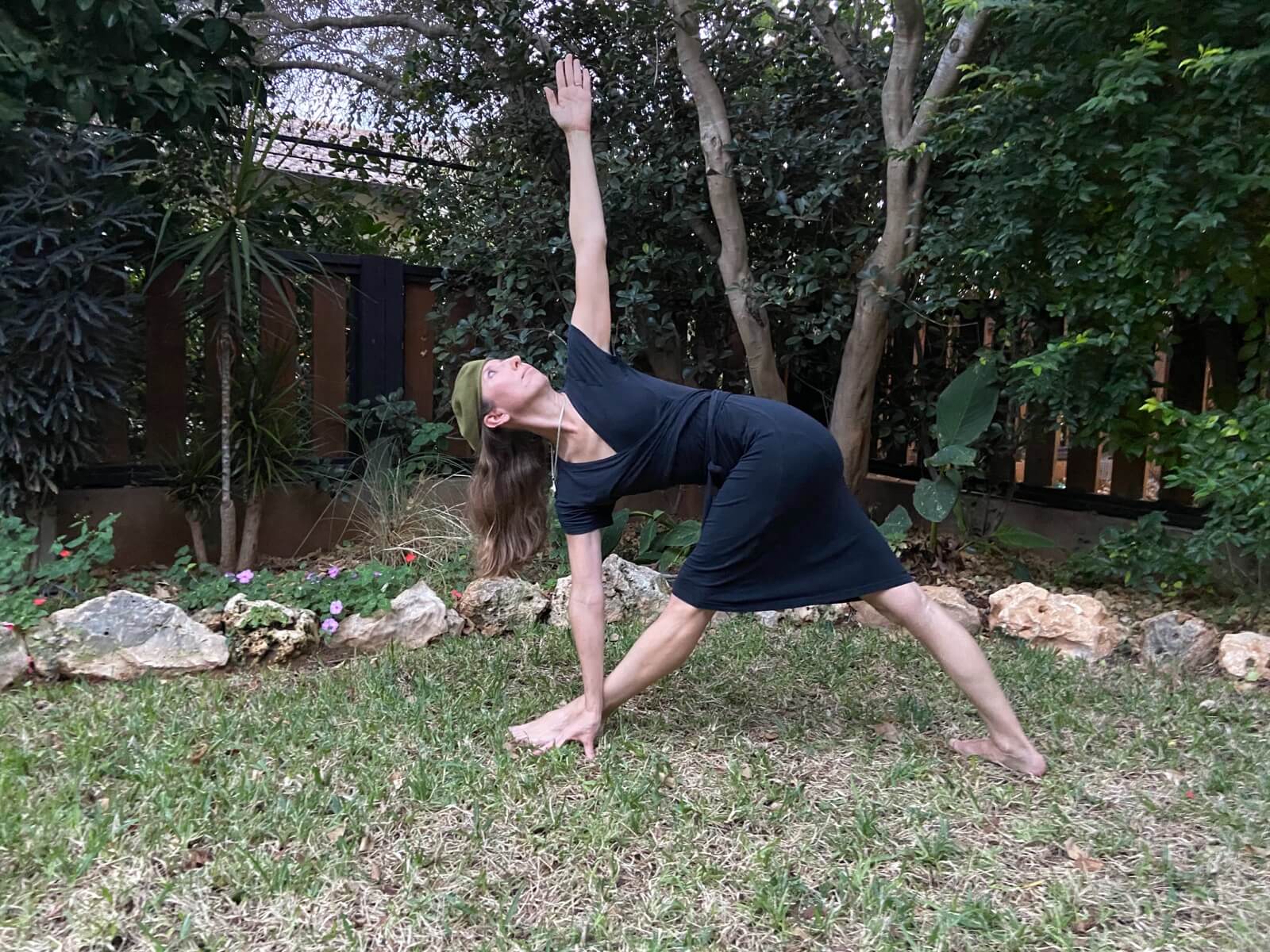
To visualize a Parivrtta pose done well is to be slightly confused at what you are seeing. The legs are going in one direction, but then the torso and face are flipped and moving in the opposite direction (pictured). Revolving triangle pose, is one such pose that we typically begin learning this action in.
Parivrtta Trikonasana
The legs are positioned more or less in the familiar triangle pose stance. Then you turn your body in the direction of the rotated “front” leg, as you would in such poses like Virabhadrasana I, or Parsvottanasana. Here’s where it gets interesting. Your legs stop revolving and your hips put on the brakes, stopping here and anchoring the pose with a compressive action. But your torso, your heart, your arms and your head keep going! And going. You find anchor with one hand reaching to the floor, but you continue revolving the chest and heart and gaze, up, up, up, using your other arm as leverage to move you further than you ever thought you could go. Lean a little in the back space, with faith and trust in the steady firmness of your legs, your anchor, while flying up with the soul to a new revolutionary height. Then you stop. You don’t go any further. Maybe you can’t physically go any further. But we work to achieve this line of channeling through the arms. They stack, one on top of the other, the lower, grounding you deep into the energy of the earth, while the upper reaches towards the heavens. And there you are, in your own little revolution, suspended in the middle.
Revolutions, our great teachers
Typically when our legs stop us, we stop. We are dependent upon them, as organs of action, to get us places. This revolutionary pose teaches us many things, both physically, mentally and spiritually. Sometimes, when some force (inner or outer) tells us to stop, we must stop and listen. Other times, we resist the resistance, moving forward on the path less taken in order to continue (r)evolving. To the point of Desikachar, this revolutionary tool is that it gives us the ability to see clearly the current path and know that we need a change or redirection. But not every revolution has to be a fight or a struggle. In a balanced Parivrrta Trikonasana, you feel the support of the previous path, giving you just the right amount to tension so you can continue your (r)evolution, grounding you, stabilizing you, and yet giving you the freedom and faith to fly.
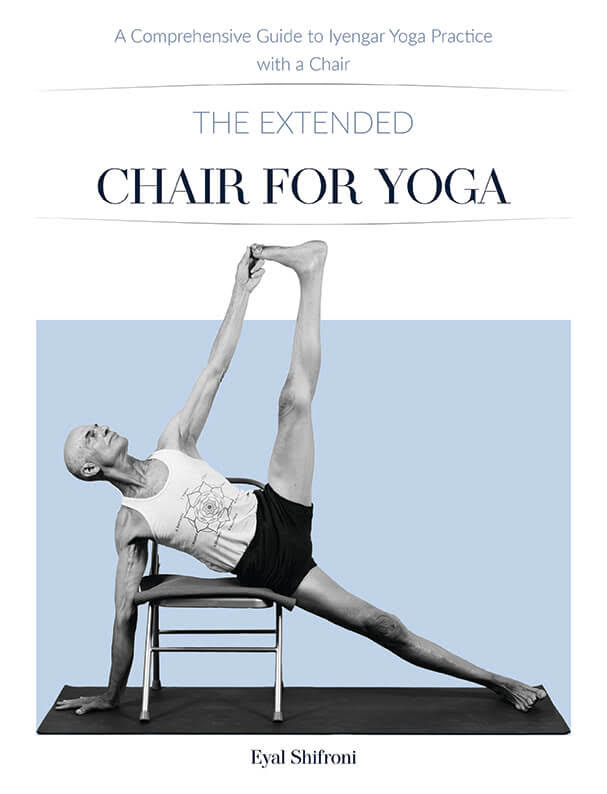
I love Eyal Shifroni’s new book, The Extended Chair for Yoga! Creative, fun, and accessible for practitioners of all levels, this book allows beginners to learn poses with support and stability. Beginner and intermediate practitioners alike can find lightness, integration, and access to various key aspects of a pose to inform the classical postures. A worthwhile resource in the light of BKS Iyengar’s work. I highly recommend this book. Thank you, Eyal for your inspiration!
I highly recommend this new book that is already in my hands. I have been using A Chair for Yoga for years for my personal practices and for teaching. I find in practice with a chair something very special that the book sheds light on: it takes care of my body and it helps me to deepen my practice and learning. This new book adds new postures and new variations that I receive with great joy to enrich my practice and teaching, giving me more clarity on new postures as well as new ways for doing different actions.
Noga Chepelinski, Director of Iyengar Yoga Center, Buenos Aires, Argentina, and translator of Eyal’s books to Spanish
Anyone who marches on the path of asana practice, or the practice of yoga postures or poses – feels that there is something special about this practice, something that affects our entire being on all levels and brings tremendous joy and contentment. So why don’t other sports and activities have the same effects that asana practice has? This short article is one answer to this question.
Asana practice requires mindfulness
Yoga asanas or postures – as practiced in the Iyengar methodinvolve the performance of a large variety of movements and actions which are intricate and not easy to learn. Compare this with activities like jogging, cycling, or swimming. These are very positive and healthy activities, but the actions one performs are repetitive and mechanical – once you learn to cycle, your body knows how to do that and you don’t need to think about what and how you do it – you just repeat the same actions, over and over again, developing only a limited number of muscle groups.
Eyal Shifroni – Asana Practice
Activities like jogging, cycling, or swimming are very positive and healthy, but the actions one performs are repetitive and mechanical.
Asana practice differs as it involves the activation of many muscles in a coordinated manner. When practicing asanas you must be attentive and think about what you do, so the effect is bringing the mind and body together. Coordinating many actions requires communication between various capacities, for example, breathing, focusing, observing, and adjusting. One becomes totally absorbed in this process. Coordination leads to communication which in turn leads to communion. There is an orchestration of actions that becomes more and more harmonious as one continues to practice and refine.
Asana practice differs as it involves the activation of many muscles in a coordinated manner.
This kind of skillful activity has deep effects on the mind and body. You need to fine-tune the actions you do. This requires observation and sensitivity. Swimming and running – with all the benefits they definitely have – do not require the practitioner to fully engage the depth of their sensitivity and intelligence in the performance of their sport. Whereas asanas – when done mindfully, have the potential to educate you on many levels and to improve your sensitivity, sense of proportion, quality of judgment, and so on. Asana practice can enhance your intelligence in the deepest sense of the word (not the IQ measure). It will also give you more joy and peace – but this is a topic for another discussion.
Asanas – when done mindfully, have the potential to educate you on many levels and to improve your sensitivity, sense of proportion, quality of judgment, and so on.
To provide the best experiences, we use technologies like cookies to store and/or access device information. Consenting to these technologies will allow us to process data such as browsing behavior or unique IDs on this site. Not consenting or withdrawing consent, may adversely affect certain features and functions.
Functional Always active
The technical storage or access is strictly necessary for the legitimate purpose of enabling the use of a specific service explicitly requested by the subscriber or user, or for the sole purpose of carrying out the transmission of a communication over an electronic communications network.
Preferences
The technical storage or access is necessary for the legitimate purpose of storing preferences that are not requested by the subscriber or user.
Statistics
The technical storage or access that is used exclusively for statistical purposes.The technical storage or access that is used exclusively for anonymous statistical purposes. Without a subpoena, voluntary compliance on the part of your Internet Service Provider, or additional records from a third party, information stored or retrieved for this purpose alone cannot usually be used to identify you.
Marketing
The technical storage or access is required to create user profiles to send advertising, or to track the user on a website or across several websites for similar marketing purposes.
 Skip to content