During our confinement period of Covid-19, this series of conversations with well-known yogis from around the world, aims to focus our minds on the “other aspect of yoga”. How can our practice of yoga philosophy help us navigate these difficult times? This program with Iyengar Yoga Teacher Eyal Shifroni of Israel, took place on April 19, 2020. The program was created and moderated by Rahel Wasserfall, Phd, Certified Iyengar Yoga Teacher. Sponsored by Artemis Yoga of Watertown, MA and the Iyengar Association of New England.
About “The Extended Chair for Yoga (2020)”

What’s new in The Extended Chair for Yoga
Since the initial publication of his successful book, A Chair for Yoga, Eyal has discovered many new and exciting ways of using the chair for yoga. This new book is an expanded, richer adaptation of the first book.
- It more than doubles the number of variations, while still keeping the original variations from A Chair for Yoga.
- It includes more than 600 photos – illustrating how to perform each variation. All the photos were retaken and are of better quality.
- It contains eight new practice sequences, in addition to the one presented in The Chair for Yoga.
- For each variation, there is a level of difficulty and benefits of using the chair in a presented way.
- The graphic design is improved significantly making the book easier to use.
There is a lot to explore in this book for both yoga practitioners and yoga teachers. One of the sequences even caters to non-practitioners who may wish to refresh during their office workday.
Those who studied A Chair for Yoga will find here a trove of new ideas for hours of enjoyable yoga practice and exploration of the asanas!

The Preface of the Book
My first book, A Chair for Yoga, was first published in a limited Hebrew edition in 2012. This edition quickly sold out and people began urging me to translate it to English. After some hesitation, I wrote a slightly extended English version, which I showed to my Guruji, B.K.S. Iyengar. Guruji gave me valuable comments and suggestions. With this feedback, I published the book in 2013. As Guruji’s predicted (see his letter in Appendix A), the book was very well received by teachers and practitioners of yoga around the world.
I was very happy to know that many practitioners found this book useful, and I was deeply moved by the amount of positive feedback I received from all corners of the world. The book has circulated widely all over Europe, America, Asia, Australia, and to some countries in Africa. It was translated into eight other languages (including Spanish, Russian, Korean, and Chinese).
It really fills my heart with joy to know that my modest work has touched so many people. I became a kind of “chair expert,” and some even began calling me “the chairman.” Naturally, I continued to experiment and explore different ways of practicing with the chair and found many useful new Variations. I tested these Variations in my teaching, both in my center and in workshops I was fortunate enough to conduct around the globe. Friends and colleagues contributed many new ideas, and I felt that the new material had grown into a new, extended book; hence, The Extended Chair for Yoga.
Although this book is based on A Chair for Yoga, it is entirely new. I have edited the entire text, added many new Variations and sequences, revised and took new photos, and organized the material in a more accessible way. I’ve also given special attention to aging and disabled people who need the chair as a practice aid. In some sections, the Variations are grouped by chair usages, rather than by āsanas. For example, I have grouped together several āsanas from the same family, which share the same usage of the chair. This makes the presentation more concise and efficient. For each Variation, I have added a list of props needed (omitting the sticky mat and of course the chair – as their usage is assumed), as well as a benefits section, explaining the special benefits of using the chair for that Variation. I have also included nine practice sequences for students of all levels, from elderly people with movement or balance limitations to advanced yoga teachers.
I hope this new, expanded book will help practitioners deepen their practice and find more joy in it, and will serve as inspiration to further explore the āsanas!
Eyal Shifroni, Feb. 2020
[1] I use Variations with capitalized ‘V’ for variations presented here, to differentiate them from regular asana variations.
Why Chairs?
B.K.S. Iyengar developed a range of equipment and accessories that enable every person to improve his or her āsana practice and benefit from it. The main purposes of these “props” is to help practitioners to:
- Perform āsanas that are difficult to perform independently with greater ease;
- Achieve and maintain correct alignment;
- Remain longer and relax in challenging āsanas, in order to attain their full benefit;
- Study and investigate the āsanas in greater depth.
This guide focuses on one prop: the chair! The chair is indeed a very useful prop, which is both widely available and very effective as an aid for all types of āsanas. As you will see in this book, there are many, many ways to use this one simple prop. Often, chairs can replace specialized expensive props. For example, many Iyengar Yoga centers have a “horse” prop, or trestle – which is a large and bulky piece of equipment. It’s not feasible to have such specialized and expensive props for every student in a class. Chairs can serve as a good substitute, and yoga centers usually have enough chairs to provide one for each student. Here is an example of using a chair instead of a trestle for Utthita Trikoṇāsana.

Photo 2 Comparing use of a yoga trestle with that of a chair Yoga chairs are affordable for any practitioner to have at home for his or her self-practice. Moreover, chairs are not made just for yoga; they are everywhere and can be used to do simple yoga poses at home, in the office, and even in airplanes and trains.
This book covers many uses of chairs for diverse groups of people.
Advanced practitioners can use the chair to explore the āsanas to a greater depth. Performance of each āsana involves doing intricate actions which the practitioner has to understand and implement with his or her body. Often, using a prop helps us to understand the action and to feel the effects of it. Once the effects are felt, one can attempt to recreate them without the aid of the prop.
Many āsanas are physically challenging and difficult to perform without props, especially for beginner students. The chair can help to build the required strength and flexibility gradually. For example, beginners are often asked to do Adho Mukha Śvānāsana (downward-facing dog pose). However, many simply don’t have the strength and/or flexibility to perform it, even roughly. Elevating the hands on a chair (see photo on page XXX) reduces the load on the arms and helps to activate the legs, thus allowing beginners to do this pose, even when the independent performance of it is out of their reach.
There are two groups of people for whom props, and especially chairs, are very important, if not essential. These are people with disabilities and aging people. For these people, it is especially important to move their bodies and to learn to breathe with awareness. In Iyengar Yoga therapy classes, people with all kind of injuries, diseases, and disabilities practice yoga with the aid of props. The chair is an important prop in making this possible. For example, B.K.S. Iyengar once helped a woman with amputated leg to practice standing poses by using a chair.
The chair is extremely valuable for aging people. We are all aging, and sooner or later our bodies will deteriorate, and we’ll become weaker. Yet aging people can continue to practice with the aid of the chair, which allows for many types of āsana, such as twists and backbends, to be performed even when the body is aging. Even when walking and standing are challenges, the support of the chair allows for variations of standing āsanas. In the last chapter of this book I present two sequences especially designed for aging people.
Chairs also allow all practitioners to remain longer in advanced and difficult āsanas that would otherwise be impossible, or would require great effort. They allow us to remain in these āsanas without effort and to relax deeply. For example, Viparita Daṇḍāsana is a challenging backbend (see photo on page XXX) which requires great strength and flexibility, but can be done, with the support of the chair, by almost anyone.
Moreover, all people can use chairs (not necessarily yoga-chairs) to repose and stretch during work – simple twists and stretches can be done on regular chairs. Some of the Variations in this book can be done on many types of chair, thus enabling anyone to do a short practice in the midst of a long working day – to refresh and return to work with better focus and clarity. For some examples on how a regular chair can be used at home or at the office, see sequence 3 in Chapter 12.
Remember however, that while props are an important feature of Iyengar Yoga, they should not be confused with its essence. Props are a means to achieve specific end – such as alignment, stability, precision, and extending the duration of remaining in āsanas. While I write about props, I do not recommend becoming dependent on props. In fact, I practice often at the beach, where I take with me only a towel and a belt, and use the sand as a prop. Props should be employed with discretion in pursuit of a more mature and mindful āsana practice. If you practice attentively, you will feel what kind of prop you need and will know how to use it.
Intention and Attitude: Abhyasa (Practice) & Vairagya (Renunciation)

Table of contents
Note: The translations of the Sutras are taken from Light on the Yoga Sutras of Patanjali, by B.K.S. Iyengar.
Intention and Attitude in our Practice
Our intention and attitude toward our yoga practice are very important – it makes all the difference between doing asanas as gymnastics, or as yoga! Every serious yoga practitioner should go in the twofold path of Abhyasa and Vairagya set out by sage Patanjali.
One can easily practice yoga as a body culture only. For us, practitioners of (the wonderful system of) Iyengar yoga, that know so many fine instructions about the actions of the body in each asana, it’s especially easy to become obsessed with the body.
It is important to ask ourselves with sincerity: Why do we practice? What are we trying to achieve? What is our real goal? Are we consumed with the technical details of the asanas, trying to perfect physical capabilities like strength and flexibility, or do we have something more in mind? Do we approach our practice space like one may come to a gym? Or, is the approach as a student entering a classroom or a lab?
Yoga practice is not only a body culture; it is not a ‘workout’. Our ultimate aim is to know ourselves. Who am I beyond all the movements and the noise of the business of life? Who am I before I define myself as a man or a woman, an Indian or Israeli, a student or a teacher, a parent or a child, a lawyer or a driver, and so on? Who am I beneath all these labels? Beyond all these appearances? Who is or what is the one that never comes and never goes?
Yoga holds that at the very core of our existence we are pure awareness. This awareness is like the stage on which the drama of our life takes place. We are actors in this drama. Sometimes we play well and gain, sometimes we play poorly and lose, but the stage (awareness) remains the same.
However, this is not obvious to us; as Patanjali mentions (in I.4), we deeply identify with our life’s circumstances and with the role we are playing. We are overly involved with the drama of our life. With our successes and failures, with our gains and losses, with our pains and pleasures. All this drama may be real – our suffering is real, but, at the same time, there is more than only this in us. To realize this, Patanjali says (in I.12) we need practice (Abhyasa) and detachment or renunciation (Vairagya). Practice is a self-study process toward the realization of this pure awareness (Purusha). Practice is the recognition of oneself as awareness.
Abhyasa – Action and Effort
Abhyasa is the positive path, the path of action and effort. It’s an effort to develop and foster positive qualities, to transform ourselves toward more stability and equanimity.
In Chapter 1 of the Yoga Sutras Patanjali defines Abhyasa (I.13) as an effort to stabilize (Sthitau Yatnah) the mental fluctuations (Vrittis). In (I.14) he enumerates the three ingredients or qualities that are necessary to achieve that. These are:
- Long time (dirgha-kala)
- Uninterrupted (nairantarya)
- With reverence and care (satkara-asevitah)
If these conditions are met, the practice becomes firm and solid and unshakeable like the earth (dridha-bhumih).
However, the very nature of our mind is to waver, to change and to move outwardly, toward the senses. Hence, consistency and perseverance are a challenge. When the practice is interrupted, previously attained serenity of mind and the commitment we made may be lost. Our commitment to “get on the mat” no matter how we may feel or what is happening in our lives, should be an anchor of stability!
In Chapter 2 Patanjali elaborates and gives more guidance about practice. In II.1 (Burning zeal in practice, self–study, and surrender to God are the acts of yoga), he describes Kriya Yoga – the yoga of action. Which he elaborates (in II.28-55 and III.1-3) as the Ashtanga Yoga – the eight-limbed yoga.
How Should we Practice?
The practice is a process of learning and developing. We should respect both our process and everyone else’s process! Everyone, according to her or his constitution and aspirations will have a different process. There is no point in comparing or judging. Whatever we meet along the way in the process is good; it is working for us. The practice is an exploration unto ourselves – a study of our body, breath, mind, and senses. It should never be mechanical; it should be playful and enjoyable. We have to carry out experiments and compare the effects of different settings and different variations. Sometimes we may find ourselves on side-roads and sometimes even get lost – this is all right; it’s a part of the exploration process.
One thing we can readily observe is our tendency to impress, to compare, and compete. These are very natural impulses, but they are not beneficial to our process of development. There is no point in comparing ourselves with others. It’s also impossible – we can never know the situation, or the life circumstances, of the student next to us.
We should approach our practice with the right attitude, the right mindset. When we practice, we should be mindful and reflective. Our practice is our psychophysical lab – a lab of self-study (svadhyaya), a lab for working with and on, our entire being. It’s not important how the asana looks from the outside, but how you feel it on the inside. The essence of an asana can’t be captured by a photo. Hence, when you do a pose for the camera, you are not doing an asana. The purpose of doing an asana is to feel more. The body is a field (kshetra) of sensations (sparsha). If we are obsessed with performance, we will not experience this field of sensations and will not develop awareness and sensitivity.
The object of study is our whole being and the asanas and other yogic tools or limbs are the language through which we carry out this study. The process is for the development of our whole being. We need to develop capabilities and attitudes like sensitivity, stability, (bodily and mental) flexibility, persistence, self-discipline, balance, and equanimity. These capabilities are psychophysical – they pertain both to body and mind.
Let your needs, rather than your will to dictate what you do in your practice; use and enhance your capacities and respect your limitations.
Vairagya – Total Acceptance
The second component of the yogic discipline is vairagya. Vairagya is desire-lessness, dispassion, letting go and renunciation. How can we live without desires and cravings? Is this really possible for in our modern society which tempts us to always want more and more.
Vairagya is to agree to accept reality just as it is. Usually we are not ready to accept things as they are. We want more pleasure and less pain, more gain and fame, and less loss and blame. To accept reality as it is, we must acknowledge that:
- We can’t do everything; we are innately limited,
- We can’t have everything, be it material or social. I can’t have a nice apartment, car… and I can’t always make someone else love me.
- We can’t control everything – and least of all the flow of time and the inevitable change of everything. We’ll get old, we’ll have to give up all our possessions and our relationships, and one day, we’ll die.
Vairagya doesn’t mean lack of will; it doesn’t mean that we don’t want to learn, develop, or experience joy and love. It does mean that we have to fully accept all these inevitabilities.
Awareness of the Breath: The Passive State of Soft Exhalation and Retention
After listing the nine obstacles for the yogic path (in YS I.30), Patanjali mentions a few means for tackling these obstacles. One of them (YS I.34) is an awareness of the breath which is the core of Pranayama practice:
Prachchhardana vidharanabhyam va pranayama
This is translated by B.K.S. Iyengar as:
“Or, by maintaining the pensive state felt at the time of soft and steady exhalation and during passive retention after exhalation“
It is indeed remarkable that Patanjali recommends awareness to the flow of the breath as a mean to overcome the impediments.
The Buddha in the discourse on the establishments of the foundation of mindfulness (The Satipatthana Sutta) also recommends awareness to the breath as a mean for Sati or mindfulness.
The breath is indeed a marvel! On the surface, it is just another physiological process to ensure the continuation of our lives. However, a closer inspection reveals the uniqueness of this process. The breath is both voluntary and involuntary. It happens on its own and doesn’t need our conscious intervention. But, unlike the other involuntary physiological processes of our body, we can become aware of the breath and also modify it! We don’t really feel the secretion of insulin by our pancreas, or the digestive juices secreted by our stomach, but, we can know that we are inhaling as we do so, and can be aware of our exhalation as we breathe out.

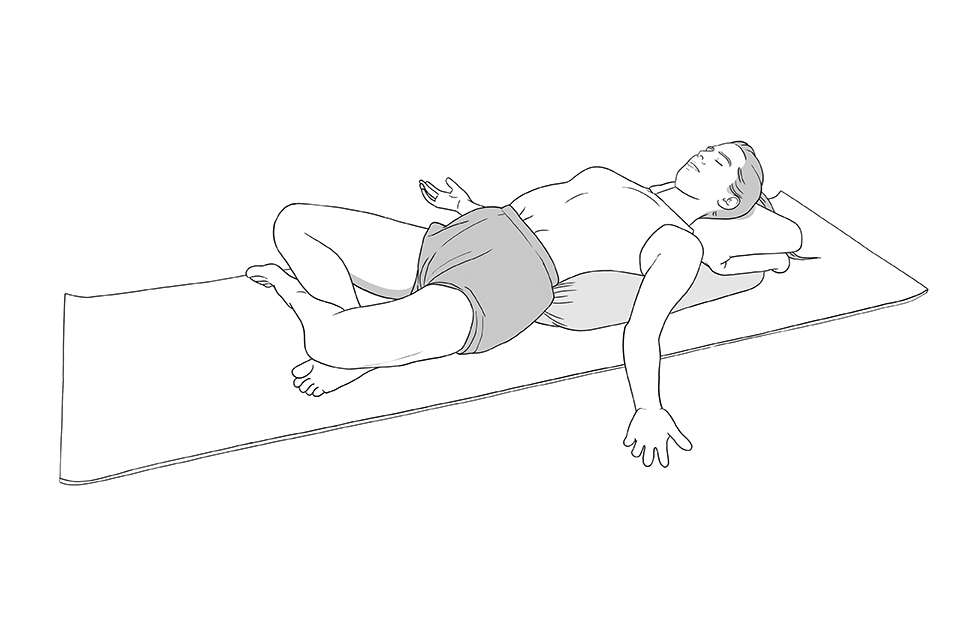
Awareness of the Breath – Eyal Shifroni in Pranayama practice This unique accessibility of the breath to our conscious awareness opens a gate for deep introspection and reflection.
Try this now:
Exhale softly and steadily and then pause for a passive retention – just observe this state of retention after exhalation. What happens? How does the next inhalation occur? What force directs the respiratory muscles to contract for the next inhalation? Observe this with the utmost curiosity; as if this is your first breath, as if you have never breathed before. Just wait there without making any willful effort to inhale nor to resist the inhalation when it comes, and ask yourself, what brings about this next inhalation? How does it happen? If I don’t do it myself, then who does?
This is indeed a wonder! A mystery! Don’t take for granted that the inhalation will occur, maybe it won’t; definitely one day it won’t. However, so long as you live, this miracle happens again and again, a dozen times every minute, whether we are aware of it or not.
The answer of yoga to this mystery is that there is a cosmic energy, called Prana – the cosmic life force, the source of all vitality – and this energy makes us breathe. What really is Prana? You can get a glimpse of it by careful observation of the “passive retention after exhalation.” Such observation and exploration through an awareness of the breath can bring deep insights, which may help to overcome obstacles, difficulties, confusion and doubt that we may encounter on our way.
The breath is indeed a great object to look at and explore, since in a sense, it resembles and reflects our life situation. Most of what happens in our life is beyond our control, however, we do have some control. We cannot control the way in which we came into this life, or the family we were born into, nor the body we got. We cannot control the aging process, the passing of time or the decay of our body. Yet, to a certain extent, we can choose our path in life; we can choose to foster some qualities and to subdue others. And to a certain extent, we can control our reactions to life’s eventualities.
A careful examination of the natural flow of our breath, as well as gentle manipulation of it, as done in the practice of Pranayama, can teach us a great lesson about Life itself. We get a glimpse into a process, which on one hand, is beyond our control, while on the other, can be affected and modified. We can retain the breath for a minute or two, but at some point, the natural impulse to breathe will take over; or, in yogic terms, the force of Prana will take over and make us breathe (it’s said that it’s impossible to commit suicide by holding the breath because of this reflex). Essentially, it’s a force beyond our control, much as Life is. This is a very liberating realization. We can’t control everything; we can let go and just go with the flow of life…
The breath can also soften our strong identification with the idea of ‘self’. We all have a concept of self that is running the show of our life. It is a very solid concept that we are very attached to and identified with. We have an idea of a solid, independent and constant ‘I’ or ‘me’. Whether we like or dislike our body, we are very much identified with it. We feel that we own it. If we like it, we are proud of it, but when it betrays us, we are miserable. We also have aversions and clinging to our mind; we are totally identified with it and tend to believe every thought that passes in our mind. However, we don’t have such ownership feeling about our breath, we don’t feel we own it. It comes and goes, and only stays with us for a few seconds; still it’s very essential and liked by all (even those who have breathing difficulties cherish and relish the breath). Or, as Prashant Iyengar puts it:
“All that is ours remains ours, because of the breath which is not ours but for us… It can be described as virgin nature, sublime, noble, divine, magnanimous, glorious, Godly, infinite, metaphysical, ageless, endless, boundless, immutable, indescribable”. .
(Yoga Rahasya, Vol 26 No. 2, 2019)In reality, we are just like a river which is constantly flowing and changing. The cells of our body are constantly changing. Not much of the molecules that constitute our body remain there after a few months. Our thoughts, emotions, sensations and feelings change all the time. We are like a collection of streams in constant motion. However, this reality is not always apparent for us. Through a close and deep awareness of the breath, we can see our inter-dependence with the universe and the impermanent nature of ourselves. At every breath some air molecules penetrate our body and become part of us; a second ago they were external, dead matter, and now they become a part of me, a part of the organic matter that constitutes my cells. At the same time, some CO2 molecules, that were part of me, are exhaled and returned to the environment. Observing closely this flowing, ever changing nature of the breath can teach us a great lesson about anitya (impermanence), which is one of the essential characteristic of the Reality.
Would you see this as an invitation to dedicate some time to just observe your breath?


