He is a Guru, and everything is balanced and harmonic about him. And despite the translations everything was clear. Physical body understood everything.
And It was incredible to open your body, chest.
It made such an impression!
We liked kumbhaka a lot.
We hope to see him in Novosibirsk again and probably there will be another workshop on kumbhaka.
Thanks a lot, Guru!
Elena
Three days of the Eyal Shifroni’s workshop have passed so fast.
It was absolutely new experience for me.
Thanks Eyal for the new knowledge. My body and conscious transformed into a research laboratory for those three days.
Oksana
Workshop of Eyal has come to an end.
With huge thanks to Guru for knowledge, for special atmosphere, that brings light of yoga, possibilities to explore yourself, to be in “a laboratory” here and now!
I have these amazing feelings from yoga that brings everyone together. We sing mantra Patanjali and it happens also around the world-we are one international family.
Irina ️
I am still under a deep impression by Eyal, by his practising and his teaching!
Eyal always practices yoga very thoughtfully, deeply, without hurrying, I felt like the place where we are it is Pune, institute, Guruji.
When a man is proffesional and when you observe his work this is magic.
I get an impression that the sequence for personal practice is updated constantly and is also modified by him.
Poses such as standing, back forward, twistings, inversion are completed easily and consciously.
Every day we practiced in a certain sequence and every time it was a new practice. Every time there was something new – this is amazing!
It is surprising how he can build very particular poses, very artfully, without extra instructions, how he can use props for yoga and eventually the pose is light, and it calms you.
I was amazed how simply Eyal can use props for any poses and at the end of the day the pose began to open, to improve.
My best wishes to the Eyal Shifroni and we are looking forward to seeing the teacher again here.
Our intention and attitude toward the practice is very important – it makes all the difference between doing asanas as gymnastics, or as Yoga! One can easily practice yoga as a body-culture only but in an attentive yoga practice we have a vast potential for self transformation.
It is important to ask ourselves: why do we practice? What are we trying to achieve? Is it only bodily capabilities like strength and flexibility, or do we have something more in mind? Do we approach our practice space like one may come to a gym? Or, as a student entering a classroom or a lab?
We must know that our practice is not only a body culture; it is not a ‘workout’. Our aim is to develop our whole being, to develop capabilities and attitudes like sensitivity, stability, (mental) flexibility, persistence, self-discipline, balance, and equanimity. These capabilities are psychophysical – they pertain both to body and mind.
An attentive yoga practice has the potential to make our life better; to make us better human beings. To do be more wholesome for us, for the people around us and for the environment. We should develop positive qualities such as: tranquility, concentration, consideration, generosity, compassion, joy and happiness with the wellbeing and success of others.
When performing an asana we should reflect on what happens in our body-mind-breath and senses. Many things are happening!
What we feel is more important than what we do since the purpose of doing is to feel more, to develop our awareness and sensitivity.
There are many correlations between the body and the mind which are revealed in the practice. Here are a few intermutual psychophysical effects we can observe:
Our level of confidence affects what we can do. Low self esteem can invoke thoughts like ‘I’ll never be able to do that pose’, ‘I can’t jump up to full-arm balance’. If we are able to let go of such fixed and limiting notions and self-images while practicing, and be open to what each moment brings, then we will gain more freedom in our life.
Our ability to perform balancing asanas is intimately connected with our concentration and focus.
Our ability to let go, relax mentally and release stress helps to progress physically.
Our breath can be used to release bodily tensions, to soften, to expand, to energize, to uplift and so on.
In our new book ThePsychophysical Lab, we examine these effects and the two-way relations between the body and the mind. We discuss whether and how our practice can develop psychophysical capabilities, such as flexibility, balance, stability, non-injury, self-discipline, patience, truthfulness. We examine whether and how, developing such capabilities on the practice mat, affects our life outside of the mat.
We also show how the practice can become a lab, for observing, exploring and studying our mental tendencies. For example:
In a class situation, there will be tendencies to impress, excel and compete. If we are flexible, we may overuse our flexibility in a way that may wear and tear our joints and ligaments.
In self-practice, we often struggle with weak determination, lack of perseverance and self-discipline, with our scattered and absent-mindedness. Sometimes we experience irritation, impatience and agitation (rajas). At other times, low-energy, dullness, sadness, laziness, or heedlessness (tamas). We may find it hard to bring ourselves to practice and to kindle our motivation due to emotions such as sorrow, remorse, anger or cravings.
We may find ourselves practicing ambitiously, to achieve and show-off, then we will be strongly affected by success and failure.
Sometimes we tend to practice mechanically and habitually. We just repeat the things we already know without a real motivation to explore and learn and with no interest, curiosity and creativity. We prefer to repeat the poses we know and are easy for us, avoiding what we really need, even if it’s harder and there are no immediate benefits or satisfaction.
In order to maintain our practice on the right track we should develop and apply the five qualities that Patanjali mentions in sutra I.20, and that B.K.S. Iyengar calls: ‘The five vitamins of the yogi’ (see: The Tree of Yoga in the chapter: The depth of Asana). These are:
Shrada – faith; trust that the path of yoga is the path we need to undertake in order to improve and progress.
Virya – prowess, energy and determination that are needed to overcome obstacles and difficulties that we will surely encounter sooner or later on our path.
Smriti – strong and keen memory to remember, moment after moment, to come back to ourselves, to the present moment, to remember what we are trying to achieve.
Samadhi –concentration and absorption.
Pragnia – spiritual wisdom.
Shrada is akin to a mother; since the mother’s love, confidence and trust in her child develops his or her faith. Virya is the energy and willpower given typically by the father. Smriti, the third quality is very central, and it appears at the center of the five. It is the gate for the following two. It is difficult for our mind to concentrate and be quiet. We want to concentrate, but soon forget. We are carried away by the business and worries of our life and forget to breathe, we rarely stop to return to our senses and to be mindful to what is happening in the present moment. We live in our memories or in our plans and worries and miss the joy of being in the present moment – the only moment where life really happens!
Smriti is mindfulness, which develops concentration (samadhi), from which wisdom (pragnia) follows.
If we approach our practice seriously, we have to develop and foster these ‘vitamins’ and combine them in our daily attentive yoga practice. Then our practice will progress and if we preserve in it, we will develop the yogi’s capabilities and qualities we mentioned at the outset of this article.
It is important for us to keep in mind and affirm that yoga practice has immense potential for improving our lives, as well as the lives of those around us. In the hustle and bustle of life and the pressures we are all in, we often forget that.
There is a tendency to focus on the physical aspect of the practice, to practice in order to become more flexible, stronger, to look better, to be healthier. If, for instance, because of life’s overload we can’t practice for a few days, we say, “ugh, I didn’t practice for a few days, my body is really stiff!” but how often do we say: “ugh, I did not practice for a few days, my mind is really stiff!”? And when would we feel more successful? When we grind our teeth to accomplish a difficult asana, even though mentally we experience stress, struggle, and ambition, or when we are performing a simple asana and experience concentration and serenity?
The body is a component of the human system and is of utmost importance, but we must view our entire system holistically and remember that yoga practice is intended to transform our entirety. It is essential to remember this especially in moments of difficulty and crisis when dealing with physical or mental difficulties. There and then, particularly, it is important for us to remember that practice is not intended only to obtain more flexible shoulders, or to succeed in performing Urhdva Dhanurasana, but to bring a greater sense of peace and joy to our lives. But how can yoga practice lead to more peace and joy?
The yoga sages have established certain principles that, if acted upon, will enhance our lives and create more peace. Patanjali wrote of Yama and Niyama that: cultivating a caring attitude (Maitri) compassion, (Karuna) encouragement (Mudita) and emotional stability (Upeksha) (Sutra I.33) will lead to a quiet, enlightened consciousness.
Yet, it isn’t easy to apply these principles. It is not enough for us to hear about Ahimsa or Aatya so that the inherent violence in us will dissolve and we will dwell in truth. It isn’t easy to be Mahatma Gandhi. We must acknowledge that we have aggressive and violent tendencies. We may think that nonviolence is an important value, but how do we actually behave when confronted with aggression or a threat to what we perceive as our legitimate right?
It’s not enough to want to be inoffensive. Prashant Iyengar said that our natural inclinations are: Himsa (aggression and violence), A-satia (non-truth), Steya (tendency to take or use what does not belong to us and was not given to us), A-brahmacharya (non-restraint), and Parigraha (possessiveness and accumulation) — that is, the direct opposites of the five Yamas of Patanjali. In order to overcome these tendencies, a transformation is required, and this, in turn, requires practice. Practice at all levels, physical practice (disciplining the body), mental practice (disciplining the mind), and practice of the heart.
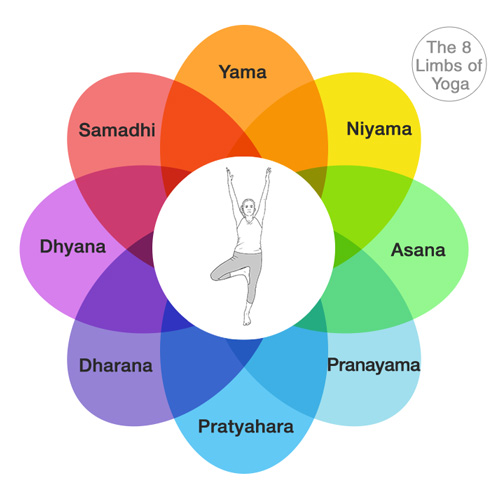
Patanjali does not stop by describing the yogic values; he outlines an entire roadmap for the yogi. In Chapter 1 of the Yoga Sutras, he depicts the high states of consciousness and in chapter 3 he describes transformations of consciousness. He points to the means for quieting the fluctuations of consciousness (I.12); lists the five vitamins a practitioner needs (I.20); reviews the difficulties and obstacles we will encounter along the way (I.30-31) and the ways to overcome them (I.32-I.39) and most importantly, in chapter 2, he provides us with a framework for practice: the Ashtanga Yoga, the eight-limbed yoga whose practice will purify consciousness leading to the dawn of the light of wisdom (II.28).
The 8 Limbs of Yoga
The potential of practice is a radical transformation of the body matter as well as our mind-stuff, a transformation that includes the entire personality and manifests itself in our behavior, not only in our thinking. Modern neuroscience has discovered that our brain is flexible and that continuous behavioral change, such as physical or mental practice brings about, can alter the brain’s neural circuits — it is scientific proof that the body matter changes. The Yogis did not need scientific evidence and knew that practice could change the body and mind substances, creating a transformation that would reduce suffering and help us find more joy in our lives.
As the body and mind stuff transform and consciousness becomes refined, pure and noble, we can spontaneously respond in accord with these yogic values. There would be no need to preach to ahimsa; it will flow spontaneously from within us. Our responses will become more balanced and compassionate. We will behave naturally according to the yogic principles, as an enlightened or a sage would behave.
This is the potential of yoga practice and it is this potential we should remember and reflect on. It is also important to remind ourselves that the fruits of our practice are not only for us but also for all those around us because when we benefit ourselves, we will also benefit those around us. The internal transformation that takes place within us will be reflected outside. When we act in a pure, balanced manner and become more considerate and caring, more compassionate, generous, and happy with the success of others — the ecology of our lives improves and those around us respond to that change. So the potential of yoga practice is not only for us, but it is also for others. It is important to remember this because it extends greater meaning and value to our practice and can help us overcome crises and periods of difficulty in our own practice.
The literal meaning of the word Karma in Sanskrit is “work,” “action,” or “deed”. This is in the sense of ‘an action carried out externally in the world’, as opposed to the Sanskrit word Kriya, implying ‘an action carried out intrinsically’. Generally, the law of karma says that every action has fruits, i.e. has implications manifesting in samsara, the cycle of death and rebirth. An action done with good intention creates good karma, while one that is done with bad intention creates bad karma. The fruit can manifest in this lifetime or in the next incarnations. The intention, approach, and desire of the doer affect the karma, but also, to a certain extent, the outcome of the action. A common example is envisioning two men standing with a knife over a man lying on the ground. One of the men standing is a surgeon, and the other is a murderer – both are performing the same action – stabbing the man lying in front of them, but their intentions are quite different. In that sense, the concept of karma differs from the principle of pure causality found in the natural sciences. However the result of the operation, also counts since it’s evident that if the surgeon was to be successful, his feelings will be very different than if the patient dies, and this affects his karma as well.
As a man himself sows, so he himself reaps; no man inherits the good or evil act of another man. The fruit is of the same quality as the action.
Mahabharata, XII.291.22
The connection between karma and causality is a central motif in various schools of Hinduism, Buddhism, and Jainism. According to these traditions, both the individual’s actions as well as his intentions affect the course of his life. Any actions carried out with expectation (an outcome in mind) result in an accumulation of karma, as opposed to actions carried out without such expectation, which leave karma intact. Good karma has a positive effect on the life of the doer, and leads to happiness, while bad karma negatively influences the doer and leads to unhappiness. The effect of karma is not limited to the individual’s current life and may also influence his next incarnations.
The concept of karma is therefore used as the ethical basis in various schools of Eastern philosophy. However, it’s not a punishment and reward system. There is no one to grant rewards or punishments. It’s just the way things are – natural law. Although it’s not always clear to us, the law of karma states that it’s simply a fact that any action done with an expectation for an outcome creates karma, actions carried out with good intention will produce good karma, while those done with bad intention will produce bad karma.
Chapter two of TheYoga Sutras of Patanjali describes the law of karma thus:
The accumulated imprints of past lives, rooted in affliction, will be experienced in the present and future lives
sati mule tat vipakah jati ayus bhogah
As long as the root of actions exists, it will give rise to class of birth, span of life and experience
te hlada-paritapa-phalah punya apunya hetutvat
According to our good, bad or mixed actions, the quality of our lives, its span, and the nature of birth are experienced as being pleasant or painful
Sutras II.12-14
Sutra 34 states that negative thoughts have infinite consequences. Thoughts create karma that the individual carries with him onto future incarnations:
Uncertain knowledge giving rise to violence, whether done directly or indirectly or condoned, is caused by greed, anger, or delusion to a mild, moderate, or intense degree. It results in endless pain and ignorance. Through introspection comes the end of pain and ignorance.
Sutra II.34
The Application of Karma
There are three types of impressions through which karma is applied in our reality:
Phala(fruit)– Karma has an immediate impact. It is the result of an action that is expressed immediately, or sometime during the life of the doer, whether overtly or covertly. For example, the good feeling one has after doing an act of kindness, generousity or compassion is an example of phala.
Samskara– Karma has a hidden influence. It is expressed internally in the life of the doer, influencing his behavior and his degree of happiness (in the current life and in certain schools even in future incarnations). Samskara is often the focus of discussion in Eastern philosophy. Karma sows tendencies (vasna) in the individual’s life, which affect their behavior as well as their vision of themselves and the world, thus dictating their experience of life.
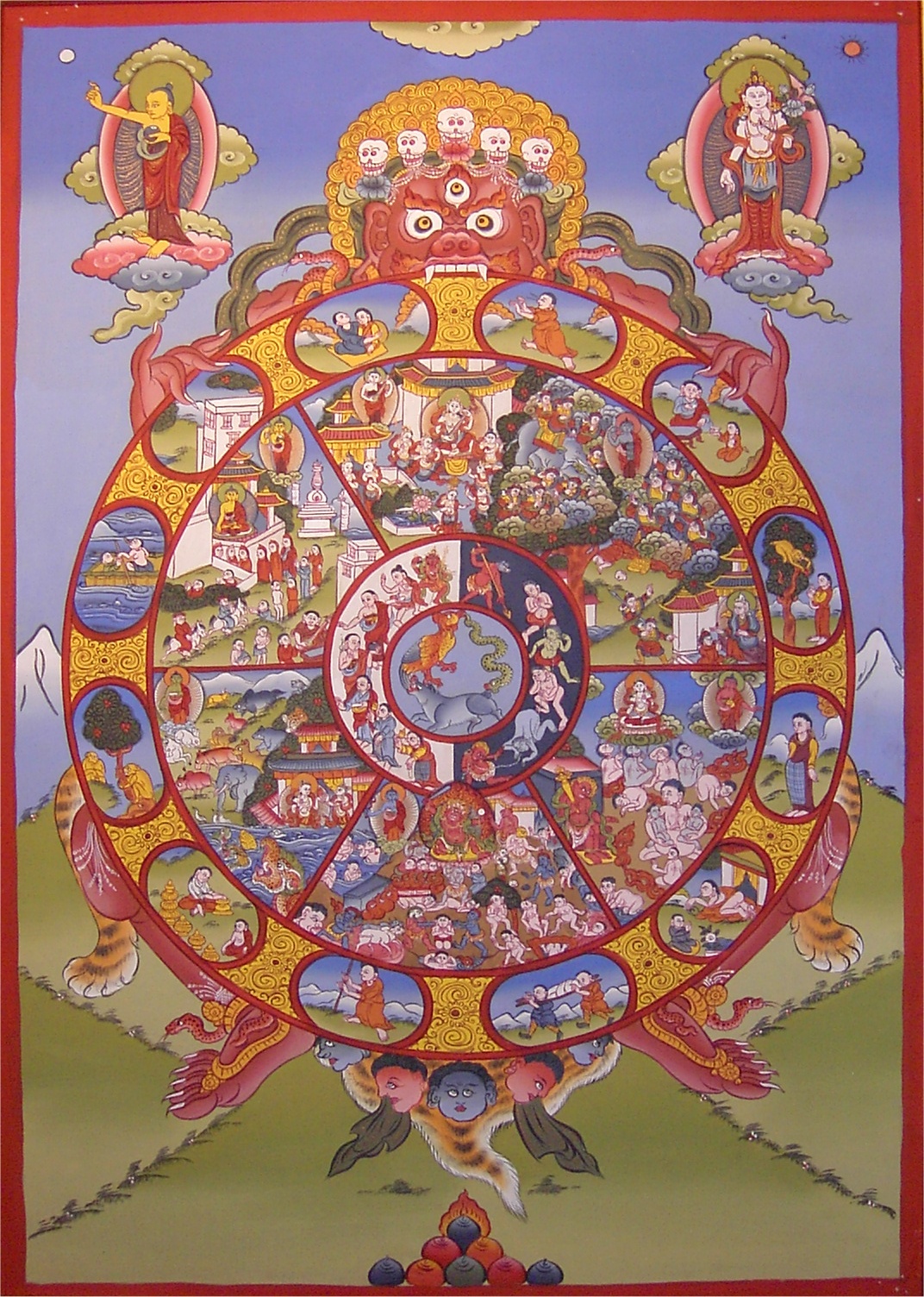
Reincarnation – The principle of rebirth (samsara) appears in various schools of Eastern religions. All forms of life undergo a process of reincarnation – that is, a series of births and deaths, whereby each birth can manifest in a different life form than the one that preceded it (for example, what was a pig in a previous life can be born again as a human being). The accumulation of karma collected during a creature’s lifetime continues with it even after death in the next incarnation and determines the shape and nature of life to which they will be born. This process of death and rebirth continues indefinitely and the only way to stop it is by consciously reaching a release, or Moksha.
Clearing Samskaras
For the Western mind, the prospect of reincarnation may seem comforting. After all, death isn’t the final and absolute ending. But in the Eastern traditions, the endless cycles of birth and death – the samsara, is replete with suffering. In fact, it seems like a prison that one is doomed to be in, endlessly. As long as we have a karmatic store or samskaras we are doomed to return to this wheel of samsara. So the only way to extricate oneself from it, is to clean our samsakaras. The actions of the yogi, done without desire and without expecting reward or personal benefit, do not produce any samskaras.
The end of chapter 1 of TheYoga Sutras of Patanjali describes the process of clearing the samskaras, in order to reach the utmost Samadhi– Samadhi without a nucleus:
Sanskrit
English
nirvichara vaisharadye adhyatma prasadah
From proficiency in nirvicara samapatti comes purity. Sattva or luminosity flows undisturbed, kindling the spiritual light of the self.
ritambhara tatra prajna
When consciousness dwells in wisdom, a truth-bearing state of direct spiritual perception dawns.
Thus truth-bearing knowledge and wisdom are distinct from and beyond the knowledge gleaned from books, testimony, or inference.
tajjah samskarah anya samskara paribandhi
A new life begins with this truth-bearing light. Previous impressions are left behind, and new ones are prevented.
tasya api nirodhe sarva nirodhat nirbijah samadhih
When that new light of wisdom is also relinquished, seedless Samadhi dawns.
Sutras I.47-51
Chapter four comes back to the subject of purifying the samskaras and describes the action of the Yogi, as actions that leaves no residue or traces of her or his karma and are therefore transparent:
Sanskrit
English
karma ashukla akrisnam yoginah trividham itaresam
A Yogi’s actions are neither white nor black. The actions of others are of three kinds, white, black or grey.
tatah tad vipaka anugunanam eva abhivyaktih vasananam
These three types of actions leave impressions which become manifest when conditions are favourable and ripe.
jati desha kala vyavahitanam api anantaryam smriti samskarayoh eka rupatvat
Life is a continuous process, even though it is demarcated by race, place and time. Due to the uninterrupted close relationship between memory and subliminal impressions, the fruits of actions remain intact from one life to the next, as if there were no separation between births.
tasam anaditvam cha ashisah nityatvat
These impressions, memories and desires have existed eternally, as the desire to live is eternal.
hetu phala ashraya alambana samgrihitatvat esam abhave tad abhavah
Impressions and desires are bound together by their dependence upon cause and effect. In the absence of the latter, the former too, ceases to function.
The lotus blossom symbolizes karma in many religions, as the lotus contains its seed while blooming. The seed traditionally symbolizes the cause, while the blossom symbolizes the result. In addition, the lotus grows in murky water, while its flower floats above the surface of the water; it is a metaphor that one can transcend difficult circumstances without being influenced by them.
“Balance does not mean merely balancing the body. Balance in the body is the foundation for balance in life. In whatever position one is, or whatever condition in life one is placed, one must find balance.“[1]
Balance is a very central concept to yoga at all levels: physical, mental, emotional and intellectual. At the physical level, we learn to balance on one foot (e.g., Vrksasana – Tree Pose), on foot and hand (e.g., Ardha Chandrasana – Half-Moon Pose), on two hands (e.g., Adho Mukha Vrksasana – Full Arm Balance), on the head and forearms (e.g., Sirsasana – Headstand), on two forearms (e.g. PinchaMayurasana – Feathered Peacock Pose), and so on.
Balance in asana is typically achieved due to proper structural alignment, or because of countless micro-adjustments happening simultaneously. An aligned balance can be likened to a tower of blocks that derives its balance and stability from its proper placement and the effect of gravity upon it. This type of balance has a sense of ease and stillness; it rests on the stability of the bones and the natural pull of gravity, and invites a quiet calm of everything being in its place. The second form of balance, like that of walking on a high rope, is achieved by constantly adjusting the body to the underlying shifts happening. This is a very organic adaptive process. From the outside it may look calm, but it is not still when delving below the surface.
In asana practice, both ways of balancing are utilized at different times. For example, in sitting poses, aligning the spine like a tower of blocks one on top of the other, achieves a steady balance. But this type of balance is not pragmatic when one attempts to balance on a narrow base, as in Vrksasana (Tree Pose) or in Adho Mukha Vrksasana, (Full Arm Balance; literally means downward-facing tree). A tree may bend with the wind, but if it is well rooted and not rigid, it will not get uprooted. A rigid structure doesn’t adapt well to environmental changes and is prone to break or collapse more easily when the earth shakes. One can think of these metaphors when taking for example, Vrksasana. We achieve balance by grounding the standing foot, and also by constantly adjusting it to the inevitable movements of the body. This type of balance requires attention and focus. For instance, thinking of lengthening vertically (upwards) may help to maintain stability in this pose. In Adho Mukha Vrksasana (when done without leaning on a wall), balance is achieved by the interplay of many actions. Constant changes occur because of the organic nature of our muscles, the ongoing movement of the breath and the constant fluctuations (vrittis) of our mind. How often have you lost balance precisely when you ‘caught yourself’ balancing and lost confidence and concentration? To maintain a balance one must therefore constantly adjust by manipulating many large and small muscles, starting from the hands and up to the feet, and also to still and focus the mind.
Similarly, finding balance in interactions off the mat may require the use of an aligned and stable response or at other times, the situation may call for a dynamic adaptive response.
Another type of balance is counterbalance, a balance that is achieved by pulls in opposition, by simultaneously doing an action and a counter action. For example, in Tadasana (Mountain Pose) the action of moving the front thighs back and that of moving the tailbone forward are such a pair of actions. The front to back alignment and balance in that pose is kept by balancing maintaining these two actions.
The concept of balance extends to our life in general. In the asanas we must find a proper balance between flexibility and strength. We need to stretch our muscles, but at the same time to strengthen them. We need to maintain a delicate balance between over-doing and under-doing, between over-exertion and laxity.
As we already discussed, asana is a balance between stability (sthira) and comfort or ease (sukha), between effort (prayatna) and letting go of effort (shaithilya)[2]. We should seek the ‘middle-way’ (viva media) between these seemingly opposite attitudes. The result of learning to balance effort and non-effort, says Patanjali[3], is acquiring immunity to dualities. It seems like Patanjali is telling us that when one learns to stay on the middle-way (which changes constantly), then one is no longer affected by the dualities, such as those mentioned in earlier section, and is able to keep a balanced mind in all circumstances and eventualities. This is equanimity! The practice can teach us this, as said by Yehudi Menuhin: ‘The practice of Yoga induces a primary sense of measure and proportion‘[4]. This sense of measure and proportion helps us to develop intellectual and emotional balance as well.
Still another kind of balance is a long-term one. It is the skill of maintaining a balanced state of mind over time. In the practice, this turns into finding a sequence of asanas that will leave us in a sattvic state of tranquility and quietness. We learn this as we get mature in our practice and know how our body and mind react to different sequences of asanas and find sequences that are balanced in this respect – neither too heating nor too cooling; not exhausting but deep enough to create a mental and emotional transformation.
By acquiring this skill in our practice, we may learn to keep a balanced state in any activity, be it our working day, or a long hike that we do on our day off.
A balanced life means also to fulfill one’s duties, obligations and responsibilities. If our practice time don’t allow us to perform our duties, then the balance and harmony is disturbed. If the practice of a mother to a new baby prevents her from being devoted to her duty as a mother, then it is unbalanced conduct of life. Yoga is not a path of extremes but that of finding balance and harmony within ourselves and between us and our environment. In the Bhagvad Gita, Krishna describes, “Verily, yoga is not for him who eats too much or abstains too much from eating. It is not for him, O Arjuna, who sleeps too much or keeps awake too much. For the men who is temperate in food and recreation who is restrained in his actions, whose sleep and waking are regulated, there ensues discipline (yoga) which destroys all sorrow”[5].
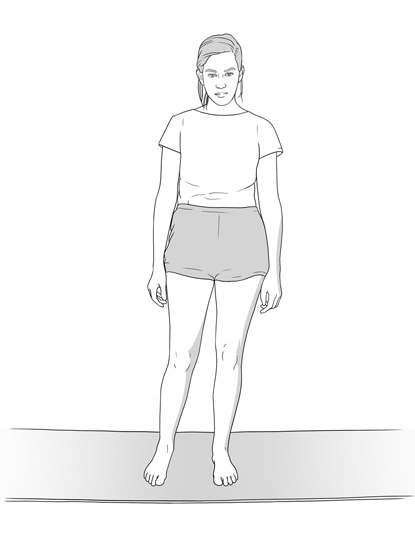
Stand as you would in a queue during the day, without taking any specific care to your posture.
Photo 1 Standing in a slouch posture
Sense the space in the chest as you inhale.
Ω Without changing anything, observe the position of your shoulders, the space in your chest, the flow of your breath, the softness of your eyes, and the state of your brain.
Now do Tadāsana:
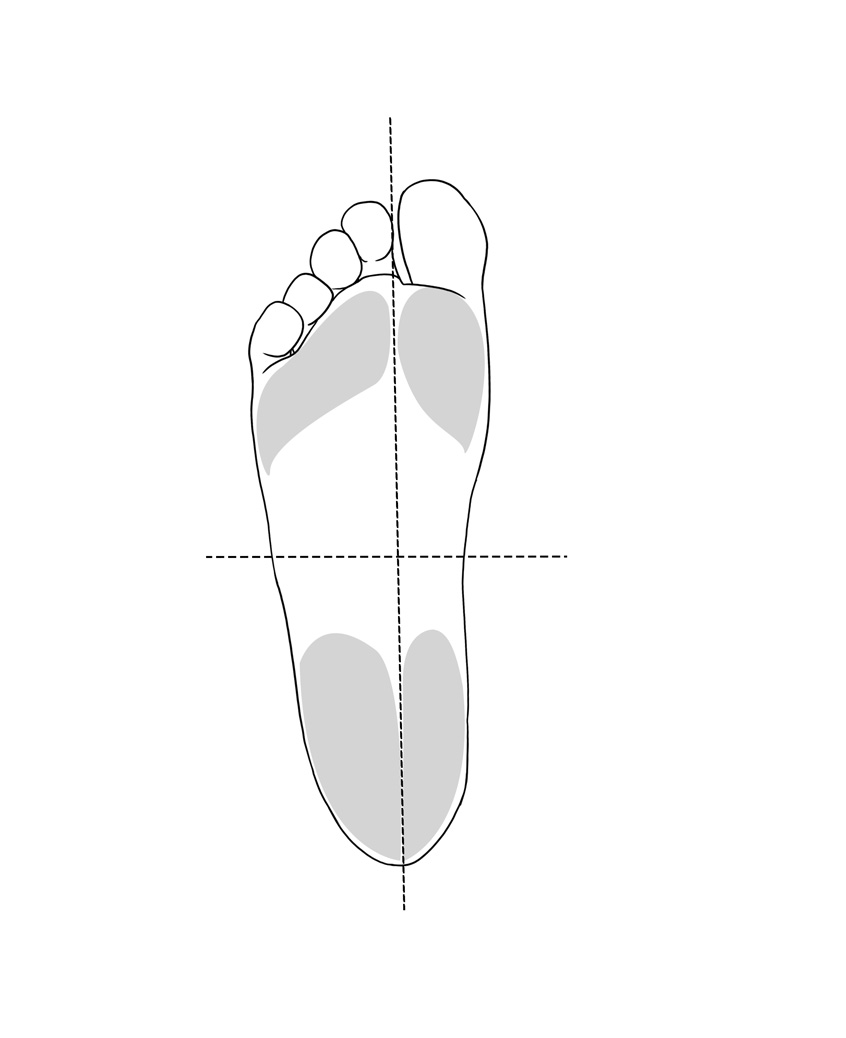
Widen your toes and feet. Feel the touch of the soles of your feet with the floor and ground your heels, the outer edges of your feet and your toe mounds.
Photo 2 Contact regions of the foot with the floor
Move your tailbone forward into the pelvis and at the same time move the front of your upper thighs back.
In his teachings, B.K.S. Iyengar stressed time and again the importance of this apparently simple pose; he taught fine points about this pose even when instructing his most advanced students and teachers. Some of these subtle actions should be learned over time under the guidance of a competent teacher. Here we can only offer the most basic instructions.
Elongate the spine; roll your shoulders back and down; move your shoulder blades in and activate your back muscles to widen the chest.
Photo 3 Tadāsana – the mountain pose
Moving the shoulder blades in means moving them forward toward the front (anterior) part of the body. Imagine someone is looking at your back and you want to hide your shoulder blades from her. Activate your back muscles to move the entire plates of the shoulder blades closer and closer to the ribs at your back. This action opens the chest and improves the breath.
Exhale and concentrate on your spine; then, while inhaling, imagine an external pull, as if a string is connected to the top of your head and gently pulls it up. Feel how this creates space between each adjacent vertebra, as if an air cushion is formed between them. Sense the space in the chest cavity as you inhale.
Maintain a stable pose but release any tension, especially in the diaphragm, face, eyes and shoulders.
Mentally connect the back of your brain to your sacrum and then to your heels, and at the same time, open and lift your heart center at the center of the chest.
Ω Observe again: how is the flow of your breath now? How soft are your eyes? What is your mental state? What are the differences between the first casual, sloppy posture and a proper Tadāsana?
Opening the chest – or more precisely, increasing the dimensions of the chest cavity – has enormous effects on our overall disposition. We discuss in more length how opening the chest can rapidly change our mood drastically. This simple action can take us from gloomy and depressed mood to optimism and cheerfulness. When the shoulders are dropped forward and the chest is sunken, one feels restricted and probably even depressed to some degree. Indeed, depression is often associated with a rounded upper back and a tendency for a narrow chest. In a depressed mood, we tend to look down and our breathing is typically shallow. Research into the effect of yoga on depression shows significant relief of depression as a result of a routine yoga practice. Such a practice emphasizes chest-opening poses, and supported back bends; see [research on the effects of Iyengar yoga on depression].
To provide the best experiences, we use technologies like cookies to store and/or access device information. Consenting to these technologies will allow us to process data such as browsing behavior or unique IDs on this site. Not consenting or withdrawing consent, may adversely affect certain features and functions.
Functional Always active
The technical storage or access is strictly necessary for the legitimate purpose of enabling the use of a specific service explicitly requested by the subscriber or user, or for the sole purpose of carrying out the transmission of a communication over an electronic communications network.
Preferences
The technical storage or access is necessary for the legitimate purpose of storing preferences that are not requested by the subscriber or user.
Statistics
The technical storage or access that is used exclusively for statistical purposes.The technical storage or access that is used exclusively for anonymous statistical purposes. Without a subpoena, voluntary compliance on the part of your Internet Service Provider, or additional records from a third party, information stored or retrieved for this purpose alone cannot usually be used to identify you.
Marketing
The technical storage or access is required to create user profiles to send advertising, or to track the user on a website or across several websites for similar marketing purposes.
 Skip to content



 ️